
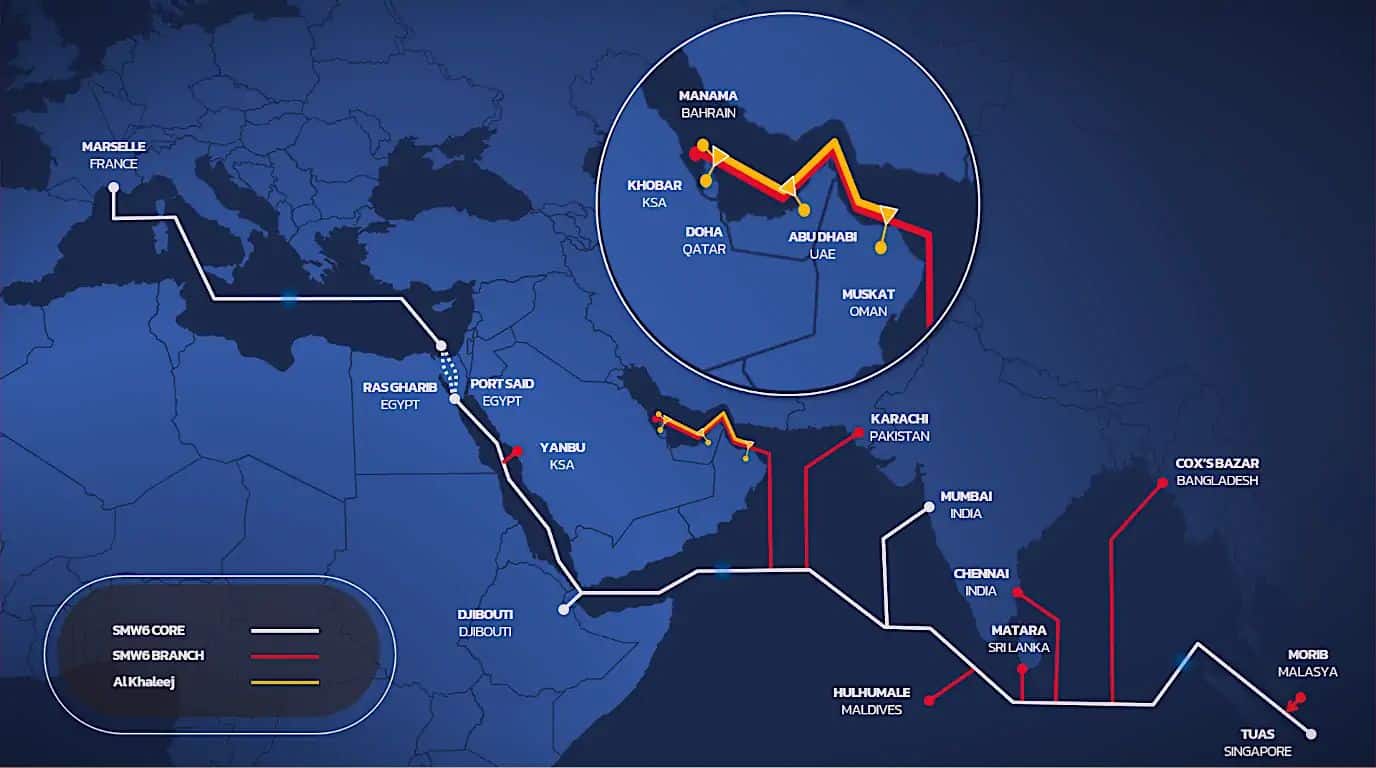
The SeaMeWe-6 submarine cable — which will connect Singapore (Tuas) to Marsella (France) over 21,700 km and with 17 landing points — has arrived this week at Hawkes Bay, on the outskirts of Karachi. The operation, shared by staff from Transworld Associates on professional networks, consolidates Pakistan as a key node in international communications and marks a new milestone in the deployment of this digital highway that will connect Southeast Asia, the Middle East, and Europe via Egypt through various terrestrial routes.
The system, announced in 2022, features 10 fiber pairs with a capacity of 12.6 Tbps per pair, elevating its total theoretical capacity to 126 Tbps thanks to SDM (Space Division Multiplexing) technology. According to the schedule shared by the consortium and involved operators, the network will be phased into service with global commissioning expected next year.
What Does the Anchorage in Karachi Mean?
Pakistan already has nine cables reaching its coast, all with entries through Karachi, and the new anchorage at Hawkes Bay (Keamari Town) strengthens the route diversity, international capacity, and resilience of the country against disruptions in other systems. Transworld, which operates the landing station and data center in the area, is a partner in the SeaMeWe-6 consortium and also participates in SeaMeWe-5; additionally, it owns the TW1 system.
For the Pakistani operator, the arrival of SeaMeWe-6 fits within a national digitalization strategy. Its Deputy General Manager, Saad Waraich, emphasized that Transworld “fully supports Pakistan’s initiatives for a Digital Nation” and will continue investing in submarine cables and AI-enabled data centers. Over the past year, the company has received at its cable landing station two of the three systems that have made landfall in the country (2Africa and SeaMeWe-6), demonstrating Karachi’s coast as a gateway for international traffic.
A Wide Consortium and Top-Tier Partners
SeaMeWe-6 involves major telecom operators and infrastructure providers along its route. Its partners include, among others, Beyon (Bahrain), Bangladesh Submarine Cables PLC, Bharti Airtel (India), Dhiraagu (Maldives), Djibouti Telecom, Microsoft, Mobily (Saudi Arabia), Orange (France), PCCW Global, Singtel (Singapore), Sri Lanka Telecom, Telekom Malaysia, Telin (Indonesia), and Transworld Associates (Pakistan). Upon completion, the anchorage points will include Manama (Bahrain), Cox’s Bazar (Bangladesh), Yibuti (Djibouti), Port Said and Ras Ghareb (Egypt), Marsella (France), Chennai and Mumbai (India), Morib (Malaysia), Hulhumalé (Maldives), Muscat (Oman), Karachi (Pakistan), Doha (Qatar), Yanbu (Saudi Arabia), Tuas (Singapore), Matara (Sri Lanka), and Abu Dhabi (UAE).
The supply contract was awarded to SubCom, and the system has been completing landing and testing phases throughout 2024 and 2025. In terms of performance, the consortium has targeted a round-trip latency close to 130 ms between Marseille and Singapore, a competitive figure for traffic between Europe and Asia that will help improve response times for cloud services, video platforms, and financial applications.
Strategic Connectivity in a Complex Context
SeaMeWe-6 was conceived with Chinese participation, but China Mobile and China Telecom withdrew in 2023 amid geopolitical tensions between the US and China that have also impacted the submarine cable industry. Despite these fluctuations, the project has progressed with a diverse group of operators and wholesale clients interested in expanding Europe–Asia routes with true redundancy and greater fiber capacity.
Practically, the arrival in Karachi adds bandwidth for mobile operators, ISPs, digital banking, e-commerce platforms, and government agencies, while opening options for more efficient and interconnection in the region. It can also reduce the average international cost per gigabit by increasing capacity and multiplying routes, especially relevant in emerging markets where wholesale capacity prices influence affordability and service quality for end users.
Impact on the Global Network
The demand for traffic between Southeast Asia, the Gulf, and Europe continues to grow driven by cloud services, AI, online gaming, streaming, and remote work. Systems like SeaMeWe-6, with multiple entry points and terrestrial diversification in Egypt, add elasticity to the global cable map: enabling load balancing, traffic rerouting during maintenance or incidents, and providing alternative routes that minimize service disruption.
For Pakistan, aiming to establish itself as a regional hub for data and internet, the anchor provides a critical piece: new fiber pairs and SDM capacity within an enclave with its own station and a local operator with experience. The next steps include commercial capacity integration, peering with transit networks, and the utilization of the system by hyperscalers and major platforms accelerating their edge deployment in the Middle East and South Asia.
Upcoming Milestones
In the coming months, the consortium will continue with installations, testing, and activation along the route until the system’s full commercial operation. Simultaneously, landing operators will advance in expanding stations, repeater power systems, and national backhaul to absorb the increased traffic and distribute it towards data centers and neutral points.
Frequently Asked Questions
What will be SeaMeWe-6’s capacity and what technology does it use?
The system is designed with 10 fiber pairs and 12.6 Tbps per pair, totaling a theoretical 126 Tbps, employing SDM (Space Division Multiplexing) to enable more pairs and better spectrum utilization.
Why is the anchorage in Hawkes Bay (Karachi) significant?
Because all cables reaching Pakistan arrive via Karachi, and the new anchorage enhances redundancy and international capacity, boosting resilience and lowering wholesale prices by increasing supply.
When will the entire system be operational?
The consortium has been completing landings since 2024 and expects gradual commercial deployment, with full system launch anticipated next year, pending testing and certification at each segment.
Which operators are involved, and who is building the cable?
Partners include Beyon, BSCCL, Bharti Airtel, Dhiraagu, Djibouti Telecom, Microsoft, Mobily, Orange, PCCW Global, Singtel, Sri Lanka Telecom, Telecom Egypt, Telekom Malaysia, Telin, and Transworld Associates. The construction contract was awarded to SubCom.