
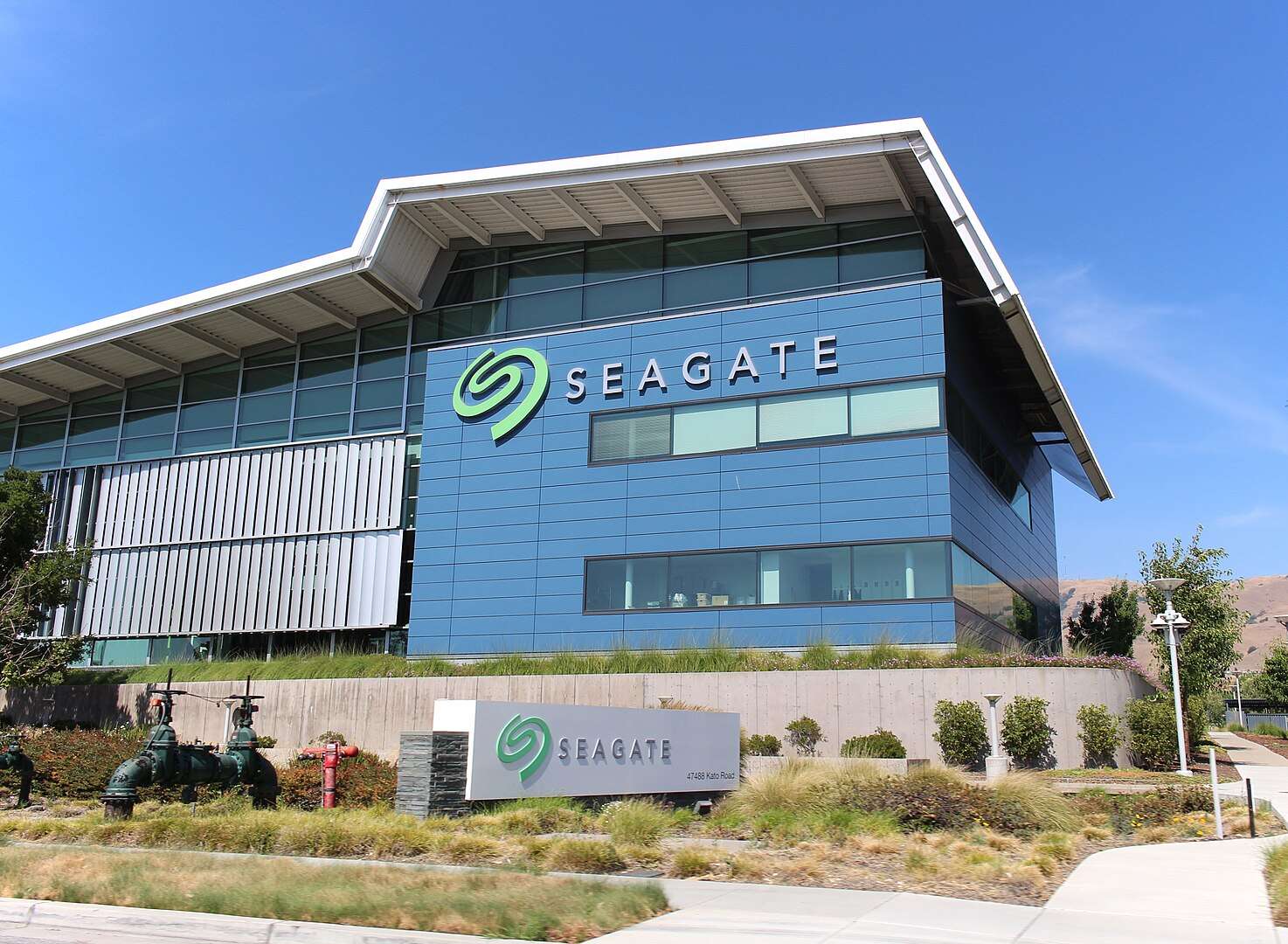
Mass storage is once again making headlines in the AI conversation, and this time not with lab promises. Seagate has announced that its new Mozaic 4+ platform, based on HAMR (Heat-Assisted Magnetic Recording), is already qualified and in production with two major hyperscale cloud providers, and that its high-capacity drives are being shipped in volume for large-scale industrial deployments. This is a significant milestone: Seagate presents Mozaic 4+ as the only HAMR platform deployed at scale in cloud environments, with a clear goal: increase capacity per rack without expanding physical footprint or boosting power consumption.
The eye-catching figure is straightforward: up to 44 TB per drive. But the real message is strategic. With data explosion linked to AI models — training, fine-tuning, inference, dataset archiving, and multimodal content — data centers face an uncomfortable equation: compute is growing, yes, but data is also increasing. And sooner or later, data must be preserved, reactivated, and moved. Hard drives remain the most cost-effective storage format at scale, and Seagate aims for its jump in density to be the next evolutionary step.
What Changes with Mozaic 4+: More Density Without Disrupting Rack Design
Mozaic is an engineering platform, not just a disk model. In its 4+ version, Seagate talks about more than 4 TB per platter (“4+ TB per disk” in terms of density per platter) and achieving 44 TB while maintaining an architecture of 10 disks (platters) within the 3.5” enterprise format. One of the main appeals for hyperscalers is precisely that: adding capacity without disruptive changes to the design and operation of entire storage fleets.
Technical sources also indicate that these disks are geared toward “nearline” and cloud deployments, with typical parameters (like 7,200 rpm and sustained transfer rates around 300 MB/s, based on industry reports and tests). The key point here for system administrators is that these are not marketed as “faster disks,” but as more dense drives that improve critical data center metrics: capacity per rack, watts per terabyte, and cost per exabyte deployed.
HAMR Explained Without Marketing: The Laser as a Lever for Smaller Bits
HAMR has been on the industry radar for years but has yet to fully cross into mass production. The simplified idea involves locally heating the magnetic material of the platter during write operations. This temporary heating facilitates writing smaller, more stable bits, increasing density without sacrificing retention. The challenge has historically been scaling this process reliably, with thermal control and cost efficiency.
Seagate emphasizes a differentiating element: the vertical integration of photonics, meaning its ability to design and manufacture internally the laser technology and nanophotonic components needed for HAMR. The clear thesis is that controlling this critical part reduces supply chain risks, improves yields, and accelerates qualification with customers.
The Argument That Wins Over an Operator: Infrastructure Efficiency per Exabyte
Beyond just “bigger disks,” Seagate wants users to consider the system-level outcome. The company provides a reference example: in a 1 exabyte deployment, Mozaic 4+ would improve infrastructure efficiency by approximately 47% compared to deployments with 30 TB disks, reducing data center footprint by about 100 sq ft (roughly 9.3 m²) and cutting annual energy consumption by around 0.8 million kWh. Extrapolating to large fleets, the impact isn’t trivial: fewer racks, less energy, less cooling, and simplified operational complexity per terabyte stored.
This kind of metric aligns with the new priorities: data centers are no longer optimized solely based on hardware costs but also around physical limitations (available power, thermal density, space) and the total cost of ownership, which has become highly sensitive to every watt.
An Ambitious Roadmap: From 44 TB to 100 TB Without Changing “Philosophy”
Mozaic 4+ is the current step, but Seagate already envisions the next curve: moving from more than 4 TB per platter toward 10 TB per platter, enabling drives of up to 100 TB. The company promises that each new generation maintains continuity: incremental improvements in density without requiring a complete redesign of the system architecture.
For the industry, this roadmap carries a subtext: data growth won’t slow down because of AI’s rise; quite the opposite. While SSDs dominate hot-tier layers, cold and nearline storage remain the backbone of the digital economy. If HAMR can be widely deployed at scale, it becomes an infrastructure technology, not just a curiosity.
Implications for Systems and Architecture Teams
For administrators and infrastructure architects, this announcement isn’t about “buying 44 TB disks now” (since initial shipments target hyperscalers), but about preparing the groundwork:
- Density Planning: More TB per unit shifts the balance between capacity, spindle count, and overall rack performance.
- Rebuild and Resilience Strategies: Higher capacity per disk means longer rebuild times and greater impact if a large drive fails. Resilience strategies (erasure coding, replicas, rebuild policies, telemetry) will need to evolve accordingly.
- Data Retention Economics: Lower cost per TB encourages “storing more,” which in turn raises governance requirements (what we store, how long, and rehydration policies).
In essence: the value isn’t just cheaper storage but more storage without multiplying the infrastructure. That’s a key differentiation in 2026.
Summary Table: Mozaic 4+ in Figures and Key Messages
| Key Point | What Seagate Announces | Why It Matters in Data Centers |
|---|---|---|
| Underlying Technology | HAMR (Heat-Assisted Magnetic Recording) | Increases density without altering form factor |
| Max Capacity Announced | Up to 44 TB per drive | Improves capacity per rack and reduces footprint |
| Product Status | Qualified and in production with 2 hyperscalers | Signals industrial maturity, not just a prototype |
| Efficiency (example) | +47% in 1 EB deployment vs 30 TB; ~0.8M kWh less/year | Direct impact on TCO and energy limits |
| Roadmap | From 4+ TB per platter to 10 TB per platter; up to 100 TB per drive | Long-term planning for future fleets |
Frequently Asked Questions
What is HAMR, and why is it considered “ready” now for hyperscale?
HAMR uses localized heating (laser) during write to increase bit density. Seagate claims Mozaic 4+ is already qualified and in production with two hyperscalers, indicating validation at an industrial scale.
Do the 44 TB disks replace SSDs in AI data centers?
No. SSDs dominate low-latency layers. These disks target mass storage (nearline, datasets, archives) where cost per TB and density are the main drivers.
What operational risks come with increasing capacity per disk?
Primarily longer rebuild times and greater impact if a large drive fails. Thus, resilience strategies like erasure coding, replicas, rebuild policies, and telemetry are crucial.
When will these disks be available outside hyperscalers?
Seagate indicates volume shipments to two hyperscalers and “greater availability” as production scales up. Broader market availability will be gradual and depend on additional qualifications.
via: seagate