
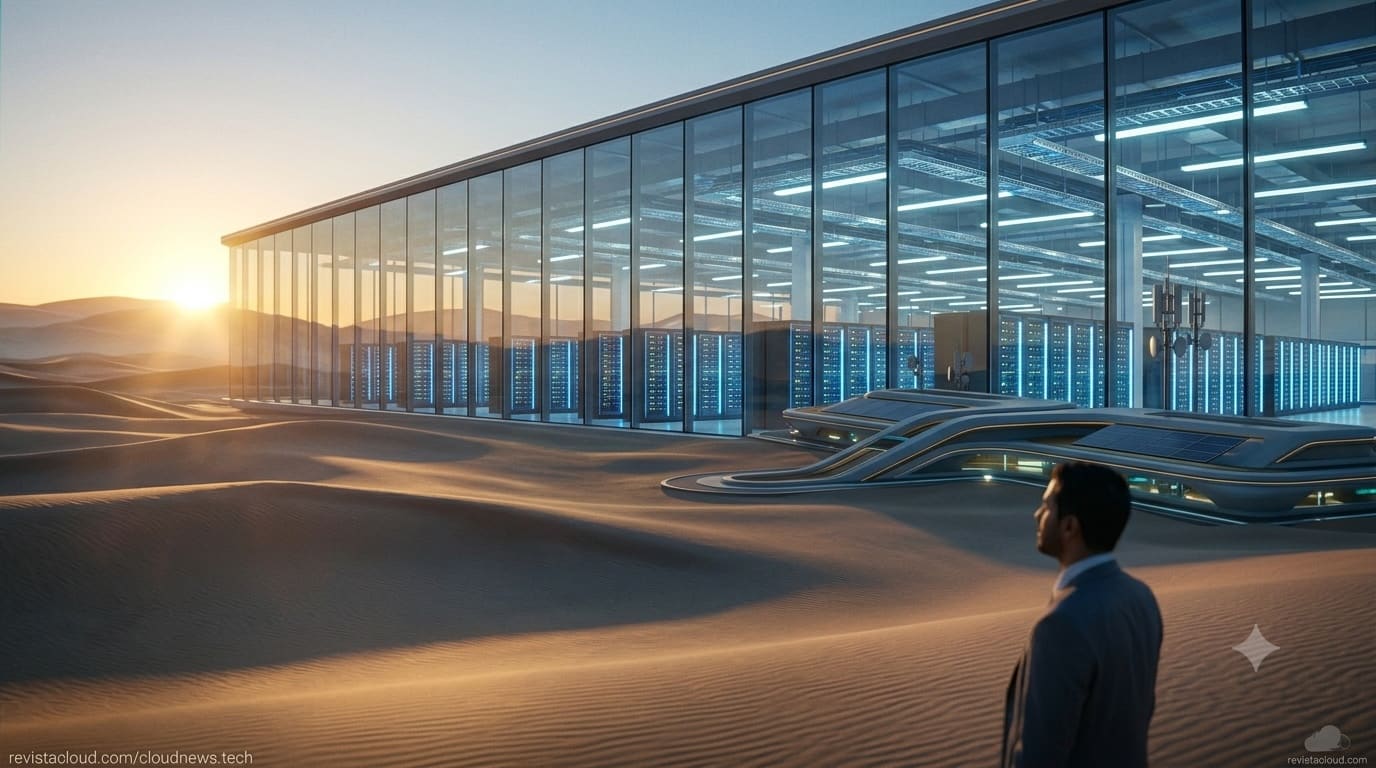
Saudi Arabia is reframing NEOM’s narrative. The mega-project that for years was marketed worldwide with images of a futuristic linear city, The Line, is increasingly being seen in a different light: as a physical platform for data centers, artificial intelligence, and sovereign computing. While iconic architecture continues to make headlines, the investment and industrial agreements point to a more concrete priority: expanding computing capacity on a global scale in the desert.
The shift is significant. Artificial intelligence has transformed energy, land, chip access, cooling, and long-term capital into strategic assets. Saudi Arabia possesses several of these ingredients and aims to leverage them to position itself within the new computing geography. It isn’t just about hosting third-party data centers; the goal is to develop a comprehensive stack: infrastructure, chips, networks, cooling, models, cloud services, and international clients.
From The Line to Oxagon: Less spectacle, more infrastructure
NEOM hasn’t disappeared but appears to be shifting its focus. Recent information suggests a thorough review of The Line due to costs, delays, and feasibility, while Oxagon, the project’s industrial zone, is gaining prominence as a hub for digital infrastructure. This change aligns with a global trend: AI data centers are beginning to compete with other major industrial uses for energy, land, water, connectivity, and permits.
The most visible indicator is the agreement between NEOM and DataVolt to develop a 1.5 GW “AI factory” in Oxagon. According to NEOM, the first phase will be financed by an initial $5 billion investment from DataVolt, expected to be operational by 2028. The project aims to establish high-density infrastructure with energy-efficient architectures, addressing one of AI’s major challenges: the electricity consumption of data centers.
The 1.5 GW figure illustrates the scale. We’re not talking about a conventional corporate data center but a facility comparable to large energy infrastructure. In current industry language, an “AI factory” isn’t just a building full of servers; it’s an industrial plant designed to produce training, inference, models, cloud services, and computing capacity as digital commodities.
| Project or agreement | Main actors | Capacity or announced investment | Timeline |
|---|---|---|---|
| AI factory in Oxagon | NEOM and DataVolt | 1.5 GW; initial $5 billion phase | Expected for 2028 |
| AI factories with NVIDIA | HUMAIN and NVIDIA | Up to 500 MW; first deployment with 18,000 GB300 Grace Blackwell | Five-year deployment |
| AI joint venture | HUMAIN, AMD, and Cisco | Up to 1 GW infrastructure by 2030; initial phase of 100 MW | Starting in 2026 |
| Cloud-to-edge partnership | HUMAIN and Qualcomm | AI data centers, CPUs, hybrid inference solutions | MoU announced in 2025 |
| Refrigeration for Oxagon | LG, SHAKER Group, and DataVolt | Advanced thermal solutions for AI data centers | Agreement announced in 2025 |
HUMAIN’s role is pivotal. Supported by the Public Investment Fund, the company positions itself as Saudi Arabia’s national champion in AI. Its ambitions encompass data centers, cloud infrastructure, models, and applications. In other words, Saudi Arabia aims to control more parts of the value chain, moving beyond land ownership or cheap electricity provision alone.
A Sovereign AI stack, not just data centers
The Saudi strategy is better understood as an infrastructure stack. At the sovereign layer is the Public Investment Fund, providing capital and industrial vision. HUMAIN acts as a national vehicle to coordinate agreements with international tech firms. The compute layer includes NVIDIA, AMD, and Qualcomm. Networks are linked with Cisco. Cooling involves LG and local partners. Customers and workloads revolve around generative AI, advanced models, and cloud services.
NVIDIA announced a partnership with HUMAIN to build AI factories in Saudi Arabia with a projected capacity of up to 500 MW, powered by hundreds of thousands of advanced GPUs over five years. The first phase includes a supercomputer with 18,000 NVIDIA GB300 Grace Blackwell units and InfiniBand networking. This agreement exemplifies Saudi Arabia’s goal: importing top-tier computing capacity and deploying it within a national framework.
AMD and Cisco have taken a different route: a joint venture with HUMAIN to deploy up to 1 GW of AI infrastructure by 2030, starting with a 100 MW phase in Saudi Arabia. This project combines HUMAIN data centers, AMD Instinct MI450 GPUs, and Cisco’s critical infrastructure solutions. Qualcomm, meanwhile, signed an MOU with HUMAIN to develop AI data centers, CPU solutions, and hybrid cloud-to-edge services, aiming to turn the country into an inference hub.
This partner diversity carries strategic importance. Saudi Arabia does not want to rely on a single chip supplier or architecture. Sovereign AI demands access to GPUs, CPUs, accelerators, networks, cooling, energy, and software. It also involves navigating U.S. export controls, as advanced computing has become a geopolitical instrument.
Energy: the advantage and the big question
The other piece of the puzzle is energy. AI requires abundant, stable, and affordable electricity. Saudi Arabia has gas, oil, extensive land, and a growing renewable portfolio. This combination can attract AI workloads that face network saturation, slow permits, or higher electricity costs elsewhere.
The country is developing large-scale solar and green hydrogen projects. Sudair Solar PV reaches 1.5 GW. Al Shuaibah adds approximately 2.6 GW across its plants. The NEOM Green Hydrogen Company project in Oxagon will be powered by around 4 GW of dedicated solar and wind generation. While these assets do not automatically mean all of Saudi AI will be green, they explain why the country is positioning its digital infrastructure as an integration of next-generation computing and energy resources.
| Energy project | Approximate capacity | Potential role in Saudi narrative |
|---|---|---|
| Sudair Solar PV | 1.5 GW | Major solar project backed by PIF |
| Al Shuaibah Solar | 2.6 GW | One of the largest solar plants in the region |
| NEOM Green Hydrogen Company | Around 4 GW of dedicated renewables | Green hydrogen production in Oxagon |
| New solar and wind rounds | Several GW in development | Supporting energy diversification |
The challenge is that AI data centers have highly demanding consumption profiles. It’s not enough to have significant renewable generation; there must be constant availability, a prepared electrical grid, efficient cooling, redundancy, supply agreements, permits, and meticulous planning. A “AI factory” of hundreds of megawatts isn’t something you connect to the grid like an office building.
There’s also a reputational aspect. Saudi Arabia aims to promote itself as a clean and sovereign AI power, but it remains a hydrocarbon-dependent economy. Its digital transition must demonstrate that its sustainability promises are genuine, not just marketing. In AI projects where energy consumption has become a public concern, credibility will be increasingly vital.
The new AI map passes through the Gulf
Saudi Arabia’s ambitions are part of a broader regional competition in the Middle East. The United Arab Emirates, Qatar, and Saudi Arabia all seek to carve out their share of the new AI economy. They possess sovereign capital, energy resources, and strategic positions between Europe, Asia, and Africa. What was previously seen as logistics or financial hubs is now trending toward being centers of computing.
For the U.S., these agreements have a dual significance. They enable American companies to sell chips, networks, software, and services at scale. They also reinforce controls over who accesses advanced computing and under what conditions. AI has become a tool of foreign policy and national security — each chip export, data center, or sovereign fund partnership carries geopolitical weight.
For Europe, Saudi’s moves serve as a warning. Building AI capacity isn’t just about regulation, talent, or advanced models. It requires gigawatts of power, land, fiber, cooling, chips, patient capital, and speed. If Saudi Arabia succeeds in transforming Oxagon, Riyadh, and other enclaves into hubs of massive computation, they could attract AI workloads currently contested by the U.S., Europe, and Asia.
The shift by NEOM shouldn’t be seen as abandoning urban ambitions but as market adaptation. AI has reshuffled priorities: what was once a narrative of a futuristic city might now be a profitable and strategic infrastructure, able to sell computing power globally.
Saudi Arabia’s success isn’t guaranteed. It depends on clients, talent, regulatory stability, continual chip access, operational efficiency, and technological credibility. But the move is serious. If the next decade is defined by computing scarcity, the country aims to be more than a tech importer — it wants to become a global provider of AI capacity.
Frequently Asked Questions
What’s happening with NEOM and AI?
NEOM is gaining prominence as a hub for digital infrastructure and AI data centers, especially in Oxagon, where DataVolt and NEOM have announced a 1.5 GW AI factory.
Who is HUMAIN?
HUMAIN is Saudi Arabia’s AI company backed by the Public Investment Fund. Its goal is to develop infrastructure, cloud, models, and AI applications domestically.
Why does Saudi Arabia want AI data centers?
Because AI demands huge amounts of energy, land, chips, and capital. Saudi Arabia aims to use these assets to diversify its economy and establish itself as a global computing provider.
Is a Saudi AI powered primarily by clean energy realistic?
The country has large solar and green hydrogen projects, but true sustainability will depend on how data centers are powered, grid reliability, and operational efficiency.
AI image created with AI.
