
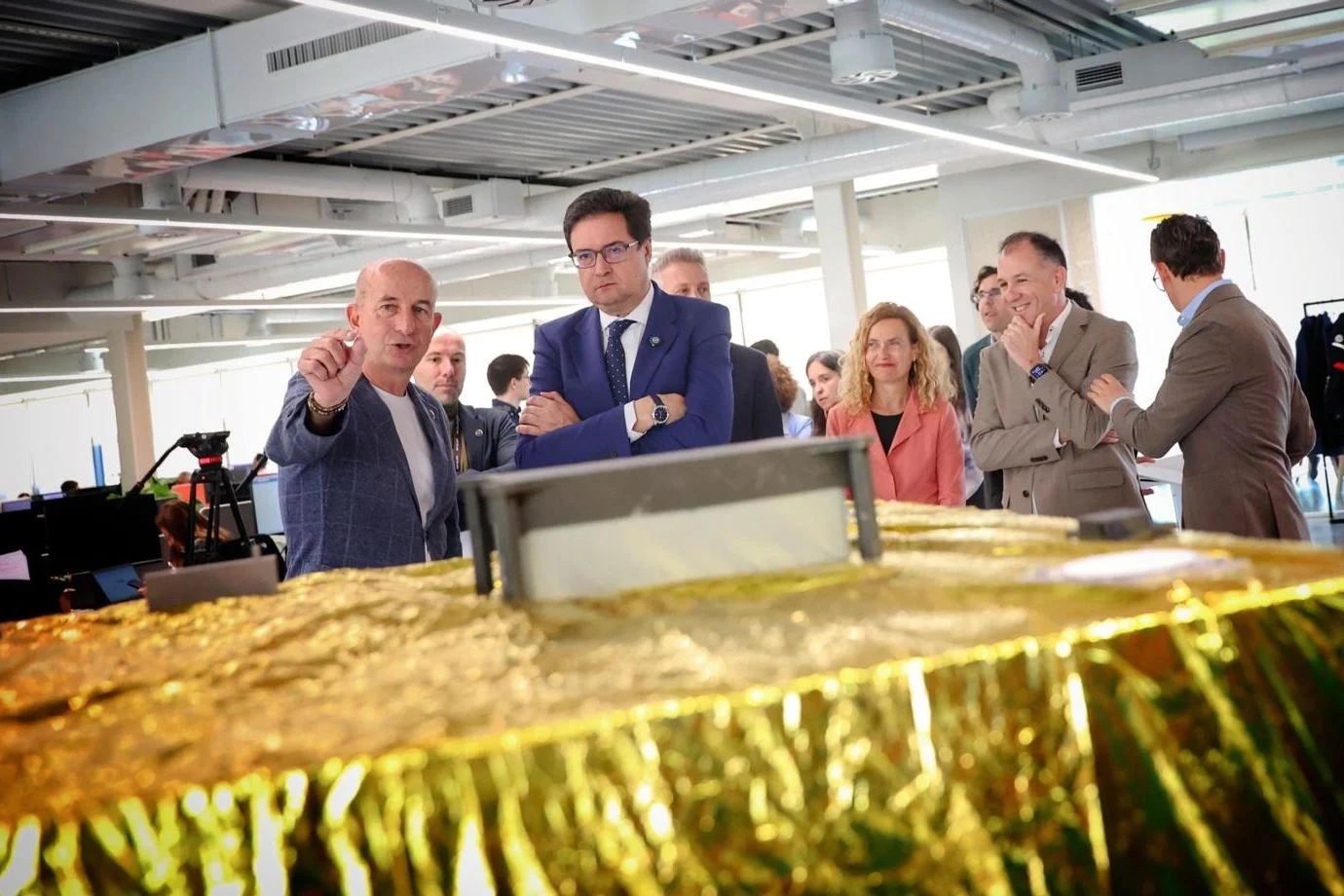
Sateliot has announced a €100 million Series C funding round to finance the next stage of its 5G satellite constellation and strengthen its position in a market where Europe is seeking greater technological autonomy in space connectivity. The operation was unveiled on April 8th in Barcelona, during a visit by the Minister for Digital Transformation and Public Function, Óscar López. This comes at a pivotal moment for the company: it has already launched six satellites into orbit, plans to launch five more in 2026, and reports pre-contracts worth €270 million, over 400 clients across 60 countries, and agreements with major operators.
The round, primarily structured as an equity increase, may also include some debt, with the company aiming to close it this summer. Sateliot has indicated that it has already begun the process of seeking a lead investor and that the round is open to new shareholders as well as current partners. Additionally, the company considers that up to 50% of the funding could come from public co-financing through match funding mechanisms—highlighting the project’s movement within the realm of industrial policy and digital sovereignty.
The allocated funds are quite targeted. Sateliot intends to finance the deployment of 16 additional satellites to complete its primary use case in Internet of Things (IoT) applications and to serve as a demonstrator for its 5G New Radio technology capable of voice, video, and data transmission. This is a significant shift: the company was initially heavily focused on massive IoT in low Earth orbit, but now aims to expand its narrative into a more ambitious satellite 5G infrastructure with dual-use potential for civil, civil protection, and defense communications.
Sateliot arrives at this new phase with a solid financial base for a company of its size. Since founding, it has raised nearly €100 million through equity and financing, supported by investors such as Indra, Cellnex, Banco Santander, Hyperion, Global Portfolio Investments, Sepides, and the Spanish Society for Technological Transformation. It also secured a €30 million loan from the European Investment Bank in December 2024 to co-finance the initial deployment of its over 100 LEO satellites.
Within this ownership structure, public ownership is particularly notable. SETT owns 16.3% of the company, and combined with Sepides’s 2.4%, the Spanish government’s direct stake reaches 18.7%, according to Sateliot itself. This figure explains why the government has chosen to publicly support the operation and highlight the company as an example of Spanish and European digital sovereignty.
A funding round to move from talking to scaling
The key now is less about proving the technology works and more about scaling it. Sateliot no longer positions itself as a promising lab project but as a company aiming to become “the first global-scale 5G operator from space,” as stated by SETT. To achieve this, it needs more than just additional launches: it requires constellation density, commercial agreements that generate real revenue, and sustained industrial capacity to design, assemble, launch, and operate satellites at a much faster pace.
In this arena, the company has aimed to boost its credibility through recent milestones. In February, it signed its first commercial contract with PLD Space for a dedicated Miura 5 launcher mission to orbit two Tritón satellites. The companies presented this as the first fully Spanish private space mission, covering everything from manufacture and launch to operation and commercialization. While this doesn’t guarantee the success of the Series C, it does position Sateliot within a broader narrative of a national space industry chain.
Additionally, the company has leveraged its international visibility. In February, it received the DigitalEurope Dual-Use Technology Award, a recognition the company and the government have used to bolster its profile as a European player with strategic potential. While awards don’t replace market success, they help enhance the company’s profile as it seeks to convince a leading investor that it can transition from a project with strong institutional backing to a commercial-scale operator.
The context: Europe seeks muscle in satellite connectivity
Sateliot’s funding round also occurs amid rising competition in direct satellite connectivity. Deutsche Telekom recently announced a partnership with Starlink to offer device-to-device services in ten European countries starting in 2028. Meanwhile, Telefónica has disclosed an agreement with Satellite Connect Europe to explore satellite D2D services that complement its 4G and 5G networks in Spain and Germany. This rapid market evolution means Sateliot is no longer just competing as a promising startup but is vying for a place in a European race where large operators and more robust constellations are entering.
Arguably, this Series C is not just about raising money to grow slightly; it’s a maturity test. If Sateliot can close the round this summer on the terms it seeks, it will demonstrate its ability to attract scale capital for critical infrastructure. Failing to do so would reveal a challenging reality: in the new European space ecosystem, possessing technology, institutional support, and initial contracts is not enough; convincing large investors that the industrial and commercial phases can sustain rapid growth with disciplined financial management is essential.
Thus, the stakes go beyond just a Catalan company’s growth. They also involve whether Spain can establish a company capable of integrating into Europe’s emerging space connectivity layer, with indigenous technology, local manufacturing, and a replicable business model. In this sense, Sateliot’s round is significant both for the amount of money it seeks and for what it symbolizes: a commitment to demonstrate that digital sovereignty isn’t built solely through regulation but also through infrastructures capable of operating at scale.
Frequently Asked Questions
How much money does Sateliot aim to raise in this new round?
Sateliot has opened a €100 million Series C funding round, primarily as equity, with potential debt inclusion, aiming to close this summer.
What will Sateliot use the Series C funds for?
The company will primarily deploy the capital toward the deployment of 16 additional satellites and strengthening its 5G New Radio technology demonstrator, enabling voice, video, and data transmission from space.
What is Spain’s ownership stake in Sateliot?
According to Sateliot, SETT owns 16.3%, and Sepides owns 2.4%, making Spain’s direct stake 18.7%.
What commercial backing does Sateliot have before this round?
The company reports having €270 million in pre-contracts, over 400 clients across 60 countries, and agreements with operators including Telefónica, Deutsche Telekom, and VIVO in Brazil, based on information from SETT and the company itself.