
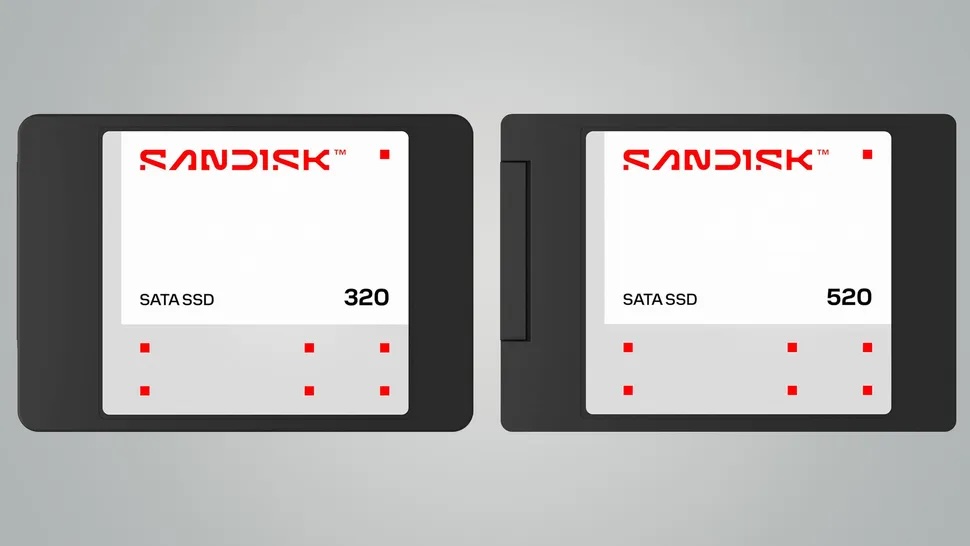
SanDisk is preparing to launch two new SATA SSD families in 2026: the SanDisk 320 and SanDisk 520. This move, which a few years ago might have seemed unremarkable, now reflects the current state of the storage market quite well. The impact of artificial intelligence on NAND memory and enterprise SSDs has driven up the prices of NVMe models, making veteran technologies like SATA relevant once again for many users.
The news isn’t that SATA is faster or more modern. It’s not. A 2.5-inch SATA SSD is limited by an interface that hovers around 600 MB/s, far from the 5,000, 7,000 MB/s, or higher speeds that a PCIe 4.0 or PCIe 5.0 NVMe can deliver. The important takeaway is this: when the cost of high-speed storage skyrockets, the market begins to revisit solutions that seemed relegated to old systems, budget upgrades, or secondary uses.
The new SanDisk 320 and 520 appeared in listings on Amazon UK spotted by hardware leakers, though product pages were later taken down. According to this information, both models will use the traditional 2.5-inch, 7 mm form factor, compatible with many desktops and laptops that still support SATA drives.
Modest SSDs, but highly practical if the price is right
The SanDisk 320 is aimed as the primary choice for basic consumers, with capacities ranging from 250 GB to 2 TB. Its sequential speeds are expected to reach up to 545 MB/s read and 525 MB/s write. The SanDisk 520 would sit slightly above, with capacities from 500 GB to 4 TB, speeds up to 560 MB/s read and 525 MB/s write. The 4 TB version is claimed to have a durability of 1,000 TBW.
Important details like the controller, exact NAND type, cache size, final prices, or country availability are still unknown. Additionally, SanDisk hasn’t officially confirmed international launch plans. Still, the mere appearance of new SATA drives in 2026 is noteworthy.
For years, the market strongly favored NVMe. Modern motherboards feature several M.2 slots, ultrathin laptops have often abandoned 2.5-inch bays, and current consoles rely on NVMe storage for expansions. SATA became primarily an option for upgrading older systems, adding inexpensive storage, or replacing mechanical HDDs.
Now, that role could regain significance. For a modern gaming PC or a workstation, a SATA SSD isn’t ideal as the main drive when maximum performance is desired. But for expanding game libraries, saving projects, replacing an HDD, reviving an older laptop, or adding secondary storage, it remains a satisfactory solution for many users.
| Model | Expected Capacities | Sequential Read | Sequential Write | Format |
|---|---|---|---|---|
| SanDisk 320 | 250 GB to 2 TB | Up to 545 MB/s | Up to 525 MB/s | 2.5-inch SATA |
| SanDisk 520 | 500 GB to 4 TB | Up to 560 MB/s | Up to 525 MB/s | 2.5-inch SATA |
| SanDisk 520 4 TB | 4 TB | Up to 560 MB/s | Up to 525 MB/s | 1,000 TBW |
AI also drives up domestic storage costs
The explanation lies in the supply chain. The demand from AI data centers is consuming memory, high-capacity storage, and enterprise-grade products with higher margins. Manufacturers are prioritizing NAND and SSDs for servers, accelerators, training systems, inference, databases, fast storage solutions, and large cloud platforms.
This pressure eventually reaches the end-user. High-capacity NVMe SSDs have increased in price significantly, with fewer aggressive deals, and models that once seemed affordable now sit at prices hard to justify for many buyers. Even SATA SSDs, which should be the cheapest option, have seen price increases of 10% to 20% over the past year, according to industry estimates.
This phenomenon isn’t limited to SanDisk. Executives from brands like Team Group warn that prices for DRAM and SSDs could continue rising due to strong AI server demand. Essentially, consumers are indirectly competing with data centers—not for the exact same products, but for manufacturing capacity, NAND chips, controllers, wafers, assembly, and commercial priority.
The paradox is this: older technology is becoming more reasonable because modern options have become too expensive. SATA isn’t gaining because of performance; it’s gaining because of availability, compatibility, and potential pricing. If SanDisk can position the 320 and 520 well below comparable NVMe drives, they could carve out a clear market niche. But if prices are too close, their advantage diminishes.
SATA still makes sense, but not for everything
It’s important to be realistic. A SATA SSD isn’t a direct substitute for a good NVMe in all scenarios. For heavy workloads, intensive video editing, large local databases, frequent transfer of huge files, or games that leverage ultra-fast storage, NVMe remains superior. It’s also the natural format for many modern systems.
However, in everyday use, the difference isn’t always noticeable. Upgrading from an HDD to a SATA SSD remains a major improvement: faster boots, more responsive applications, less noise, lower power consumption, and a much smoother experience. For older systems, it could be the most cost-effective upgrade if prices stay reasonable.
There’s a clear use case for desktops too. Many users have all their M.2 slots occupied or prefer not to pay extra for a large NVMe just to store games, photos, local backups, or media libraries. A 2 TB or 4 TB SATA drive may suffice as long as the cost per gigabyte remains competitive.
In home servers, simple NAS devices, personal labs, or secondary systems, SATA still holds value. Not everything needs PCIe 5.0. Sometimes, what matters most is stable capacity, low power consumption, and compatibility with existing bays.
A symptom of a fractured market
The launch of new SATA SSDs in 2026 shouldn’t be seen as nostalgia. It signals that the storage market is under tension. AI has transformed memory and storage into strategic resources. Manufacturers can command higher prices by selling to data centers rather than competing on tight margins in consumer markets. And end-users are starting to feel the impact of this industrial shift.
For SanDisk, this could be a smart move. There is a segment of buyers who need storage but want to avoid the high prices of NVMe. A well-positioned SATA drive can sell easily. The brand is already recognized, the format is compatible with many systems, and the concept is simple: it won’t be the fastest, but it can be sufficient and more affordable.
The key question is price. A 4 TB SanDisk 520 could be appealing if it’s significantly cheaper than a 4 TB NVMe. But if the price gap is small, many users will prefer to pay a little more for a faster M.2 drive. Success will depend on finding that balance.
This situation offers a clear lesson for buyers and manufacturers alike: the AI boom isn’t just raising GPU, HBM memory, or server prices; it’s also changing the cost dynamics of storage inside everyday PCs. In this context, SATA is returning—not because it’s the future, but because the present has become too costly.
Frequently Asked Questions
What are the SanDisk 320 and SanDisk 520?
They are upcoming families of 2.5-inch SATA SSDs planned for 2026, aimed at budget storage upgrades and system expansion.
Are they faster than NVMe SSDs?
No. They are limited by the SATA interface, with speeds around 545-560 MB/s, well below modern NVMe performance.
Who are they suitable for?
For users looking to replace HDDs, add secondary storage, revive older laptops, or store games and files without high costs associated with NVMe.
Why is SATA SSD interest returning?
Because of rising NVMe and NAND prices driven by strong AI server demand, making simpler, cheaper options more appealing.
via: techspot
