
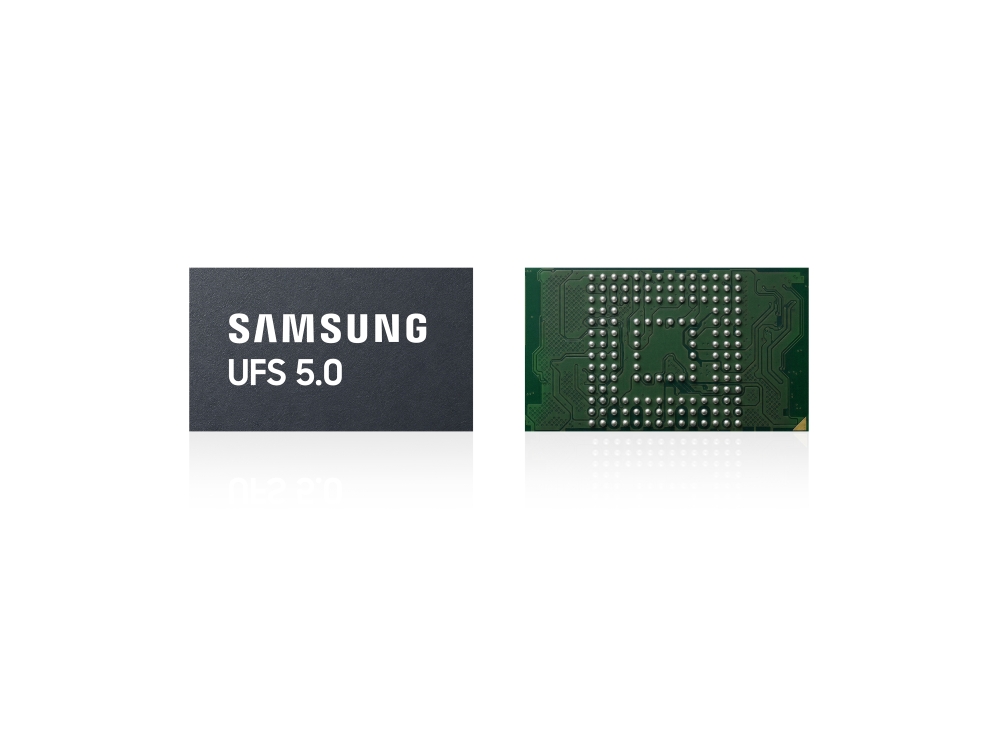
Samsung has announced its first UFS 5.0 solution, a new generation of mobile storage that boosts sequential read speeds up to 10.8 GB/s and write speeds up to 9.5 GB/s. This figure isn’t just a technical leap for future high-end smartphones. It’s a clear signal of where smartphones are heading: less reliance on the cloud and greater capacity to run Artificial Intelligence tasks directly on the device.
The announcement comes amid a rush to bring language models, generative functions, real-time translation, personal assistants, advanced image editing, and XR experiences to the smartphone itself. Until now, many of these capabilities depended on remote servers. But if manufacturers want the mobile device to process more data locally, storage is no longer just a place to store photos, videos, and apps. It’s beginning to become part of the computing infrastructure.
UFS 5.0 Doubles Performance Compared to UFS 4.1
Samsung claims its new UFS 5.0 integrates the latest embedded interface standard from JEDEC and achieves a maximum bandwidth of 10.8 GB/s. Compared to UFS 4.1, the company reports speeds more than twice as fast in both sequential read and write operations.
This improvement will be especially noticeable when the device needs to load large volumes of data quickly. On a typical smartphone, this could mean faster app launches, better multitasking response, less wait times with heavy files, and quicker game loads. In smartphones with local AI, the impact could be even deeper: reducing load times for models, databases, or extensive contexts before the system begins to respond.
| Feature | Samsung UFS 4.1 | Samsung UFS 5.0 |
|---|---|---|
| Sequential Read | Previous reference | Up to 10.8 GB/s |
| Sequential Write | Previous reference | Up to 9.5 GB/s |
| Speed Improvement | Base comparison | More than double, according to Samsung |
| Power Efficiency | Base comparison | Over 40% better |
| Package Size | Larger | 7.5 mm x 13 mm x 0.9 mm |
| Size Reduction | Base comparison | 16.7% smaller |
| Expected Capacity | Depending on configuration | Up to 1 TB |
| Mass Production | Already available in previous generations | Q4 2026 |
Samsung also highlights an energy efficiency improvement of over 40% compared to UFS 4.1. To achieve this, the company cites technologies like clock gating and multi-voltage, techniques aimed at reducing power consumption during data transfer. In mobiles, wearables, and extended reality glasses, this aspect is as important as speed: moving data faster is pointless if the battery drains quickly or heat forces performance throttling.
The packaging has also been shrunk. The new solution measures 7.5 mm x 13 mm x 0.9 mm, a 16.7% reduction from its predecessor, according to Samsung. Though this difference may seem small, every millimeter matters in a modern smartphone. Manufacturers compete for internal space for cameras, batteries, antennas, sensors, thermal dissipation, and connectivity modules. A more compact storage solution leaves room for denser designs or new features without increasing device size.
AI on Device Requires More Than a Powerful NPU
Discussions about AI-enabled smartphones often focus on the NPU, RAM, and processor. It’s understandable—these are the most visible performance components. But storage is increasingly important because local models don’t appear out of nowhere in system memory. They are stored initially in UFS, then loaded into DRAM, before the CPU, GPU, or NPU can run inferences.
Kioxia recently explained the role of UFS 5.0 in on-device AI: local models can occupy several gigabytes even when quantized, and the growth in parameters extends load times before the first response. With speeds up to 10.8 GB/s, UFS 5.0 would enable loading larger models and local RAG databases with less delay.
This concept is crucial. The future of AI on mobile isn’t just about having an assistant that answers questions. It could also involve local semantic search within documents, offline text generation, assisted video editing, private translation, image analysis, personal memory on the device, and enterprise functions that can’t send sensitive data to the cloud.
For this model to work, the phone needs three things simultaneously: capacity, speed, and efficiency. Capacity to store models, personal data, and multimedia content; speed to load and access information with minimal latency; and efficiency so that intensive AI use doesn’t drain the battery too quickly.
Qualcomm Is in the Mix, but No Official Confirmation Yet
Samsung’s announcement was accompanied by information regarding the future Snapdragon 8 Elite Gen 6. Wccftech reports a leak from well-known tipster Reptalica suggesting that chips SM8975 and SM8950, associated with variants of Snapdragon 8 Elite Gen 6, will support UFS 5.0 with Gear 6 and dual lanes. It’s also noted that upcoming MediaTek and Exynos platforms might adopt the standard.
It’s important to distinguish confirmed facts from probable ones. Samsung has officially announced UFS 5.0, its speeds, efficiency, size, and mass production timeline for Q4 2026. Qualcomm hasn’t yet publicly confirmed support for UFS 5.0 in Snapdragon 8 Elite Gen 6. The adoption makes technical sense for the next generation of flagship phones, but for now, it remains based on leaks.
If confirmed, the combination of Snapdragon 8 Elite Gen 6, next-gen LPDDR memory, and UFS 5.0 storage would mark a significant upgrade for high-end phones in 2027. Not just in raw performance, but in the kinds of experiences it could enable: larger local models, faster responses, more available context, and less dependency on constant cloud connections.
The arrival of UFS 5.0 could also impact other devices. Samsung mentions flagship smartphones, XR glasses, and AI wearables. For these formats, balancing size, power consumption, and performance is even more critical. XR glasses can’t carry large batteries or cooling systems but need to load scenes, vision models, environment maps, and multimodal assistants with very low latency.
The mobile industry is entering a new phase. For years, storage was primarily marketed by capacity: 128 GB, 256 GB, 512 GB, or 1 TB. Then came the speed battle with UFS 3.1, UFS 4.0, and UFS 4.1. With UFS 5.0, the game changes: storage now also influences the quality of local AI experiences.
That doesn’t mean all phones will need UFS 5.0 immediately. Mid-range models will continue using older tech for years, and many AI functions will still run in the cloud. But in the premium segment, where manufacturers aim to differentiate with more private, faster, and contextual assistants, the storage leap could be a key factor.
Samsung will begin mass production in Q4 2026, with capacities up to 1 TB. Actual availability in devices depends on manufacturer schedules, compatible processors, and platform design. If timing aligns, UFS 5.0 should appear in the next wave of flagship phones.
Frequently Asked Questions
What is UFS 5.0?
UFS 5.0 is the latest generation of the Universal Flash Storage standard for mobile devices. It offers much higher transfer speeds than UFS 4.1 and is designed for smartphones, wearables, automotive, XR, and on-device AI applications.
What speed does Samsung’s UFS 5.0 achieve?
Samsung announces up to 10.8 GB/s sequential read and up to 9.5 GB/s sequential write speeds, more than double their UFS 4.1 solution.
Why is UFS 5.0 important for on-device AI?
Because local AI models and databases need to load from storage into system memory. Faster load times mean lower latency and smoother experiences.
Does Snapdragon 8 Elite Gen 6 already support UFS 5.0?
There is no official confirmation from Qualcomm yet. Compatibility has been hinted at in leaks related to upcoming Snapdragon chips, but it remains unconfirmed until Qualcomm makes an announcement.
via: news.samsung
