
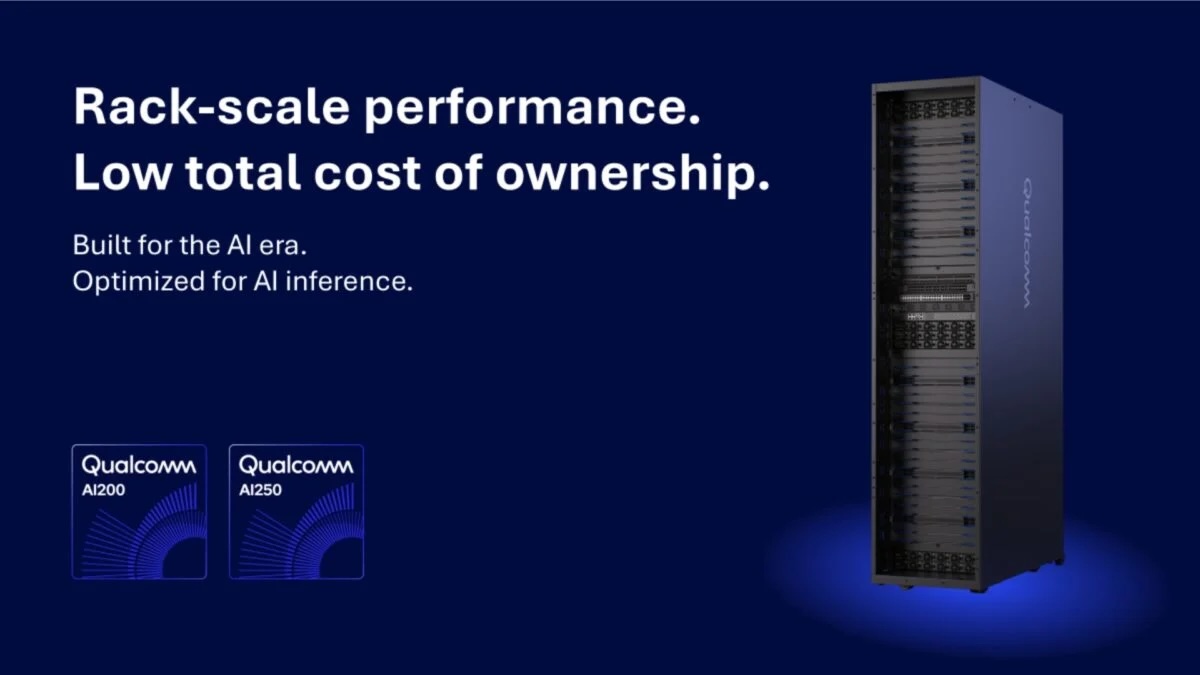
Samsung Electro-Mechanics has started mass production of FC-BGA substrates for the Qualcomm AI200, Qualcomm’s first AI accelerator aimed at data centers. The move, reported by ZDNet Korea and picked up by SamMobile, expands a relationship that has previously been more associated with mobile and PC processors, taking it into a higher-growth area: AI inference infrastructure.
This news may seem minor compared to major announcements of GPUs, HBM memory, or new 160 kW racks. But it’s not. Advanced packaging substrates have become a critical piece of the semiconductor supply chain. Without them, the chip cannot connect efficiently to the board, dissipate heat properly, or sustain the electrical speeds demanded by modern accelerators. In data center AI, the competition also takes place beneath the silicon.
What FC-BGA brings to the Qualcomm AI200
FC-BGA stands for Flip-Chip Ball Grid Array. It’s a type of encapsulation substrate that connects the chip to the board via tiny bumps instead of traditional wire bonding. Its advantages lie in superior electrical and thermal properties—two essential factors when working with high-performance semiconductors.
According to published information, Samsung Electro-Mechanics has begun manufacturing at its Busan facility in South Korea. The FC-BGA substrate intended for the Qualcomm AI200 is expected to have between 10 and 15 internal layers, a lower complexity compared to the over-20-layer substrates used in some high-end training accelerators. This difference aligns with the focus of the AI200: not designed to compete head-to-head in heavy training against NVIDIA or AMD’s largest systems, but rather for rack-scale AI inference.
Qualcomm officially announced the AI200 and AI250 in October 2025 as solutions optimized for inference in data centers. The AI200 is scheduled for 2026, and the AI250 for 2027. The company states that the AI200 will feature 768 GB of LPDDR memory per card, direct liquid cooling, PCIe for internal scaling, Ethernet for system-to-system scaling, confidential computing, and a rack-level power consumption of 160 kW. Their strategy does not involve HBM for this first generation but focuses on an architecture that emphasizes memory capacity, energy efficiency, and lower cost per inference.
| Element | Qualcomm AI200 | Data Center Reading |
|---|---|---|
| Product Type | AI inference accelerator | Focused on running pre-trained models |
| Expected Availability | 2026 | First generation of Qualcomm’s new roadmap |
| Memory | 768 GB of LPDDR per card | More capacity and lower cost compared to HBM alternatives |
| Encapsulation | FC-BGA manufactured by Samsung Electro-Mechanics, as reported by ZDNet Korea | Critical for electrical connection and thermal management |
| Layers in the substrate | Between 10 and 15, based on published info | Less complex than extreme high-end training accelerators |
| Scaling | PCIe and Ethernet | System and rack integration for inference |
| Cooling | Direct liquid cooling at rack level | Designed for high-density data center deployment |
| Next Generation | Qualcomm AI250 in 2027 | Will feature near-memory computing architecture for memory bandwidth and efficiency gains |
Qualcomm seeks a niche between NVIDIA, AMD, and proprietary chips
Qualcomm’s entry into data center AI accelerators is not starting from scratch. The company has been developing NPUs, low-power processors, and AI solutions in devices for years, but moving into inference racks puts it in a different league. The market it aims at is dominated by NVIDIA in training, with increasing competition in inference—where AMD, Intel, Broadcom, Marvell, hyper-scale proprietary chips, and new specialized startups are active.
Qualcomm does not intend to be just another copycat of HBM-based GPUs. Its message is centered on performance per dollar and per watt, LPDDR memory capacity, compatibility with AI frameworks, and deploying pre-trained language and multimodal models. This differentiation makes sense because inference is going to become a significant part of AI operational costs. Training a model is expensive, but deploying it daily to millions of users is also costly.
Encapsulation plays a growing role here. High-quality FC-BGA availability can influence the volume production of advanced chips. Large accelerators require multi-layer substrates, materials like ABF, tight tolerances, and sufficient thermal capacity. The supply chain was already under stress from server CPUs, GPUs, AI ASICs, and networking chips. The fact that Samsung Electro-Mechanics is a supplier for the AI200 shows how Korean component manufacturers want to capture value in AI’s expansion beyond memory.
For Samsung Electro-Mechanics, this partnership is a path to growth in a higher-margin segment. The company had previously invested in expanding its FC-BGA business, including an $850 million plan announced in 2021 for Vietnam capacity, and supplied substrates for Qualcomm application processors in mobile devices. Now, the relationship is shifting toward a category with product cycles and requirements more aligned with servers.
Inference opens a new supply chain
The AI200 also highlights an important distinction within AI. Not all infrastructure is designed the same way. Accelerators for intense training tend to require HBM, high-density interconnects, more complex encapsulation, and systems made to move massive amounts of data over weeks or months. Inference, by contrast, needs to serve responses efficiently, with controlled latency, low cost, and scalability to many users or agents.
This allows for different chip architectures. Using LPDDR5 reduces complexity compared to HBM and enables more memory per card, though with different bandwidth profiles. In language model workloads—where token cost and rack energy consumption matter increasingly—this decision can be competitive if the software optimizes utilization and system efficiency.
Qualcomm asserts that the AI200 and AI250 will be part of an annual data center roadmap. The AI250, scheduled for 2027, will incorporate a near-memory computing memory architecture, promising a boost in effective bandwidth and efficiency over the AI200. It’s still early to gauge the adoption success of this family, but Samsung Electro-Mechanics already beginning production of FC-BGA for the first product indicates a concrete phase beyond just commercial presentation.
The potential involvement of LG Innotek in the AI200 supply chain starting next year, per the same reports, is another signal. Advanced substrates are becoming a strategic market for South Korea, much like HBM memory has been for SK Hynix, Samsung Electronics, and Micron. In AI, value is no longer only in designing the accelerator but also distributed across foundries, advanced packaging, memory, substrates, networking, cooling, and rack assembly.
The market takeaway is clear: the expansion of generative AI is reshaping the entire infrastructure supply chain. Qualcomm aims to enter data centers via efficient inference. Samsung Electro-Mechanics wants its substrates to be part of this new demand. Cloud providers are seeking alternatives to reduce costs of deploying large-scale models without relying solely on the most expensive platforms.
The success of the AI200 will depend not only on its chip design but also on software, availability, cost, rack integration, power consumption, memory, networking, and manufacturing capacity. The start of FC-BGA production in Busan doesn’t solve all these uncertainties but sends an important signal: Qualcomm is already moving its supply chain to bring its data center AI ambitions to market.
Frequently Asked Questions
What is Samsung Electro-Mechanics manufacturing for Qualcomm?
According to ZDNet Korea and SamMobile, Samsung Electro-Mechanics has begun producing FC-BGA substrates for the Qualcomm AI200, Qualcomm’s first AI accelerator for data centers.
What is an FC-BGA substrate?
It’s an advanced encapsulation base that connects the chip to the board via flip-chip bumps. It offers better electrical and thermal properties than traditional wire bonding, which is why it’s used in high-performance semiconductors.
Does the Qualcomm AI200 compete with NVIDIA’s training GPUs?
Not exactly. AI200 is optimized for AI inference—running pre-trained models. Its LPDDR-based design prioritizes capacity, efficiency, and lower operating costs, not the heavy training based on HBM.
When will the Qualcomm AI200 and AI250 be available?
Qualcomm expects AI200 to be commercially available in 2026 and AI250 in 2027. The AI250 will include a near-memory computing architecture designed to improve bandwidth and efficiency over the AI200.
via: sammobile
