
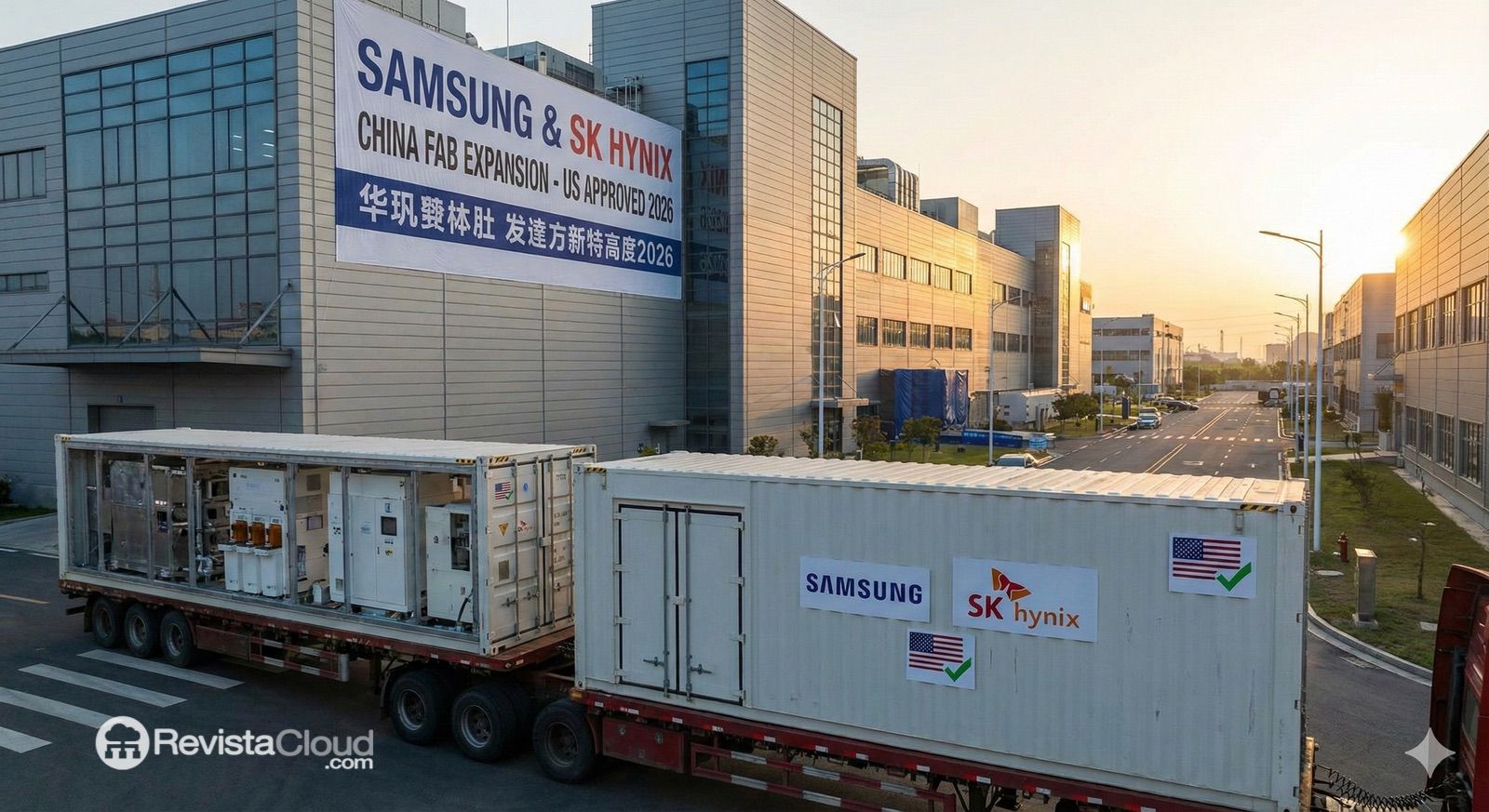
Memory chip inventories at Samsung Electronics and SK hynix fell below the equivalent of ten days of supply during the third quarter of 2026, according to a KB Securities report cited by Business Korea. The research firm believes heavy investment in AI infrastructure is absorbing growing amounts of DRAM, NAND, and HBM memory, a situation that could tighten further in 2027 as HBM4 production ramps up.
The Memory Shortage in 30 Seconds
- Samsung and SK hynix reportedly held less than ten days of memory inventory during the third quarter, according to KB Securities.
- The firm expects $1.3 trillion in global AI infrastructure investment in 2027, up 60%.
- KB estimates memory will absorb 57% of that spending.
- HBM4 requires roughly three times the wafer capacity of conventional DRAM.
- Samsung and SK hynix already acknowledge demand exceeding supply in several categories.
The inventory figure comes from KB Securities, not from Samsung or SK hynix’s published accounts, so it should be treated as an analyst estimate. The companies have separately acknowledged very tight supply conditions. When presenting its second-quarter results, Samsung anticipated the market would remain undersupplied through the second half of 2026, despite some softening in PCs and phones. SK hynix says additional supply requests from customers keep growing.
SK hynix’s financial snapshot also reflects the pace at which its business is growing. Its first-quarter 2026 filings show total assets of 222.829 trillion won, up from 176.108 trillion three months earlier and 123.985 trillion a year earlier. Inventory stood at 15.974 trillion won at the close of that quarter, though that accounting figure isn’t equivalent to the days-of-supply metric KB Securities calculated later.
AI Is Already Pulling on HBM, DDR5, and Enterprise SSDs
The bottleneck doesn’t affect only high-bandwidth memory (HBM), used alongside AI accelerators. Servers also need large amounts of DDR5 and solid-state drive (SSD) storage, so data center growth is spreading the pressure to other parts of the market.
Kim Dong-won, head of research at KB Securities, warns that the problem may stop being simply a demand recovery and start becoming a matter of physical product availability. According to his analysis, AI servers will simultaneously absorb HBM, server-grade DDR5, and enterprise SSDs, raising the risk of an especially severe shortage.
Investment forecasts help explain that concern. KB Securities has raised its estimate of major cloud providers’ investment in AI infrastructure for 2027 to $1.3 trillion, a 60% year-over-year increase. The report also calculates that memory chips could account for 57% of that spending, up from 14% the year before. TrendForce, according to Business Korea, puts that potential share as high as 68%.
There’s an important timing nuance here: those figures correspond to KB’s forecast for next year, 2027, not 2026. The projected expansion also doesn’t guarantee that all of that money will translate into memory sales. These are estimates of investment levels and spending mix.
The manufacturers themselves, however, describe extraordinarily high demand. SK hynix reported in July that both DRAM and NAND prices rose during the second quarter and attributed part of its results to growth in products aimed at AI servers. It also said it kept receiving additional supply requests from customers.
Samsung offered a similar reading. Its Device Solutions division posted 127.5 trillion won in revenue during the second quarter of 2026, and the memory business hit quarterly records for both sales and operating profit. The company attributed part of that result to AI demand, limited capacity, and broad-based price increases.
HBM4 Consumes More Capacity and Complicates the Balance
The arrival of HBM4 adds another challenge. This type of memory is built by stacking multiple layers of DRAM and requires more complex manufacturing and packaging processes than conventional products.
KB Securities calculates that HBM4 requires roughly three times the wafer production capacity of conventional DRAM. If available capacity doesn’t grow at the same pace, dedicating more resources to HBM4 shrinks the room left to make memory for other applications. The firm estimates that by 2027, bit demand for DRAM and NAND could exceed supply by more than ten percentage points.
That shift matters because manufacturers have strong economic incentives to serve demand for high-value products aimed at data centers. Samsung said in its latest results that it will keep focusing its output on HBM4, DDR5, and SOCAMM2, among other products. The company has also started ramping up HBM4 sales and has already shipped HBM4E samples to major customers.
SK hynix is in a similar phase. It began volume shipments of HBM4 during the second quarter and plans to increase production during the second half of 2026. In June, it also announced it had shipped 12-layer HBM4E samples to customers.
The South Korean manufacturer is responding with more capacity. In August, it announced investments of about 54 trillion won for two new fabs: 35.2 trillion won for Y2 in Yongin and 19.1 trillion won for M17 in Cheongju. But these are medium-term projects. M17’s clean room is scheduled for December 2028 and Y2’s for June 2029, so these facilities won’t resolve a potential shortage during 2027.
The Shortage Could Reach Beyond AI Accelerators
The effect on the consumer market will depend on how long the imbalance lasts and on how Samsung, SK hynix, and other manufacturers allocate their capacity. A drop in producers’ inventory can’t automatically be assumed to mean a shortage of memory on store shelves or specific price increases for every PC, phone, or graphics card.
There are signs, though, that the strain is already reaching mainstream products. Samsung expects demand for server DRAM, enterprise SSDs, and HBM to keep growing through the second half of 2026. The company acknowledges that efforts to increase production won’t fully prevent supply constraints.
SK hynix is also seeking longer contracts for greater predictability. The company reported in July that it had closed long-term supply agreements with around ten customers and was still negotiating with other major companies in the sector. Its stated goal is to secure greater supply stability amid growth it considers structural.
That’s why the under-ten-days figure should be read as a sign of exceptionally tight inventories according to KB Securities, not as a deadline after which Samsung and SK hynix would literally run out of chips. Production continues, and stock is constantly replenished.
The risk for 2027 emerges if memory consumption keeps rising while additional capacity takes time to come online. HBM4 needs more manufacturing resources, AI servers also consume DDR5 and SSDs, and new fabs take years to become operational. That combination explains why manufacturers are ramping up investment and negotiating multi-year supply contracts while analysts warn of an increasingly tight market.
Frequently Asked Questions
Do Samsung and SK hynix really have only ten days of memory left?
KB Securities estimates their inventories had fallen below the equivalent of ten days during the third quarter of 2026. It doesn’t mean they’ll run out of chips in ten days, since the fabs keep producing memory and replenishing that stock.
Why is artificial intelligence driving so much memory demand?
AI systems need HBM alongside their accelerators, but servers also use large amounts of DDR5 and enterprise SSD storage. The simultaneous growth of these categories increases pressure on limited production capacity.
Why could HBM4 worsen the DRAM shortage?
According to KB Securities, producing HBM4 requires roughly three times the wafer capacity of conventional DRAM. Dedicating a growing share of fabs to HBM4 can reduce the capacity available for other types of memory if total production doesn’t increase fast enough.
Will the memory shortage continue into 2027?
KB Securities expects bit demand for DRAM and NAND to exceed supply by more than ten percentage points during 2027. It’s a forecast, and it could change depending on AI demand, manufacturer investment, and capacity that comes online.
