
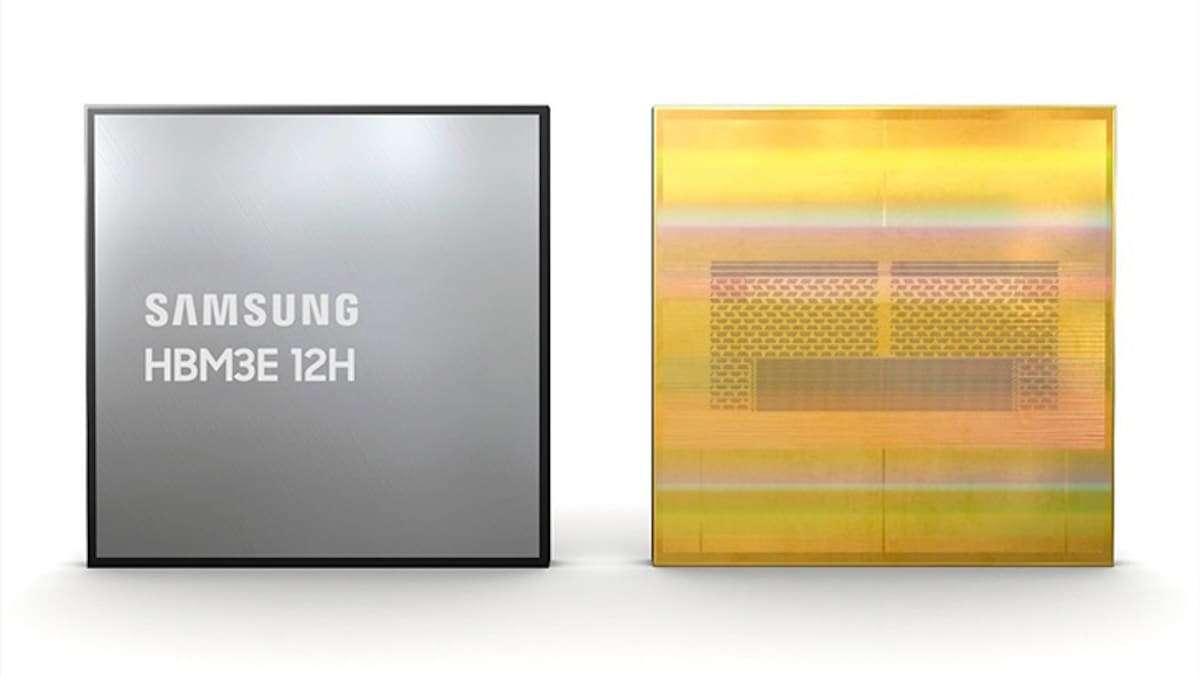
Samsung Electronics once again demonstrates its strength in the AI memory race. After beginning commercial production of HBM4 earlier this year, the South Korean company has reportedly achieved a reliability yield for HBM4E, the next generation, already surpassing 70%, according to industry information shared in Korea. While this figure does not mean the product is fully mature, it indicates that development has entered a more stable phase than usual for a technology still in validation.
In HBM memory, yield is as important as speed. A chip can promise higher bandwidth, more layers, or better efficiency, but if the percentage of valid units is low, costs skyrocket and actual supply capacity becomes limited. The industry typically considers a process nearing maturity when it reaches around 80% or higher. Therefore, exceeding 70% reliability yield for HBM4E puts Samsung in a more comfortable position for customer evaluations and future production ramp-up.
This news comes at a very sensitive moment. The demand for HBM continues to grow due to deployments of AI accelerators, high-performance servers, and new generations of GPUs. SK hynix has led much of the recent market, Micron is gaining presence, and Samsung is trying to regain ground by leveraging a structural advantage: it controls memory, foundry, and advanced packaging within the same group.
HBM4E: more speed and a critical window for Samsung
Samsung had already announced in late May that it was shipping HBM4E 12-layer samples to global customers. According to the company, this product reaches up to 16 Gbps per pin and is designed for next-generation AI workloads. The company also claimed that HBM4E improves speed performance by over 20% compared to HBM4, along with gains in energy efficiency and thermal behavior.
This technical leap is significant because HBM4E will serve as a bridge between the first wave of HBM4 and later generations such as HBM5. High-bandwidth memory has become one of the scarcest components of AI infrastructure. It is no longer enough to build a powerful GPU: actual performance depends on how much memory can feed it, with what bandwidth, power consumption, and thermal reliability.
Samsung began commercial production of HBM4 in February, presenting it as the industry’s first, with a consistent speed of 11.7 Gbps and capacity up to 13 Gbps. This generation uses sixth-generation 10 nm class DRAM and a 4 nm logical base die, a combination Samsung seeks to differentiate from competitors.
The improvement in HBM4E is crucial because the next major supply battle will revolve around future AI accelerators beyond those currently available. The market expects NVIDIA, AMD, and large ASIC cloud designers to continue pushing configurations with more memory, bigger packages, and stricter thermal requirements. In that context, arriving early isn’t enough; achieving sufficient yield is essential.
| Generation | Highlighted Status | Relevance for AI |
|---|---|---|
| HBM3E | Current generation in many accelerators | Foundation of recent AI market |
| HBM4 | Commercial production started by Samsung in 2026 | Higher bandwidth and new base die |
| HBM4E | Samples shipped with reliability yield >70% per reports | Next step for next-generation accelerators |
| HBM5 | Next major evolution | Depends on advanced DRAM processes like D1d |
D1d DRAM: the piece already looking towards HBM5
Another important detail lies in the D1d process, Samsung’s seventh-generation 10 nm class DRAM. Song Jai Hyuk, CTO of Samsung Electronics and head of the Semiconductor Research Center, reportedly communicated internally that D1d’s technical competitiveness is ahead of its rivals and that development is progressing toward achieving Production Readiness Approval (PRA) in November.
PRA is a critical internal phase before shipment and mass production. It assesses whether the process offers sufficient performance, productivity, stability, and quality to proceed to industrialization. For a product like HBM, this step is even more delicate because failure is not limited to a single die. Memory is stacked, interconnected, and integrated into complex packages alongside logic and other components.
D1d matters because Samsung plans to use it as the foundation for HBM5. If this process matures in time, the company could improve density, efficiency, and cost for the next generation of AI memory. Conversely, delays could weaken the advantage gained with HBM4E against SK hynix and Micron.
Samsung faced a challenging period with HBM initially. Throughout 2024 and 2025, several reports indicated yield and qualification difficulties compared to competitors. In fact, TrendForce reported last year that Samsung’s DRAM 1c yields had risen to the 50%-70% range in testing, after being below 30% in earlier phases.
The outlook now is different. If HBM4E exceeds 70% in reliability testing and D1d advances toward PRA, Samsung is beginning to reduce two of its main uncertainties: current HBM execution capacity and readiness for the next generation.
Samsung’s edge: memory, foundry, and packaging integrated under one roof
One of Samsung’s most repeated arguments in this new phase is its vertical integration. Unlike other players, the company combines memory business, foundry, and packaging within the same group. Song Jai Hyuk already claimed in February that this structure provides Samsung with a favorable environment to manufacture the products demanded by AI, as it can coordinate memory, logic, and packaging.
This advantage may be more valuable in HBM4 and HBM4E than in earlier generations. High-bandwidth memory is no longer just stacked DRAM. It now includes logical base dies, advanced packaging processes, thermal management, denser interconnects, and joint validation with client accelerators. The more complex the product, the more critical industrial coordination becomes.
However, vertical integration does not guarantee leadership. SK hynix has demonstrated strong execution in HBM3E and HBM, and Micron has gained relevance as a major third supplier. AI customers do not buy promises—they buy supply, performance, efficiency, stability, and the ability to meet schedules. Samsung needs to turn its technical advances into reliable volumes.
Yield is now a strategic variable
The race for HBM has often been discussed in terms of pin speed, layer count, and total bandwidth. But the variable that determines margins and availability is yield. In advanced generations, each percentage point can mean millions in usable capacity and profitability.
A yield above 70% in HBM4E does not mean mature mass production, but it changes perceptions. It indicates that technical issues are entering a controllable zone. It also allows Samsung to negotiate better with major clients, speed up validations, and prepare for HBM5 transition with more credibility.
For the AI market, this news is also positive. The more suppliers able to deliver advanced HBM with sufficient yield, the less pressure on a supply chain that remains highly concentrated. Memory demand for accelerators will continue to grow, and capacity improvements help reduce bottlenecks.
Samsung has not yet secured its leadership. SK hynix maintains a very strong position, and Micron is gaining ground. But surpassing 70% in HBM4E—if confirmed in production and customer evaluations—is a clear signal: Samsung aims to re-enter the race for the leadership of the most critical memory in the AI era.
Frequently Asked Questions
What does surpassing a 70% yield in HBM4E mean for Samsung?
It means that over 70% of units evaluated in reliability tests meet the required criteria. It doesn’t indicate full maturity but reflects a significant step forward in process stability.
What is HBM4E?
HBM4E is the evolution of HBM4, a high-bandwidth memory designed for AI accelerators and high-performance computing systems.
Why is yield so important in HBM?
Because HBM involves multiple memory layers, base dies, advanced packaging, and rigorous validation. Low yield increases per-unit costs and reduces actual availability.
What role does D1d DRAM play?
D1d is Samsung’s seventh-generation 10 nm class DRAM, expected to be the foundation for future generations like HBM5. Its maturity will be key to future competitiveness.
Does Samsung already lead the HBM market?
Not necessarily. SK hynix remains a very strong competitor, and Micron is gaining relevance. Samsung is seeking to regain ground with HBM4, HBM4E, and its integrated approach to memory, foundry, and packaging.
via: X Jukan
