
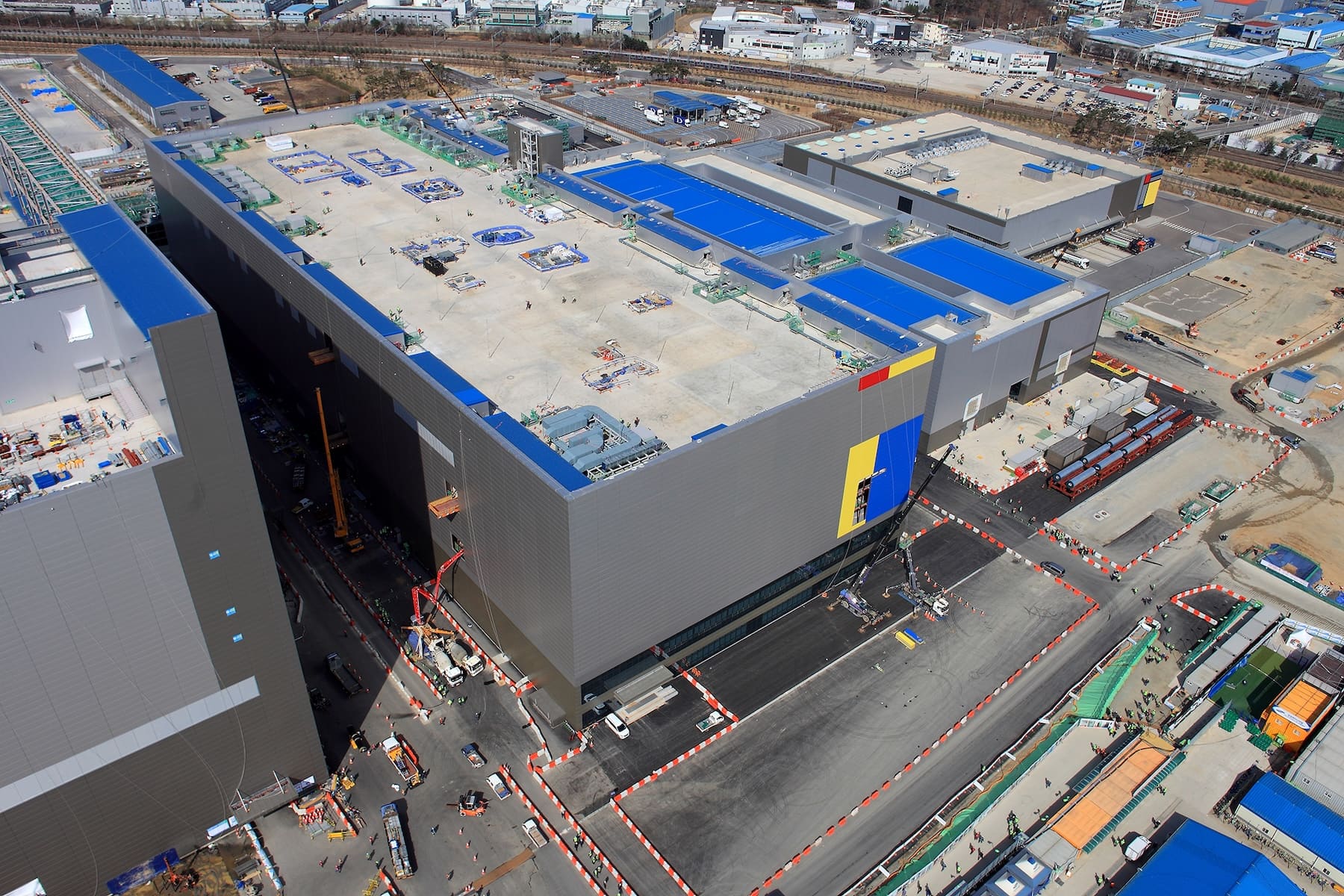
Samsung Electronics is making moves to prevent falling behind in the most scarce—and lucrative—component of the AI boom: high-bandwidth memory (HBM). In late February and just ahead of the 2026 Mobile World Congress (MWC), the company has accelerated its cleanroom construction schedule (cleanrooms) at its upcoming Fab 5 (P5) in the Pyeongtaek mega-campus (South Korea), a facility destined to become a hub for HBM production to meet the growing demand from AI accelerators and data centers.
The move, reported by industry publication Cleanroom Technology, is more than just a “cosmetic” upgrade. In semiconductor manufacturing, the cleanroom is the pivot point: without a finished cleanroom, equipment cannot be installed. And without tools, there are no wafers. Therefore, speeding up cleanroom development means preparing the ground to turbocharge production when the market demands it.
The “Shell First”: build the shell first, decide the contents later
Samsung frames this acceleration within a strategy it calls “Shell First”. The concept is straightforward and pragmatic: complete the infrastructure first (cleanroom, piping, critical services) without fully investing in equipment, so the company can respond quickly if demand spikes or if a customer requires volume on an aggressive schedule.
According to Cleanroom Technology, Samsung has already advanced several milestones:
- The full construction of cleanrooms was originally scheduled for early 2027, but now the company plans to start key work earlier.
- Preparatory tasks have been rescheduled for the second quarter, with cleanroom deployment set to begin in early third quarter.
- Preliminary installation of “inserts” (structural elements embedded before certain installations) is planned for the fourth quarter.
- Piping installation, critical for deploying semiconductor equipment, is also moved forward to late 2026.
In an industry where ramp-ups are measured in quarters and major clients plan years in advance, gaining months in civil work can make the difference between “getting on time” or missing a cycle entirely.
P5, larger than previous fabs and designed for HBM
Pyeongtaek is Samsung’s flagship semiconductor campus, and P5 is designed to be bigger than earlier plants in the complex. According to Cleanroom Technology, P5 will feature six cleanrooms spread across three floors, compared to four cleanrooms in two floors in previous campus fabs. Samsung describes P5 as a future nerve center for HBM, especially as the memory industry shifts to prioritize high-margin products for AI.
The economic scale is equally impressive: the total investment in the campus is estimated in the tens of billions of dollars, with P5 itself projected to cost between $23 billion and $46 billion, according to the same source. This range highlights the real industry challenge: building spare capacity is expensive, but having no capacity might be even costlier if AI contract demand surges.
Market signals: Samsung regains DRAM leadership driven by HBM momentum
The acceleration is driven by a clear reason: demand for AI memory remains strong. Additionally, Samsung has regained momentum in the competitive landscape. TrendForce’s Q4 2025 report indicates that Samsung retook the lead in DRAM revenue, hitting $19.3 billion (a 43% quarter-over-quarter increase) and capturing 36% market share, partly fueled by growth in HBM sales. In the same period, SK hynix posted $17.22 billion with a 32.1% share, and Micron reached $11.98 billion and 22.4%.
This distribution underscores that HBM has become one of the most direct levers for increasing memory revenue. When AI customers buy at large scale, volume, performance, and delivery capacity take priority.
While Korea accelerates, Texas adjusts expectations: Taylor’s ramp stretches to 2027
Samsung’s other strategic focus is its foundry division, especially in the United States. However, recent reports suggest that Samsung’s major project in Taylor, Texas is progressing, but on a less linear timeline than initially expected.
The Korea JoongAng Daily recently reported that significant production at the Taylor plant could shift to early 2027, citing supply chain sources. TrendForce echoes this, indicating questions around the actual pace of production ramp-up. Simultaneously, the same Korean media mentions an interesting shift: some facilities initially planned as foundry lines in Korea might pivot to prioritize memory expansion due to AI demand.
Put together, the message is clear: Samsung is reinforcing its strength where it has immediate traction (AI memory), while the Texas foundry follows a longer, demand-sensitive ramping path that depends on client needs, permits, equipment availability, and project economics.
A race won in cleanrooms, not in presentations
Externally, the chip industry is often described by nodes (2nm, 3nm) and big players (GPU, AI, data centers). But on the ground, many changes start with something more prosaic: the cleanroom schedule and the ability to install machines on time.
Samsung speeds up Pyeongtaek P5 because it knows HBM memory is a direct highway to AI racks. At the same time, the company maintains its international ambitions—including the Texas foundry—even though the market is showing that execution and actual demand set the pace, not initial plans.
Summary table: Pyeongtaek P5 vs. Taylor (Texas)
| Project | Main goal | Recent status / timeline | Strategic key |
|---|---|---|---|
| Pyeongtaek P5 (Korea) | HBM production hub for AI | Accelerated construction: preparations in Q2, cleanroom start early Q3, “inserts” in Q4, pipes by late 2026 | “Shell First”: ready infrastructure to deploy tools when demand demands |
| Taylor (Texas, USA) | Advanced foundry expansion | Reports indicate significant production ramp in early 2027 | Adjust expectations, align investment with actual market pace |
FAQs
What is a “cleanroom” and why is it so critical in a fab?
A controlled environment (particles, temperature, humidity, pressure) essential for chip manufacturing. Without a finished cleanroom, equipment can’t be installed, making it a key milestone in the schedule.
What does Samsung’s “Shell First” strategy entail?
It involves building the infrastructure first (the “shell”: cleanrooms and services) before fully investing in equipment, enabling quick response if demand shifts.
Why is HBM so important for Artificial Intelligence?
Because AI accelerators require extremely high memory bandwidth to support computing. This has driven demand and made HBM a strategic product for data centers.
What does shifting Taylor’s ramp to 2027 mean?
It indicates a longer timeline for significant volume from the U.S. advanced capacity. For Samsung, it reinforces the idea of accelerating where immediate returns are easier—memory and HBM.
via: cleanroom technology