
SAIMEMORY, SoftBank’s subsidiary developing ZAM memory, has signed a memorandum of understanding with Japanese semiconductor packaging and substrate maker Shinko Electric Industries to work together from research through to the commercialization of the technology. The two companies announced the deal on September 28, 2026. Shinko will contribute its expertise in packaging substrates and high-density packaging, precisely one of the hardest pieces to solve for ZAM to move from the lab to production.
The SAIMEMORY-Shinko agreement in 30 seconds
- SAIMEMORY and Shinko will collaborate on research, manufacturing technology, and the future commercialization of ZAM.
- ZAM is a 3D memory with high bandwidth and low power consumption designed for AI data centers.
- Shinko will handle the packaging and manufacturing processes required.
- It’s a memorandum: it includes no financial figures or a new timeline.
The agreement reinforces the project’s Japanese profile. ZAM (Z-Angle Memory) was born at SAIMEMORY, a company created by SoftBank in December 2024, and its development is partly funded by a NEDO program, Japan’s agency for new energy and industrial technology development, dedicated to post-5G communications infrastructure. Both presidents stress that point: they present ZAM as a memory “originating from Japan” and speak of drawing on years of experience accumulated in the country’s industry.
What Shinko Brings to the Project
Shinko Electric is an integrated semiconductor packaging manufacturer with a long track record in designing and manufacturing substrates, the pieces on which a chip is mounted to connect it to the rest of the system. According to the announcement, the company will use that experience and its high-density packaging technologies to establish the packaging and manufacturing processes ZAM needs, both in the research phase and in the commercial one.
It’s not a minor role. In high-bandwidth memory, much of the value and difficulty lies in how the chips are stacked and connected, not just in the memory cells. Current HBM depends on very complex packaging, and that same bottleneck has limited the supply of AI accelerators in recent years. If ZAM wants to be a real alternative, it needs partners capable of producing its packaging reliably and at a reasonable cost.
Hideya Yamaguchi, president and CEO of SAIMEMORY, said he was “very excited to have reached this agreement with Shinko to build an alliance that spans from R&D to future commercialization.” He added that by combining both companies’ technologies, they will speed up the practical rollout of ZAM and work to deliver a memory that is competitive in both the Japanese and international markets.
Susumu Kurashima, president and CEO of Shinko, described the memory as “one of the critical core technologies” for the transformation brought by AI and digitalization, and said the company wants to help bring this new generation of memory into practice.
ZAM, an Alternative to HBM Still in Development
ZAM is a 3D-stacked DRAM memory that aims to deliver more density and bandwidth with lower power consumption than HBM, the memory that today accompanies AI accelerators from NVIDIA, AMD, and other manufacturers. Cloudnews.tech previously covered how Intel and SoftBank allied in February to develop it, and at the 2026 VLSI Symposium researchers from SAIMEMORY, Intel, PSMC, and AP Memory presented a prototype with eight layers of DRAM stacked on a logic layer.
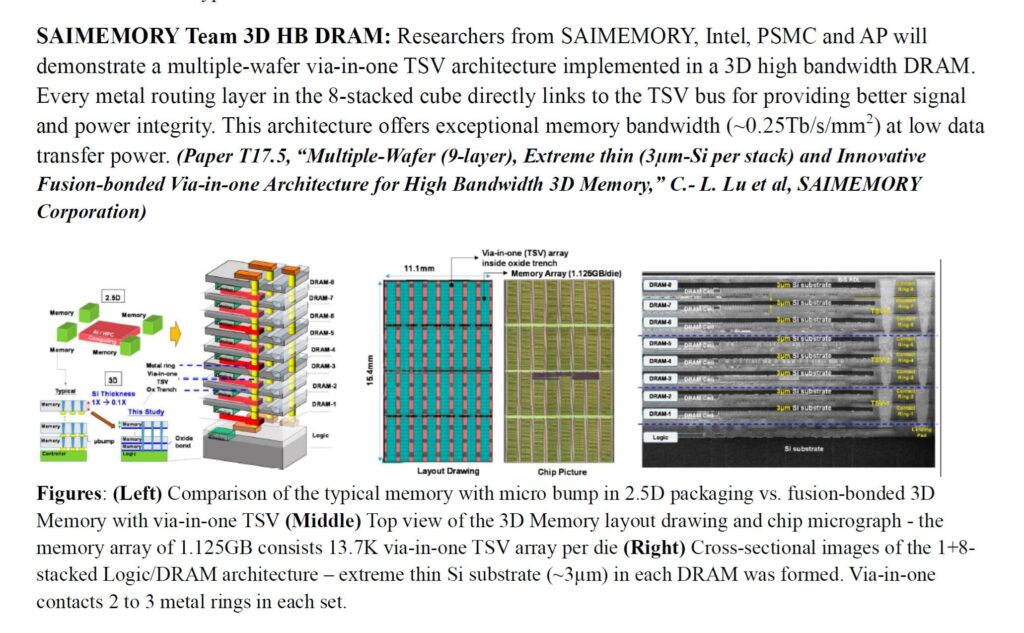
That work described a bandwidth density of about 0.25 Tb/s per square millimeter, with silicon layers roughly 3 microns thick and about 13,700 TSV vias, the vertical connections between layers, per chip. These are lab figures, not the specifications of a commercial product, and key data such as final capacity, actual power consumption, or manufacturing cost are still missing.
The timeline remains medium-term. In February, SoftBank spoke of building prototypes during the fiscal year ending March 31, 2028, and a possible commercial launch in fiscal year 2029. The memorandum with Shinko doesn’t change those dates or add investment figures, but it does complete a piece of the industrial chain ZAM will need if it wants to reach servers.
Japan Seeks to Regain Ground in Memory
The HBM market is concentrated among three manufacturers, SK hynix, Samsung, and Micron, none of them Japanese. For a country that was a DRAM powerhouse in the 1980s, ZAM is also a chance to return to this business with its own technology, backed by public funding and by a group like SoftBank, which is investing heavily in AI infrastructure.
The growing roster of partners is sketching out that chain: Intel on stacking and bonding technology, wafer manufacturers like PSMC, and now Shinko on packaging. It remains to be seen who will manufacture at volume and, above all, which accelerator makers will be willing to integrate a new memory into their designs. Until that happens, ZAM will remain a bet in development against an HBM that already has a standard, suppliers, and customers.
Frequently Asked Questions
What is ZAM memory?
Z-Angle Memory is a 3D-stacked DRAM memory developed by SAIMEMORY, a SoftBank subsidiary, to offer high density, high bandwidth, and low power consumption in AI data centers.
What will Shinko Electric do in the project?
It will contribute its expertise in substrates and high-density packaging to develop ZAM’s packaging and manufacturing processes.
When will ZAM reach the market?
SoftBank expects prototypes in the fiscal year ending in March 2028 and a possible commercial launch in fiscal year 2029. The agreement with Shinko doesn’t change that timeline.
How is ZAM different from HBM?
Both stack layers of DRAM, but ZAM uses a different vertical connection architecture to seek more bandwidth per area with lower power consumption. HBM is already a commercial standard; ZAM is still in development.
Sources:
