
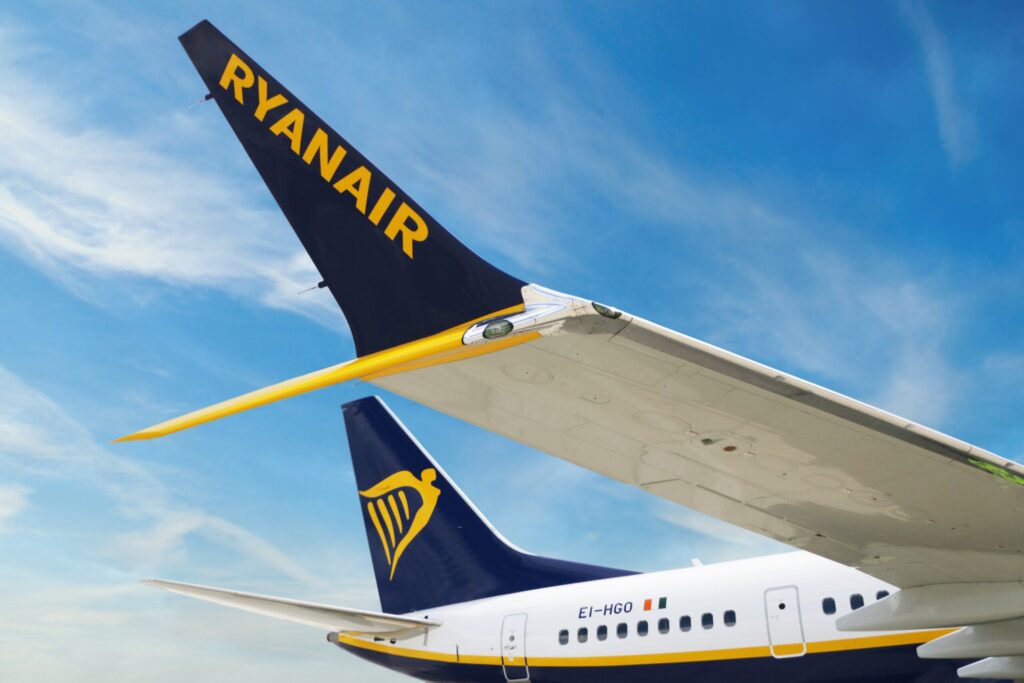
Ryanair has signed a five-year agreement with Google Cloud to expand its use of data services, cloud, and artificial intelligence in its operations. The airline will deploy Google Workspace, Gemini Enterprise, and other Google technologies among 35,000 employees, while adding a second major provider to its infrastructure, which already utilizes Amazon Web Services (AWS). This move makes multi-cloud resilience and automation through AI key elements of its strategy to surpass 300 million annual passengers by fiscal year 2034.
The key points of the Ryanair and Google Cloud partnership in 20 seconds
- The agreement will last five years and will impact approximately 35,000 employees.
- Ryanair will incorporate Gemini Enterprise, Google Workspace, and Google Cloud services.
- The airline will maintain AWS and plans an architecture with two major cloud providers.
- AI will be applied to crews, maintenance, fleet, and internal processes.
- Ryanair aims to exceed 300 million passengers annually by 2034.
This agreement is particularly significant from a technological perspective. Ryanair is not simply migrating from one provider to another. The company maintains its relationship with AWS, recently renewed for another five years, and adds Google Cloud as part of a strategy to reduce operational dependency on a single platform.
On July 27, Ryanair and AWS announced the extension of their collaboration for an additional five years. Just weeks later, the partnership with Google Cloud was announced. The combined architecture will support the airline’s loads and services across more than one provider, although the companies have not publicly detailed which applications will run on each cloud or the technical design ensuring continuity between them.
Two major clouds to reduce operational risk
Resilience is a key justification for this partnership. In an airline operating thousands of flights daily, system outages can quickly extend from digital services to processes involving customers, staff, planning, or flight management.
Ryanair’s strategy is to increase flexibility in case of issues with a cloud platform. This does not necessarily mean all applications will run simultaneously on AWS and Google Cloud. Multi-cloud architectures can vary greatly, from distributing applications across providers to disaster recovery systems or redundant services.
Currently, Ryanair has not specified the level of redundancy for each workload or the mechanisms it will use to migrate services between platforms. Financial terms of the agreement have also not been disclosed.
This approach reflects a broader trend among large organizations: cloud selection is shifting from solely capacity considerations to include business continuity and access to different AI platforms.
Additionally, Ryanair’s scale makes this architecture especially relevant. Its 2026 annual report states the company transported around 208 million passengers during that fiscal year, with a goal to surpass 300 million by 2034.
This growth will be supported by the gradual addition of new aircraft. The airline has ordered 300 Boeing 737 MAX 10s, which are expected to increase capacity over the coming years.
Gemini Enterprise joins Ryanair’s operations
The second major component of the agreement is artificial intelligence. Ryanair will deploy Gemini Enterprise, Google Cloud’s enterprise platform designed for AI models and agents integrated with corporate data and applications.
The airline plans to use these tools to automate certain decision-making processes, optimize crew logistics, and enhance internal tasks. Google Workspace with Gemini will also be provided to employees as part of replacing and modernizing current collaboration tools.
The scope extends beyond simply providing an AI assistant for drafting documents or summarizing emails. The announced goal includes creating agents and connecting AI with organizational data and workflows.
One of the most interesting technological aspects of this project is the aim to apply AI models to operational optimization challenges directly related to airline operations.
Technologies mentioned include AlphaEvolve, developed by Google DeepMind and publicly available on Google Cloud since July 2026. It’s an agent based on Gemini that specializes in discovering and improving algorithms through evaluation systems tailored for each problem.
Google states that AlphaEvolve can be applied in fields such as logistics, high-performance computing, semiconductors, or combinatorial optimization problems. Ryanair is considering using it to support fleet operations and maintenance planning.
The airline also references WeatherNext, Google DeepMind’s family of weather prediction models. Weather forecasting directly impacts aviation processes; however, Ryanair has yet to specify how these models will be integrated or which decisions will be supported by them.
In summary, these are intended applications within the alliance, not capabilities already deployed throughout the operation.
AI as another layer in cloud competition
This partnership illustrates how the competition among major cloud providers is evolving. AWS, Microsoft, and Google have long competed over storage, databases, VMs, and enterprise services. AI now adds a new variable to this rivalry.
Ryanair will have access to Google technologies while maintaining its relationship with AWS. In the July renewal, the airline confirmed it would continue using Amazon’s computing and AI services, including Amazon Bedrock and AgentCore.
This allows Ryanair to avoid, at least theoretically, depending solely on one platform for AI. However, managing multiple providers introduces technical complexity—identity management, data integration, networking, observability, security, and cost control across different environments.
The partnership with Google does not mean AI will autonomously make critical flight decisions. The companies talk about automation, optimization, and operational support but have not disclosed which processes will be under human supervision or which systems are authorized to act automatically.
The scale of deployment is clear: Google Workspace and related tools will reach 35,000 workers, demonstrating that this isn’t just a pilot project for generative AI.
For Google Cloud, Ryanair provides a prominent showcase within the European aviation sector. For the airline, the alliance combines a second major cloud infrastructure with new AI tools, supporting growth projections from 208 million passengers last year to over 300 million by 2034.
The technological challenge now is greater: proving that automation and multi-cloud architecture can be effectively integrated into everyday operations, scaled at high volume, and heavily reliant on digital systems.
Frequently Asked Questions
How long will the Ryanair-Google Cloud agreement last?
The announced partnership lasts five years. The economic terms of the contract have not been made public.
Will Ryanair stop using AWS?
No. Ryanair renewed its agreement with Amazon Web Services in July 2026 for another five years. The addition of Google Cloud is part of a multi-cloud strategy.
What will Ryanair use Gemini Enterprise for?
The airline intends to use Gemini Enterprise to automate certain processes, support decision-making, optimize crew logistics, and improve employee productivity. It also plans to develop AI agents connected to organizational data.
What are AlphaEvolve and WeatherNext?
AlphaEvolve is a Google DeepMind technology based on Gemini, designed to discover and optimize algorithms. WeatherNext encompasses DeepMind’s meteorological prediction models. Ryanair has indicated it is considering utilizing these technologies to support fleet operations and maintenance planning.
