
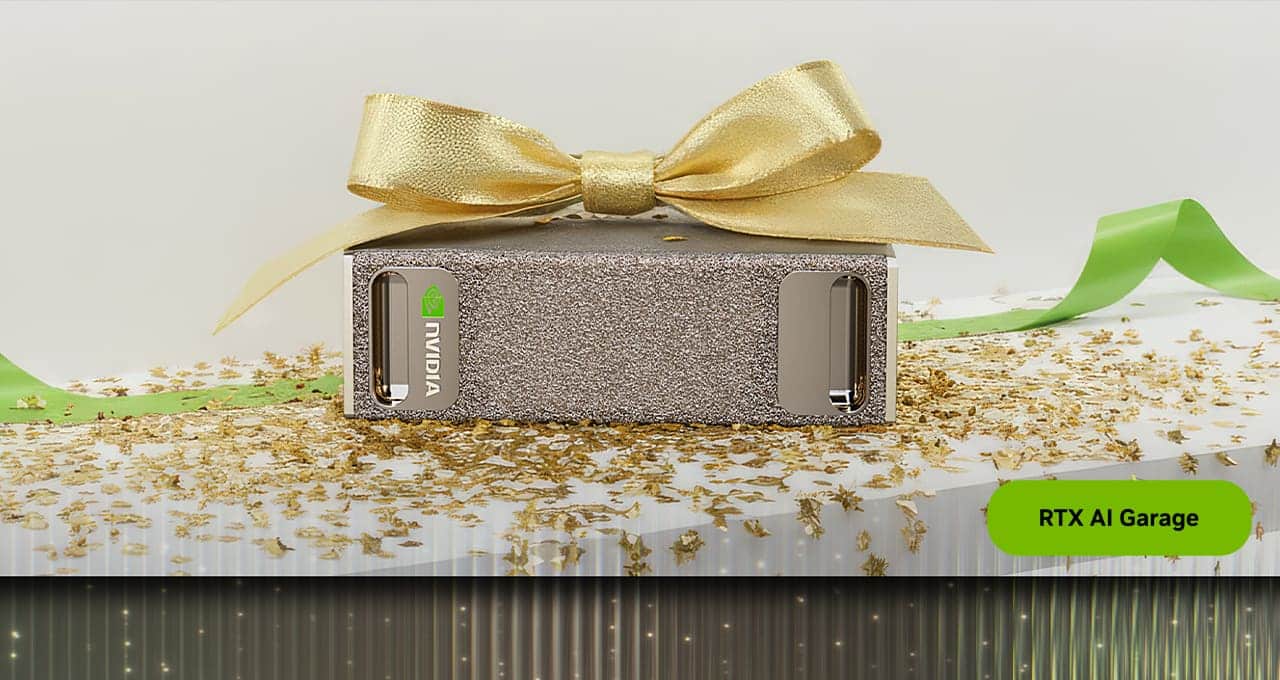
NVIDIA has once again shifted the landscape of personal computers with RTX Spark, a platform developed jointly with Microsoft to bring advanced AI capabilities directly to Windows devices. The proposal goes beyond simply adding a powerful GPU to a laptop or mini PC. Its goal is more ambitious: to create a new category of machines designed to run personal agents, generative models, and local AI workloads without always relying on the cloud.
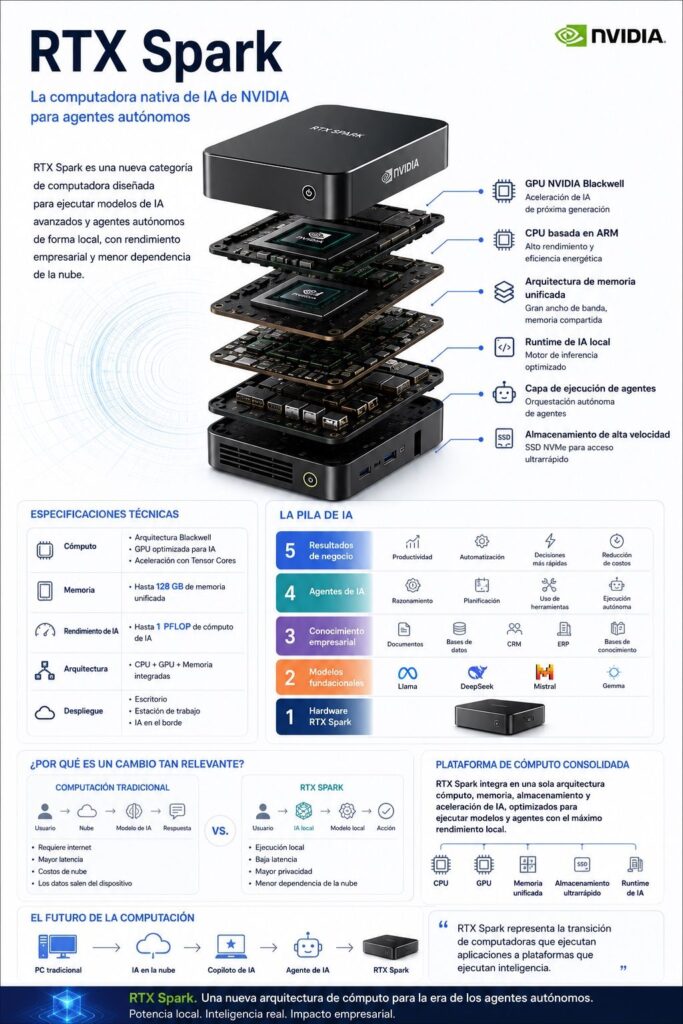
The announcement arrives at a time when the industry is trying to define what a truly “AI PC” will be. So far, many proposals have focused on adding an NPU to accelerate specific functions such as transcription, video calls, image generation, or small assistance tasks. RTX Spark aims at a different level: it combines Arm CPU, Blackwell GPU, up to 128 GB of unified memory, and the CUDA and RTX ecosystem to run more demanding workloads locally.
From Application-Running PC to Agent-Running PC
The core idea is clear. For decades, personal computers have been machines for running programs: word processors, spreadsheets, browsers, video editors, development environments, or games. With agent-centric AI, NVIDIA and Microsoft aim for the PC to start executing systems capable of interpreting instructions, querying information, operating tools, maintaining context, and performing tasks for longer periods.
RTX Spark is specifically designed for this kind of scenario. NVIDIA presents it as a platform for “personal agents,” with 1 petaflop of AI performance, up to 128 GB of unified memory, and a full stack of AI and graphics technologies. This combination is important because many models not only require computational power but also sufficient memory to stay loaded, work with broad contexts, and run inference smoothly.
Microsoft, on its part, frames the announcement as a new chapter for Windows. The company discusses devices accelerated by RTX Spark aimed at developers, creators, and advanced users, supporting a new generation of agents. The collaboration also includes security elements and native execution so these agents can operate on the main device more securely.
| Element | What RTX Spark Brings | Why It Matters |
|---|---|---|
| Blackwell GPU | AI and RTX graphics acceleration | Enables local execution of models, inference, and creative workloads with more performance |
| Arm CPU | General-purpose cores with high efficiency | Enhances autonomy and performance in laptops and compact devices |
| Up to 128 GB of unified memory | Shared memory for CPU and GPU | Makes it easier to work with large models and broader contexts |
| 1 petaflop of AI | Peak performance for AI workloads | Brings capabilities traditionally limited to data centers or cloud infrastructure |
| CUDA and RTX | NVIDIA’s development and acceleration ecosystem | Maintains continuity with tools familiar to developers and creators |
| Windows native for agents | Integration with Microsoft and new security mechanisms | Aims to run agents on the main PC without always relying on the cloud |
| Device formats | Slims laptops and mini PCs | Brings local AI to everyday devices, not just specialized workstations |
| Use focus | Personal agents, creation, development, and gaming | Blends productivity, AI, creativity, and graphics on a single platform |
Local AI, Privacy, and Reduced Cloud Dependence
The significance of RTX Spark goes beyond the raw numbers. The interesting part is the architectural shift it proposes. If a device can run advanced models and agents locally, many tasks can be done without relying completely on external data centers. This can reduce latency, improve privacy, lower the cost of intensive uses, and enable organizations to handle sensitive data without constantly transmitting it to remote services.
This doesn’t mean the cloud will lose importance. Larger models, large-scale training, and many enterprise applications will still require specialized data centers. But the balance might shift. Hybrid workloads will become more common: some tasks on the device, some on corporate servers, and some in public cloud. For businesses, developers, and creative professionals, this flexibility might be more valuable than an abstract race for maximum TOPS.
NVIDIA previously demonstrated a similar vision with DGX Spark, aimed at developer workstations, featuring 128 GB of unified memory and the ability to work locally with models of up to 200 billion parameters in certain scenarios. RTX Spark brings this philosophy to the broader Windows PC market, with partners like Acer, Asus, Dell, Gigabyte, HP, Lenovo, and MSI featured on the platform’s official webpage.
Unified memory is a key element. Traditional configurations often have CPU and GPU working with separate memories, which limits the size of models that can be comfortably run and forces data transfers between subsystems. A shared memory architecture simplifies this flow and better leverages the device’s total capacity for inference and AI applications.
A Challenge for Intel, AMD, and the Copilot+ Concept PC
RTX Spark also carries a competitive edge. NVIDIA isn’t content with just selling discrete GPUs for laptops and desktops. With this platform, it more directly enters designing the full PC, combining CPU Arm, Blackwell GPU, memory, and software. This move puts pressure on Intel, AMD, and Qualcomm, which have been competing for months to define the future of AI-enabled PCs.
NVIDIA’s approach is distinct because it leverages a very concrete advantage: its AI acceleration ecosystem. CUDA, Tensor Cores, RTX, inference libraries, and developer tools are already integrated into many workflows. If this foundation is embedded into slim, compact Windows devices with sufficient memory, the case for other AI chips in PCs becomes stronger.
However, the promise will need to prove itself in real-world use. While the announced AI performance is impressive, actual user experience will depend on compatibility, battery life, cooling, price, software support, local model support, and Windows’ ability to manage agents securely. Compatibility with x86 applications on Arm devices and the performance of games, professional tools, and enterprise software must also be evaluated.
The first RTX Spark devices are expected in fall 2026, according to NVIDIA and Microsoft. The companies have also emphasized maintaining compatibility with the Windows ecosystem, ensuring users can run their usual applications alongside new AI experiences.
Approaching a Personal AI Workstation
RTX Spark envisions a broader transition. The PC stops being just an access point to cloud services and begins reclaiming its role as a node of intelligent computing. Instead of sending each request to a remote server, the device can run models, keep agents active, work with local documents, assist in software development, accelerate content creation, and provide low-latency responses.
For professionals, this could mean assistants reviewing entire projects, agents automating repetitive tasks, models working with private data, faster creative tools, and enterprise applications combining local data with cloud services. For companies, it opens the door to more controlled AI environments, especially in workplaces where privacy, latency, or inference costs are critical.
The risk lies in overpromising. Not all users need this type of machine, and not all AI tasks make sense to run locally. Moreover, the true value of agents depends not just on hardware but also on their ability to operate with proper permissions, context, memory, security, and oversight. A powerful agent on a personal computer could also become a new risk vector if it accesses too much data or executes actions without clear controls.
The most reasonable takeaway is that RTX Spark won’t replace the cloud nor turn every laptop into a data center. But it does point toward a direction: part of the intelligence that currently resides in remote servers will start executing on the user’s own device. NVIDIA proposes it as a new architecture for the era of autonomous agents. If this approach succeeds, the AI-capable PC will no longer be just a marketing term but will closely resemble a local smart computing platform.
Frequently Asked Questions
What is NVIDIA RTX Spark?
RTX Spark is a NVIDIA platform for Windows PCs focused on personal agents and local AI. It combines Arm CPU, Blackwell GPU, up to 128 GB of unified memory, and CUDA and RTX technologies.
How does it differ from a PC with an NPU?
Many PCs with NPUs accelerate specific low-power AI functions. RTX Spark offers a more powerful architecture, with Blackwell GPU and substantial unified memory, designed for more demanding models and agents.
Does RTX Spark replace the cloud?
No. Cloud will still be necessary for large-scale training and very big models. RTX Spark aims to run more AI tasks locally, reducing latency, external dependence, and data transmission in certain cases.
When will the first RTX Spark devices arrive?
NVIDIA and Microsoft have scheduled the first RTX Spark devices for fall 2026, with several laptop and mini PC manufacturers participating.
via: LinkedIn
