
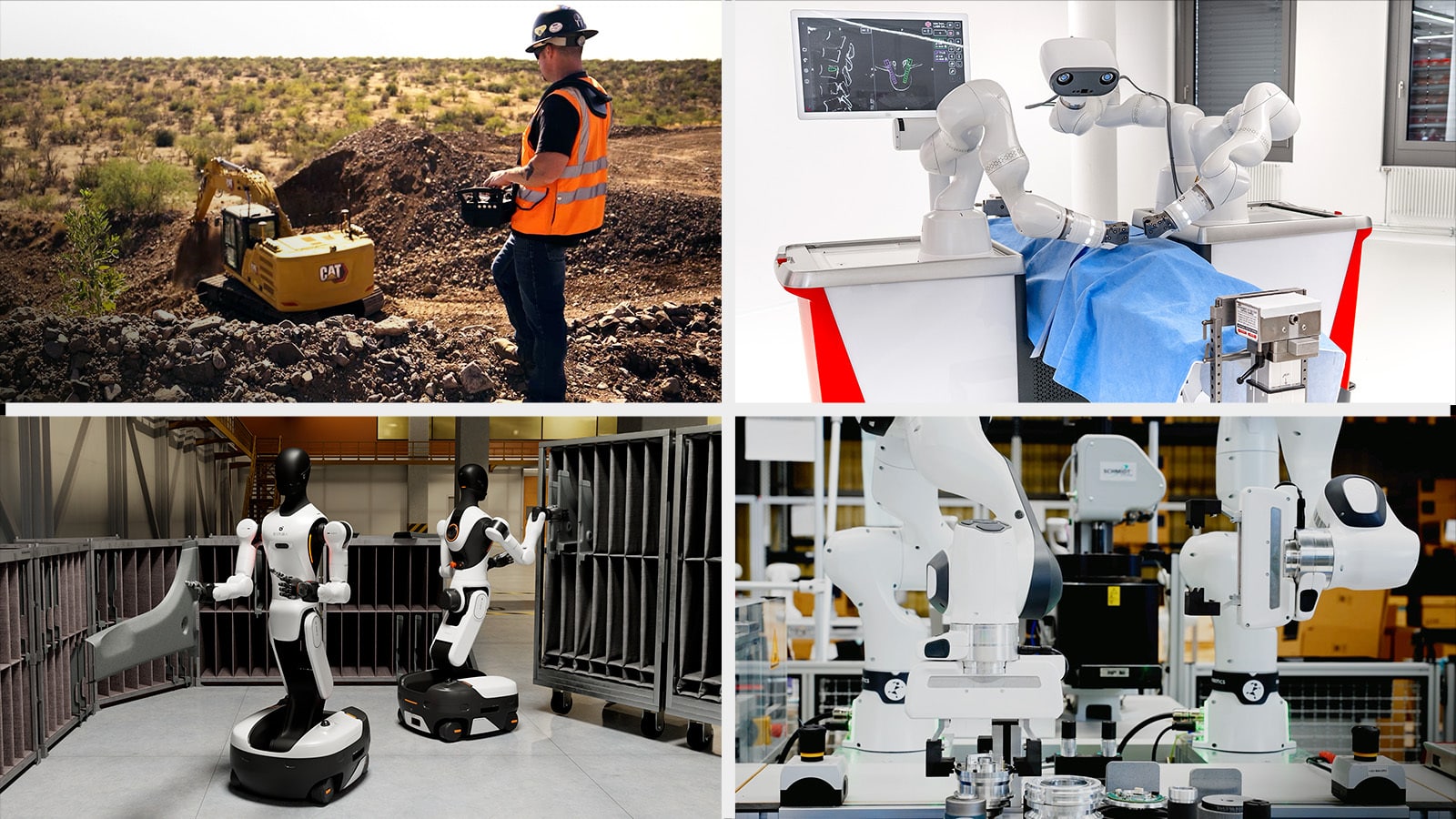
Investment in robotics is having an exceptional year. Robotics startups had raised $18.8 billion worldwide by mid-2026, already surpassing the $15 billion raised throughout all of 2025, according to Crunchbase data. At the same time, SoftBank is finalizing its purchase of ABB Robotics for $5.375 billion, and NEURA Robotics has announced a round of up to $1.4 billion. Capital is pouring into what’s being called Physical AI, though this broader robotics boom shouldn’t be confused with the much narrower soft robotics market.
Robotics investment in 30 seconds
- Robotics startups had raised $18.8 billion in 2026 through June, according to Crunchbase.
- SoftBank agreed to buy ABB Robotics for $5.375 billion and expects to close the deal during 2026.
- NEURA Robotics announced a Series C of up to $1.4 billion.
- 542,000 industrial robots were installed worldwide in 2024, according to the IFR.
- Soft robotics could benefit from this investment wave, but it’s a specific segment that shouldn’t be confused with all of Physical AI.
A report from Next Move Strategy Consulting (NMSC) places soft robotics precisely among the markets that could benefit from this wave. The firm estimates the segment was worth $1.89 billion in 2024 and could reach $13.38 billion by 2030, with a compound annual growth rate of 38.6% between 2025 and 2030.
That’s a commercial forecast from the consulting firm itself, not an observed figure of the market’s future size. The distinction matters especially in a sector where definitions vary: a humanoid, a collaborative robot or an industrial arm with artificial intelligence doesn’t automatically qualify as soft robotics.
Soft robotics is defined by the use of deformable structures, flexible materials and mechanisms that can physically adapt to the object or environment they interact with. That covers everything from grippers that handle food without damaging it to medical devices, prosthetics, exoskeletons and actuators built from elastomers and other flexible materials.
Money is flowing into robotics, but mostly because of physical AI
One of the most striking figures comes from Crunchbase.
As of June 22, 2026, robotics startups had raised $18.8 billion during the year. That was more than the $15 billion raised in all of 2025 and also surpassed the $14.1 billion recorded in 2021, until then one of the sector’s highs.
The figure covers funding for robotics startups broadly, not exclusively soft robotics.
Part of the shift is tied to the development of AI models capable of interpreting images, language and other signals to control physical systems. The industry has grouped much of this trend under terms like embodied AI or Physical AI.
The appeal for investors lies in carrying some of generative AI’s progress off the screen and into machines capable of acting in the physical world.
SoftBank’s move fits directly into this trend.
In October 2025, the Japanese group signed an agreement to acquire ABB Robotics for $5.375 billion. The deal is still subject to customary conditions and regulatory approvals, and SoftBank still expects to complete the acquisition sometime between mid- and late 2026.
Masayoshi Son, SoftBank’s chairman and CEO, explicitly framed the deal around Physical AI.
ABB had announced months earlier its intention to spin off Robotics into an independent, publicly traded company. SoftBank’s offer changed that plan.
The acquired division has around 7,000 employees and had generated approximately $2.3 billion in revenue in 2024, about 7% of ABB Group’s total revenue.
| Move | Amount announced | Status |
|---|---|---|
| Global robotics startup funding in 2026 through June | $18.8 billion | Crunchbase data |
| SoftBank’s purchase of ABB Robotics | $5.375 billion | Pending close |
| NEURA Robotics Series C | Up to $1.4 billion | Announced June 2026 |
| Global robotics startup funding in 2025 | $15 billion | Full year |
Another especially relevant example comes from Germany.
NEURA Robotics announced a Series C of up to $1.4 billion on June 10, led by Tether, with announced participation from investors and partners including Qualcomm Technologies, Amazon, NVIDIA, Bosch, Schaeffler, the European Investment Bank and imec.xpand, among others.
The phrase “up to $1.4 billion” also deserves attention. It’s the maximum announced size of the round and shouldn’t automatically be presented as $1.4 billion already disbursed.
NEURA develops humanoids, robotic arms, mobile robots and other cognitive robotics platforms. Again, it’s a good example of the growth of Physical AI, but not a pure soft robotics investment.
542,000 industrial robots installed, and China with more than half the market
The financial investment coincides with an industrial market that already operates at considerable scale.
The International Federation of Robotics (IFR) counted 542,000 new industrial robots installed during 2024. That was the second-highest annual figure on record, just 2% below the peak reached in 2022.
For four consecutive years, global installations have stayed above 500,000 units.
The global operational stock of industrial robots reached 4.664 million units in 2024, up 9% year over year.
The geographic breakdown also shows where automation’s center of gravity is shifting.
| Region | Share of new installations in 2024 |
|---|---|
| Asia | 74% |
| Europe | 16% |
| Americas | 9% |
China alone accounted for roughly 54% of global installations, with 295,000 robots.
There’s another important shift. For the first time, Chinese manufacturers overtook foreign suppliers within their own domestic market, reaching a 57% share, according to the IFR. About a decade earlier, they held around 28%.
Europe moved in the opposite direction during 2024.
European installations fell 8%, though the result was still the second-highest ever recorded in the region. Germany installed around 27,000 units and kept its position as Europe’s leading market.
The gap between Europe and Asia matters for soft robotics because building commercially viable robots takes more than algorithms.
Actuators, gearboxes, motors, sensors, cameras, power electronics, batteries, materials and manufacturing capacity form an industrial supply chain where scale can significantly cut costs.
AI can improve a machine’s autonomy, but it doesn’t eliminate the need to actually build it.
Soft robotics is trying to solve a problem rigid robots have spent decades avoiding
Much of traditional industrial automation works because the environment is carefully controlled.
A robot knows where it will find a part, what shape it will have and how it needs to move it. Factories design cells, cages, conveyor belts and fixtures specifically to reduce unexpected situations.
Soft robotics aims to work better once that rigidity stops being an advantage.
A conventional gripper can handle thousands of identical parts with enormous speed and precision. The problem shows up when it has to pick up tomatoes, bread, fruit, irregularly shaped products or fabric without crushing them.
A flexible gripper can deform around the object and distribute pressure.
That principle explains why one of the most developed markets for this technology is food handling.
It also has obvious applications in logistics, where warehouses hold objects of very different sizes, weights and shapes.
In medicine, flexibility opens other possibilities. Devices that interact directly with the human body can benefit from deformable structures and materials that reduce concentrated forces. Soft exoskeletons and robotic garments also aim to provide assistance without necessarily relying on rigid metal structures.
The difficulty lies in controlling these machines.
A rigid industrial arm can be modeled mathematically with considerable precision because its joints have defined movements. A soft structure can deform at many points simultaneously.
Adding artificial intelligence can help interpret sensors, cameras and forces to adjust movement in real time, but it also increases the system’s complexity.
That’s where one of the real connections between the current AI boom and soft robotics appears.
Vision models, reinforcement learning, planning and multimodal models can let a robot adapt better to objects and situations that weren’t precisely defined during its programming.
But there’s still a considerable distance between a lab demo and a machine that can repeat an operation millions of times on a factory floor.
Material durability, precision, maintenance, cost, integration and safety remain significant obstacles.
That also explains why this market’s growth forecasts need to be read with caution. NMSC’s projected 38.6% annual growth would mean very rapid expansion, but it will depend on technologies that work today in specific applications being manufactured and deployed at much greater scale.
Record robotics investment during 2026 provides the capital to try.
The ABB Robotics purchase shows that SoftBank is willing to pay billions to take part in the convergence between artificial intelligence and physical machines. NEURA’s round reflects interest in new cognitive robot makers. And the IFR’s figures show that industrial automation isn’t starting from zero: there are already nearly 4.7 million industrial robots working around the world.
Soft robotics occupies a smaller slice of that market.
Its opportunity lies precisely in tasks that remain hard to automate because they involve delicate objects, human bodies or environments too variable for traditional rigid robots.
The money flowing into Physical AI could accelerate its development, but it’s still an open question how much of that investment will end up as commercially deployed soft robots and how much will concentrate on humanoids, industrial arms and other conventional architectures equipped with better AI models.
