
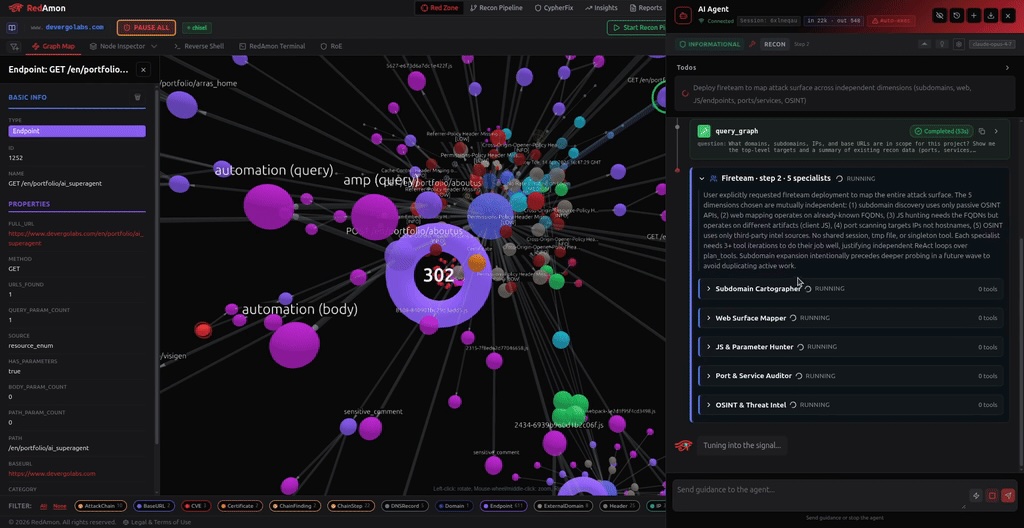
Offensive cybersecurity is entering a new phase. Until recently, discussing an autonomous red team sounded like a laboratory demo, a vendor promise, or an overly ambitious presentation. Today, open-source frameworks capable of chaining reconnaissance, exploitation, post-exploitation, findings analysis, and code remediation within a local container-based architecture are starting to emerge.
RedAmon is one of the clearest examples of this trend. The project presents itself as an AI-driven autonomous red team framework that automates offensive operations from reconnaissance to exploitation and post-exploitation. Additionally, it incorporates a remediation layer, CypherFix, capable of correlating vulnerabilities, cloning repositories, applying changes, and opening pull requests with the proposed fix.
For a technology and server-focused media outlet, the most interesting aspect isn’t just the AI component. It’s the architecture. RedAmon isn’t a remote API that someone consumes without knowing where it runs. It’s a containerized platform deployed on private infrastructure, with separate services, databases, Kali sandbox, Neo4j graph, PostgreSQL, agents, orchestrators, scanning tools, and support for external or local models.
This detail changes the conversation. Autonomous pentesting ceases to be solely a cloud service and starts to resemble a workload that a technical team can deploy within their own environment. But just because something can be installed on a server doesn’t mean it’s ready for production without proper criteria.
An offensive stack packaged in containers
RedAmon is built around Docker and Docker Compose. The project documentation states that it’s unnecessary to install Node.js, Python, or security tools directly on the host. Everything runs inside containers, with different services for the web app, agent, recognition orchestrator, database, Neo4j, Kali sandbox, and optional modules like GVM/OpenVAS or the local knowledge base.
A lightweight installation can operate with 2 cores, 4 GB of RAM, and 20 GB of free disk space. Enabling GVM/OpenVAS increases requirements to 4 cores, 8 GB RAM, and 50 GB disk, with 16 GB RAM recommended. These aren’t prohibitive figures, but they aren’t trivial either. An offensive pipeline involving scanners, graphs, models, and dynamic containers consumes resources and must be planned as a serious workload.
| Component | Function within RedAmon |
|---|---|
| Webapp | Next.js interface for projects, configuration, reports, and visualization |
| Agent Orchestrator | Autonomous agent based on LangGraph and ReAct pattern |
| Recon Orchestrator | Container management and reconnaissance pipeline |
| Kali sandbox | Isolated environment with offensive tools |
| Neo4j | Attack surface graph and relationships between findings |
| PostgreSQL | Configuration, users, and project data |
| GVM/OpenVAS | Network vulnerability scanning, optional |
| CypherFix | Triage, remediation, and pull request generation |
This architecture is powerful because it separates responsibilities. Reconnaissance can run in parallel; results become a queryable graph; the agent makes decisions with context; and tools are launched within a controlled environment. However, it also adds operational complexity: volumes, permissions, secrets, updates, resources, logs, internal network, internet access, and host isolation.
In servers, the key question isn’t whether the tool can start, but how it’s managed.
The pentesting server shouldn’t be just any server
RedAmon’s own documentation warns that it’s designed for local use and has not been hardened for exposed internet deployments. That statement alone should prevent many poor decisions. A framework capable of launching reconnaissance, offensive tools, agents, and post-exploitation should not be published as if it were just another web panel.
The prudent approach is to treat it as a lab environment or a highly restricted internal platform. Never expose it on a public VPS without protections. Never leave it behind a weak password. Never mix it with production servers. Never grant broad network access beyond the explicitly intended scope.
In a professional setting, such a platform should run on an isolated network, with limited access via VPN or jump server, strong authentication, segmentation, logging, controlled backups, and a clear usage policy. It’s also wise to separate the RedAmon environment from critical business loads—not because RedAmon is inherently insecure, but because any autonomous offensive tool increases risk if operated without limits.
The documentation mentions safeguards such as engagement rules, human confirmations for dangerous tools, and deterministic blocks for certain sensitive domains. These are necessary measures. Nonetheless, the external technical control remains the responsibility of the deploying entity.
The offensive engine is commoditized; operations are not
RedAmon signals a market shift. Many capabilities that previously required assembling a full team are starting to be packaged into open frameworks: parallel reconnaissance, scanner integrations, attack graphs, context-aware agents, local or remote models, reports, and AI-assisted remediation.
This doesn’t eliminate security work—it shifts it.
The value won’t be just in running Nmap, Nuclei, OpenVAS, Metasploit, Hydra, or crawlers. Nor will it be in claiming to use AI. These components will become increasingly accessible. The difference will be designing a secure, repeatable, auditable, and production-ready process.
A CISO doesn’t just need “an offensive engine.” They need a framework: defined scope, execution windows, intensity controls, human approval points, evidence collection, audit trail, prioritization by real risk, integration with repositories, validation of fixes, and traceability for audits or internal reviews.
| Engine | Operational framework |
| Recon and exploitation tools | Scope rules and authorized windows |
| Autonomous AI agents | Human confirmations and execution limits |
| Vulnerability scanners | Prioritized by context and criticality |
| Attack graph | Audit trail and traceability between sessions |
| Automated pull requests | Human review, testing, and validation |
| Technical reports | Evidence useful for compliance and management |
This distinction is crucial for companies considering these tools internally. Setting it up at home makes sense if there’s an experienced technical team familiar with offensive security and operational capacity. But if the organization maintains dozens of tools, deals with incompatibilities, reviews licenses, tunes models, and responds to incidents, the actual cost is no longer zero.
Open-source software can eliminate license costs but doesn’t eliminate responsibility.
Local AI, external models, and technical sovereignty
Another important aspect of RedAmon is its support for multiple model providers: OpenAI, Anthropic, OpenRouter, AWS Bedrock, and OpenAI-compatible endpoints like Ollama, vLLM, LM Studio, or Groq. This enables combining frontier models with local or self-hosted infrastructure.
For server teams, this detail matters. If an offensive framework needs to send sensitive context, findings, routes, configs, or code snippets to an external provider, questions about privacy, compliance, and dependency arise. Not all environments can afford this. Using local or self-hosted models offers more control, though it demands greater compute capacity and maintenance effort.
RedAmon also includes an optional local knowledge base with a RAG pipeline that queries security datasets before resorting to external searches. This aligns with a broader trend: keeping part of the intelligence close to the data to reduce cost, latency, and exposure.
A hybrid architecture is likely the most practical approach—using external models for complex reasoning or tasks where they add value, and local models for repetitive queries, classification, enrichment, or sensitive processes. The key is deciding what remains within the environment and what can go outside.
From lab to managed service: a big leap
The temptation with tools like RedAmon is to think that installing, configuring models, and starting automation is enough for pentesting. This approach might be suitable for learning, research, or concept validation. But in a business environment, the jump is substantial.
It’s necessary to define who can trigger tests, against what targets, with what intensity, which tools require approval, what results are considered valid, how evidence is stored, who reviews pull requests, how to prevent affecting production outside scope, and what happens if a scan causes impact.
Licensing also needs review. While RedAmon is released under MIT, it integrates third-party tools with different licenses. The documentation explicitly states that WPScan operates under its own license and certain commercial uses may require separate licensing. In managed services, these nuances are critical.
For infrastructure providers, MSPs, MSSPs, and platform teams, RedAmon is a wake-up call. The future of offensive security won’t just be consultants running tools manually, nor will it be autonomous agents attacking production systems blindly. It will be a blend of automation, control, governance, and human oversight.
RedAmon demonstrates that the engine is now reaching open source. The next question is: who can build around it a secure operational environment?
Frequently Asked Questions
What is RedAmon?
RedAmon is an open-source autonomous red team framework that automates reconnaissance, exploitation, post-exploitation, findings analysis, and remediation via pull requests.
Is it installed on private infrastructure?
Yes. It’s designed as a containerized platform based on Docker and Docker Compose, with multiple internal services such as web app, agent, Kali sandbox, Neo4j, and PostgreSQL.
What resources does it require?
A lightweight setup starts with 2 cores, 4 GB RAM, and 20 GB disk. With GVM/OpenVAS activated, the recommended specs are 4 cores, 8 GB RAM, and 50 GB disk, with 16 GB RAM advised.
Can it be exposed as a standard web panel on the internet?
It should not. The documentation states it’s meant for local use and has not been hardened for public deployment. It must run in controlled, restricted environments.
What’s the added value over standalone tools?
It integrates tools, agents, attack graphs, engagement rules, session memory, reports, and remediation in a unified architecture. Its main strength lies in coordinating the workflow, not just launching scans.
Source: Open Security
