
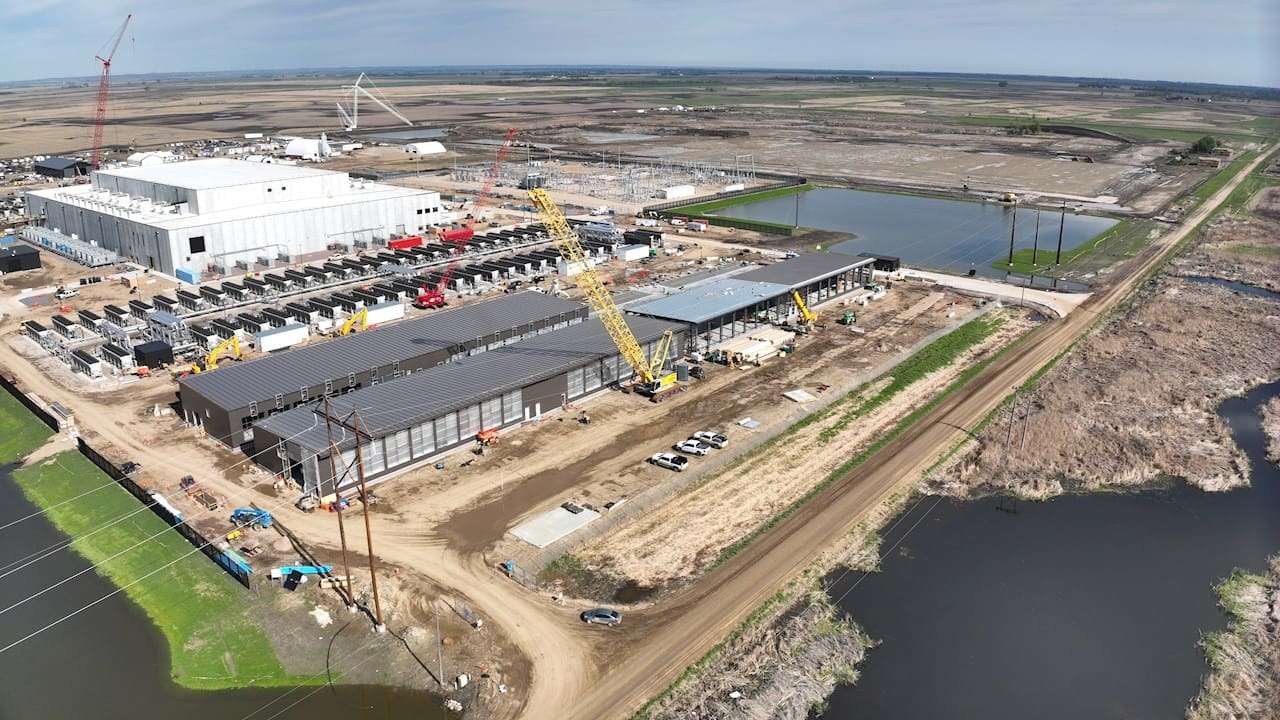
Cloud Capital and Realty Income have formed a new joint venture to invest in hyperscale data centers, with an initial portfolio valued at over $6 billion. The move kicks off with stakes in three assets located in northern Virginia, the largest data center market in the world, reaffirming a growing trend: AI and cloud infrastructure are becoming a top-tier real estate product for major institutional investors.
The operation also includes an unidentified global institutional investor. The new strategy, called Core Joint Venture Strategy, will focus on stabilized assets leased to investment-grade hyperscale clients under long-term triple-net lease contracts. In this type of agreement, common in U.S. corporate real estate, the tenant takes on significant costs such as taxes, insurance, and maintenance, providing greater predictability for the owner.
Three data centers in Virginia as a starting point
The joint venture has committed to acquiring three data centers in northern Virginia. The first is already stabilized, while the other two are under development. Exact details about the facilities and tenants have not been disclosed, though the companies have indicated they involve hyperscale clients with investment-grade ratings and contracts ranging from 15 to 20 years.
Realty Income aims to invest up to $1.4 billion in the portfolio and plans to finance an initial investment of around $700 million between the second and third quarters of 2026. The company will initially acquire a 45% stake in the first stabilized data center and a similar stake in the other two assets as they progress in development. Cloud Capital will retain a minority stake in the portfolio.
CloudHQ, a sister company of Cloud Capital, will handle asset management and development services for the portfolio. This is noteworthy because data center business no longer resembles traditional real estate: it requires technical capacity, relationships with hyperscalers, energy management, permits, cooling, specialized construction, and coordination with clients that operate on very tight schedules.
| Operational Element | Details |
|---|---|
| Initial asset value | Over $6 billion |
| Number of initial assets | Three data centers |
| Location | Northern Virginia |
| Client type | Investment-grade hyperscalers |
| Contract length | 15-20 years |
| Lease structure | Triple-net lease |
| Planned Realty Income investment | Up to $1.4 billion |
| Initial Realty Income stake | 45% in the first asset |
| Operational manager | CloudHQ |
The target is not limited to Virginia. The companies have indicated that the vehicle can invest in facilities across the U.S. and Europe, regions where demand continues to grow due to cloud consumption, generative AI, and the need for denser infrastructure.
The entry of real estate capital into physical AI
Realty Income is not a small player. Founded in 1969, the company owns more than 15,500 properties across the U.S. and Europe and is known for its long-term recurring rental model. Its most pronounced entry into data centers demonstrates how the sector has shifted from being solely a technical business for specialized operators to becoming an attractive asset class for funds, REITs, and institutional investors.
The appeal lies in the combination of structural demand, long-term contracts, and highly solvent clients. Hyperscalers require large-scale capacity for cloud and AI. Investors seek assets capable of generating stable cash flows over years. The intersection of these interests explains deals like this one.
The triple-net structure is especially convenient for a real estate investor because it reduces some operational burdens for the owner. However, in data centers, there’s an important difference: even if the contract assigns responsibilities, the asset still depends heavily on technical factors such as available power, connectivity, redundancy, cooling, permits, electrical density, and capacity for expansion.
That’s why the partnership with Cloud Capital and CloudHQ makes sense. Realty Income contributes capital and experience in long-term real estate structures. Cloud Capital brings expertise in data centers. CloudHQ provides development and operational management. The goal is to combine financial stability with technical execution.
Virginia still at the center despite pressures
Northern Virginia, especially the Ashburn area, remains the world’s leading market for data centers. Its concentration of connectivity, cloud clients, operators, and specialized land has made it an almost unavoidable hub for major deployments. But this position also brings challenges: electrical availability, permits, local opposition, land and substation competition, and territorial impact.
The fact that the joint venture is starting there is no coincidence. Stabilized assets with long-term contracts in Virginia have become highly sought-after products. For investors, they offer direct exposure to hyperscale demand without necessarily assuming all the risks involved in developing a new market from scratch.
The deal also occurs amid a context of active corporate activity in the same region. Digital Realty announced earlier this week that it acquired Blackstone’s stake in three Virginia data centers in a $3.5 billion transaction, valuing the assets at $7.8 billion, including debt and expected CapEx. While not directly comparable, this highlights investor appetite for hyperscale capacity in Virginia.
From technology provider to financial asset
The broader message is that data centers are increasingly being financed as critical infrastructure. AI growth has boosted capacity needs but also amplified capital requirements. Building data centers for AI workloads demands more power, cooling, electrical work, specialized equipment, and faster network connections. Few operators can shoulder all these demands with their own balance sheets alone.
This has led to more joint ventures, partial sales, sale and leaseback arrangements, REIT-operator alliances, and specialized funds. Digital infrastructure needs patient capital, and real estate investors seek exposure to markets with seemingly sustainable demand.
The risk lies in assuming that a long-term contract equals a problem-free asset. AI infrastructure is subject to rapid technical changes: rack densities increase, liquid cooling becomes more prevalent, network requirements evolve, and hyperscale clients hold significant negotiation power. Additionally, energy availability can be more limiting than funding.
For Realty Income, this deal deepens its engagement in a category that could diversify its traditional portfolio. For Cloud Capital, it strengthens its investment and management platform. The firm, founded in 2020 as an investment affiliate of CloudHQ, reports managing over $12 billion in data center assets, with 30 facilities and more than 330 MW of contracted IT load across over 4.2 million square feet.
The market’s message is clear: data centers are no longer just buildings filled with servers. They are financial, energy, and technological assets. AI is accelerating this transformation by turning compute capacity into a recurring, long-term necessity.
While cloud adoption made data centers essential infrastructure, AI is transforming them into one of the most contested assets in the global real estate market.
Frequently Asked Questions
What have Cloud Capital and Realty Income announced?
They have created a joint venture to invest in hyperscale data centers, starting with a portfolio of three assets in northern Virginia valued at over $6 billion.
How much will Realty Income invest?
Realty Income plans to invest up to $1.4 billion, with an initial commitment of around $700 million expected between Q2 and Q3 2026.
What type of data centers will the joint venture acquire?
The vehicle will focus on hyperscale assets leased to investment-grade clients via long-term contracts of 15-20 years under a triple-net lease structure.
What role will CloudHQ play?
CloudHQ, a sister company of Cloud Capital, will provide property management and development services for the portfolio.
Why does this deal matter?
It demonstrates how cloud and AI demand is attracting institutional real estate capital into data centers, a sector becoming increasingly strategic and costly to develop.
