
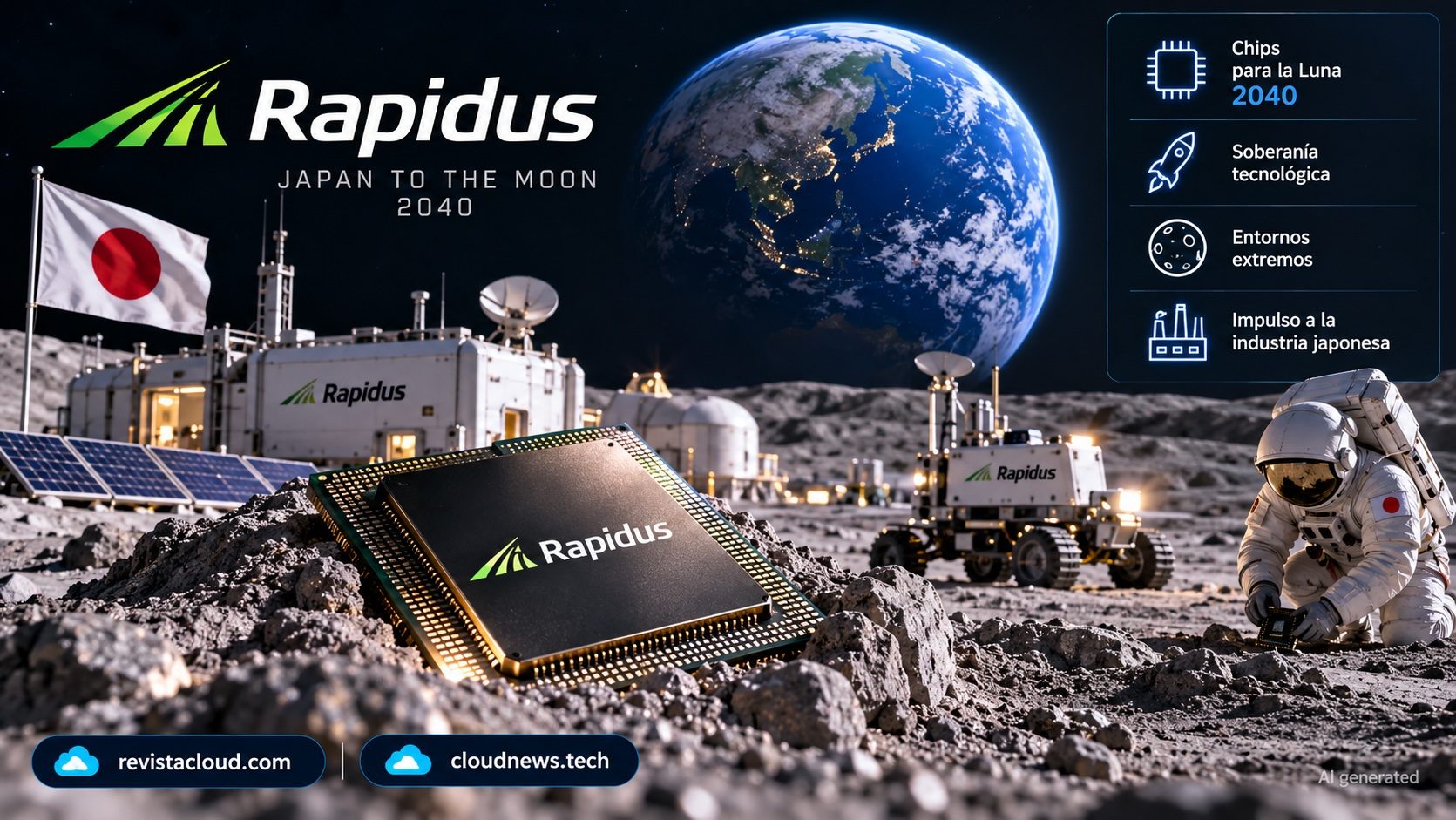
Rapidus, the Japanese company created to rebuild advanced semiconductor manufacturing capacity, is considering building a chip fab on the Moon around 2040. Its president and CEO, Atsuyoshi Koike, presented the idea on September 10 in Washington and said it isn’t a joke, although for now it remains a long-term proposal and there is no lunar construction underway.
Rapidus’s lunar fab in 20 seconds
- Rapidus is considering a semiconductor fab on the Moon around 2040.
- The company is looking at ice at the lunar poles as a possible water source for making chips.
- Its immediate project is still producing 2nm semiconductors in Japan starting in 2027.
- Japan has committed billions of yen to accelerate the Rapidus project.
- The lunar fab is still a technology vision, not an approved or under-construction plant.
The idea sounds like something out of a science fiction movie, but the proposal is real and was publicly presented by Rapidus’s top executive. Koike even showed an AI-generated video depicting a future semiconductor fab on the lunar surface. The company puts the timeline at around 2040.
Rapidus’s reasoning has to do with one of the most important resources for making chips: water. Water ice has been detected in the permanently shadowed regions of the lunar poles. If it could eventually be extracted, processed, and turned into water with the purity level needed, it could be used as a local resource for certain industrial processes.
The proposal, then, doesn’t start solely from the idea of manufacturing technology off Earth. It also tries to solve one of the logistical problems of bringing a semiconductor fab to a place where practically everything would have to be shipped from our planet.
Water is one piece of the plan
Semiconductor manufacturing uses large amounts of ultrapure water to clean wafers during the different stages of the process. In an Earth-based fab, this infrastructure is part of an industrial complex with specialized treatment and recycling systems.
On the Moon, continuously shipping water from Earth would add an enormous difficulty to a facility that would already have to deal with problems of power, communications, maintenance, radiation protection, and equipment transport.
Rapidus’s proposal is to study whether lunar resources could reduce part of that dependence. That doesn’t mean the detected ice can automatically become water suitable for a chip fab. Between finding ice and having infrastructure capable of extracting, purifying, and supplying it continuously, there is still an enormous technological gap.
For now, Rapidus hasn’t announced a lunar plant with a construction timeline, budget, or definitive industrial design. Koike’s statements should be understood as a business and technology vision for around 2040.
That difference matters, because the project currently absorbing the company’s resources is much closer to Earth.
Before the Moon comes the goal of making 2nm chips
Rapidus was founded in 2022 with the goal of developing and manufacturing advanced logic semiconductors in Japan. Its main industrial project is the IIM-1 fab in Chitose, Hokkaido, where it’s working to reach mass production of 2-nanometer chips during the second half of fiscal year 2027, part of a roadmap that, as covered in our report on how Rapidus is integrating AI, 2nm chips, HBM4, and advanced packaging, now spans well beyond manufacturing alone.
The company has already demonstrated 2nm transistor prototypes with a GAA (gate-all-around) structure. In July 2025, it announced that it had begun manufacturing prototype wafers and obtaining their electrical characteristics at the IIM-1 plant.
This is the project that helps explain why Japan is putting so many resources into Rapidus. The country is looking to rebuild its own capacity in advanced semiconductor manufacturing and reduce its dependence on other major Asian chipmakers.
In February 2026, Rapidus announced a funding round of ¥267.6 billion, with ¥100 billion coming from the Japanese government through the Information-technology Promotion Agency (IPA) and another ¥167.6 billion contributed by 32 companies. Participants include Canon, Fujitsu, NTT, SoftBank, and Sony Group.
In June, another public contribution of ¥150 billion followed. Rapidus said at the time that the company’s capital and capital reserves had reached ¥424.95 billion.
In addition, Japan’s Ministry of Economy, Trade and Industry approved an extra ¥631.5 billion in April for Rapidus’s research and development. Reuters reported at the time that accumulated public support for its R&D activities had reached ¥2.354 trillion.
The lunar fab is far further off than the next node
The 2040 proposal also needs to be put in perspective. Rapidus still has to turn its 2nm technology into large-scale industrial production and compete in a market dominated by manufacturers with far greater production capacity.
Its partnership with IBM is one piece of Japan’s technology project. Both companies are working on 2nm semiconductors and are also researching technologies around 1nm.
That’s why the lunar fab doesn’t represent the next step on Rapidus’s production roadmap. It’s a concept set much further out, conditional on space technologies maturing over the coming years in ways that don’t yet allow a conventional semiconductor fab to operate on the lunar surface.
It would also be necessary to work out how manufacturing equipment would even get there. A chip fab requires extremely precise lithography, deposition, etching, metrology, and contamination control systems. Getting them to the Moon and keeping them running would be a completely different challenge from building a fab on Earth.
On top of that is the need for a stable power source and systems capable of maintaining the environmental conditions required to manufacture circuits with extremely tight tolerances.
Koike’s idea, then, has a clear element of technology vision. Rapidus is laying out what might be possible if lunar infrastructure becomes mature enough over the coming decades. The Washington presentation itself used an AI-generated rendering, which underscores the conceptual nature of the proposal.
For Japan, the immediate goal is much more concrete: getting Rapidus to produce advanced 2nm semiconductors in Hokkaido during 2027. If that project moves forward as planned, the company will have an industrial base on which to build later technologies. The lunar fab, by contrast, still belongs to a horizon where much of the infrastructure needed to manufacture chips off Earth will have to be worked out first.
Frequently Asked Questions
Is Rapidus actually going to build a chip fab on the Moon?
Rapidus has proposed building a semiconductor plant around 2040, but for now it’s a long-term proposal. There is no lunar fab under construction.
Why does Rapidus want to use water from the Moon?
The company points to the possible availability of water ice in the permanently shadowed polar regions. If it could be extracted and purified, it could become a local resource for processes that require ultrapure water.
What is Rapidus building right now?
Its main project is the IIM-1 fab in Chitose, Hokkaido, aimed at developing and manufacturing advanced semiconductors. Rapidus’s goal is to start mass production of 2nm chips during the second half of fiscal year 2027.
How much money is Rapidus receiving from Japan?
Japan has committed significant public resources to the project. In April 2026, an additional ¥631.5 billion was approved for R&D, while Rapidus has also received public and private investment to advance toward 2nm production.
