
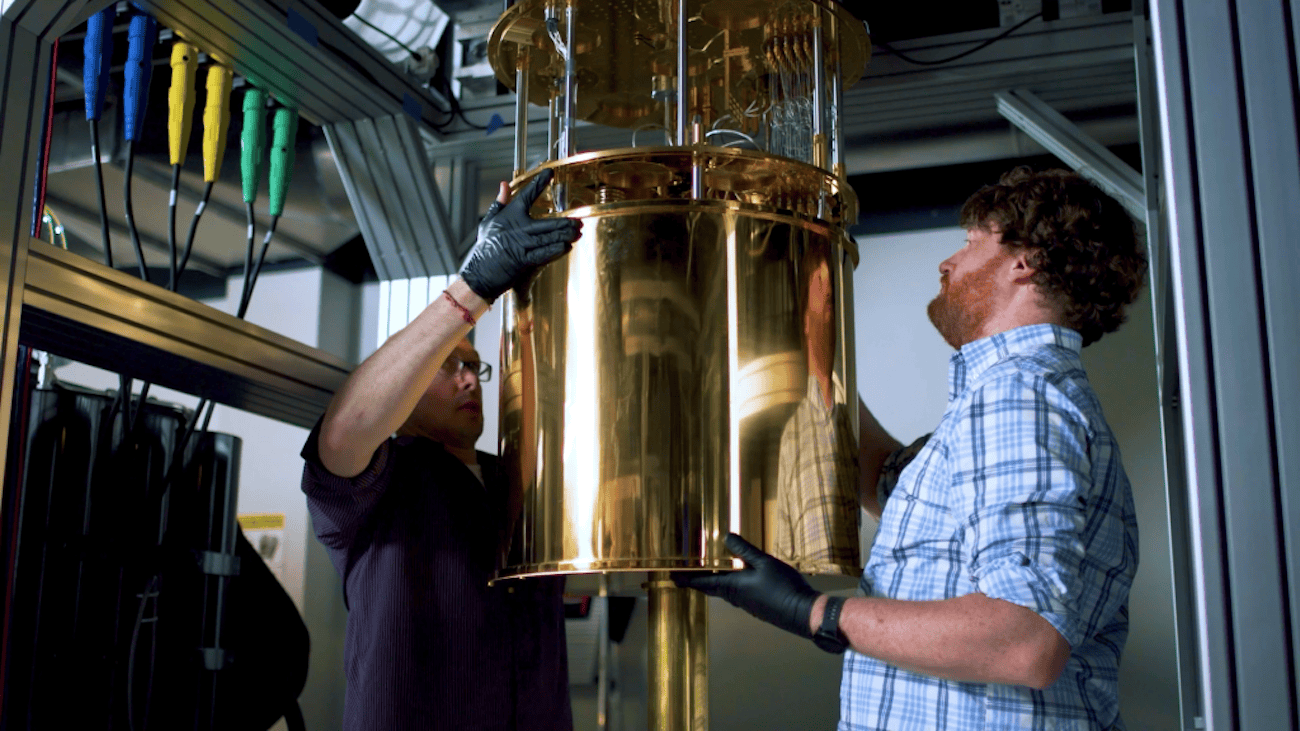
The experiment published by D-Wave in Science demonstrated that a specialized quantum processor could reproduce certain magnetic material simulations in minutes, which would be extremely costly for some classical methods. While this advance is significant, it does not mean that quantum computing has invalidated investments in data centers for AI, nor that it can replace GPUs used for training and running models.
The key points of the D-Wave experiment in 30 seconds
- D-Wave published a demonstration of quantum advantage in a specific physical simulation in Science.
- The comparison of nearly a million years applies to a classical method under specific conditions.
- The quantum system did not train an AI nor replace the usual work of a data center.
- Researchers have subsequently developed more competitive classical simulations for parts of the problem.
- Quantum computing aims to complement classical infrastructure, not eliminate it.
The claim that a quantum computer used 12 kW to solve a problem that Frontier would take nearly a million years to compute stems from estimates presented by D-Wave. The company compared its quantum annealing processor to classical simulations of spin system dynamics, a type of quantum physics problem where computational costs can grow rapidly with size.
This was not about training a large language model, processing videos, serving a generative application, or performing matrix operations that dominate AI workloads. It was a very specific simulation, further tailored to match the physical architecture of D-Wave’s processor.
That nuance completely changes the interpretation.
What D-Wave actually demonstrated
The work, published in March 2025 and later included in volume 388 of Science, used quantum annealing processors to study the out-of-equilibrium evolution of certain disordered magnetic systems.
Researchers analyzed how thousands of spins connected via a topology compatible with D-Wave hardware behaved. According to the paper, the processor generated samples that closely matched solutions to the Schrödinger equation for sizes where results could still be checked with classical methods.
The team concluded that no known method at the time could reproduce the largest simulations with comparable accuracy within a reasonable timeframe. For the most demanding comparison, D-Wave estimated that a GPU-based implementation would require nearly a million years and more energy than the world’s total annual electricity consumption.
This is an important demonstration of quantum capability, but the figure measures only the specific problem and the particular implementation under certain accuracy requirements, with the knowledge available at the time of the study.
This distinction matters because classical algorithms continue to improve. Shortly after, work appeared that used tensor networks, variational methods, and physical approximations to extend the sizes that can be simulated with conventional computers. Some achieved competitive results for parts of the regime studied by D-Wave, though they did not necessarily reproduce all the experimental conditions and precisions.
The boundary between quantum and classical does not shift permanently with a single publication. Each demonstration spurs improvements in classical algorithms, which in turn push the development of more demanding quantum tests.
The 12 kW energy figure doesn’t tell the full story
The energy attributed to the D-Wave system is often presented as if the entire simulation ran at a power comparable to a few homes. While striking, this comparison warrants context.
Quantum annealers operate at extremely low temperatures requiring cryogenic cooling, control electronics, conventional servers, and auxiliary systems. The figure D-Wave announced refers to the operational power consumption of its platform, roughly around 12.5 kW, which they state remains relatively stable even as the number of qubits increases.
The comparison with Frontier, however, involves an extrapolation of the time and energy a particular classical simulation would require. It does not imply that Frontier attempts to run the problem for a million years, nor that the quantum processor is millions of times more efficient for any task.
Frontier consumes approximately 20 to 30 MW during heavy workloads, according to measurements and configuration details. Even at idle, it requires several megawatts. It is a general-purpose scientific supercomputer performing climate modeling, materials research, biology, energy research, physics, and machine learning—not a device meant for a specific spin model.
Comparing both systems without clarifying their functions is like pitting a specialized calculator against a platform capable of executing thousands of different applications.
Quantum computing can’t currently train large AI models
AI data centers are primarily designed for performing vast amounts of matrix multiplications, moving data between memory and accelerators, and handling millions of queries. GPUs, tensor processing units, and other accelerators are specifically optimized for this workload.
D-Wave’s quantum annealing solves a different class of problems. It encodes variables with qubits and searches for low-energy states in mathematical models that can represent some optimization, sampling, and physical simulation tasks.
There are areas where this approach might be useful:
- route and scheduling planning;
- resource allocation;
- industrial optimization;
- materials research;
- portfolio selection;
- certain steps in molecular discovery.
However, translating a real-world problem into the format accepted by the processor can be challenging. Connectivity among qubits is limited, hardware is noisy, and solutions often require classical preparation and validation. A review published in 2025 noted that the advantage in exact optimization remains unproven broadly, despite progress in quantum annealing systems.
There is also no practical way for these systems to replace the millions of GPUs running current language models. A D-Wave processor cannot load the weights of models like GPT, Gemini, or Claude, nor generate responses using the same types of operations.
The most plausible approach is a hybrid architecture, where a classical system handles the AI model and offloads certain optimization or simulation subproblems to a quantum processor when a demonstrable advantage exists.
Data center energy consumption remains a real problem
The fact that quantum computing isn’t going to replace data centers does not lessen the impact of their power demands.
The Electric Power Research Institute estimates that these facilities could consume between 9% and 17% of U.S. electricity by 2030, up from current levels of around 4-5%. The range is broad because it depends on how many announced projects are built, hardware efficiency, and AI market developments.
Addressing this issue cannot be limited to simply adding more power generation. It also involves improving chips, reducing numerical precision where possible, optimizing software, reusing models, increasing server utilization, and choosing appropriate architectures for each load.
Quantum computing could contribute to this efficiency drive. For example, a specialized quantum algorithm might help solve an optimization phase that currently consumes too much time. But this does not eliminate the traditional systems that clean, prepare, run, and store data, or serve users.
Moreover, quantum development itself requires classical data centers—control systems, compilers, storage, networks, and supercomputing resources for hardware calibration and result verification.
Hybrid projects are progressing but remain experimental
The Jülich Supercomputing Centre is working on integrating a D-Wave annealer with JUPITER, Europe’s first exascale supercomputer. The goal isn’t to replace the supercomputer but to allow researchers to distribute parts of a problem across classical and quantum resources.
Such setups better illustrate the likely future than direct competition. The quantum processor acts as a specialized accelerator within a much larger infrastructure, similar to how a GPU complements a CPU.
Techniques in drug discovery, industrial planning, and power grid analysis are also being tested with quantum methods. While promising, these are mostly proof-of-concept efforts, using limited datasets or direct comparisons to classical algorithms.
Improvements in molecular quality or optimization solutions do not yet translate into a broad reduction in AI energy consumption. For production deployment, total time, data preparation, quantum access costs, solution quality, and the performance of traditional alternatives must all be evaluated.
The mistake lies in treating a specific advance as a total replacement
The D-Wave article has not invalidated the case for investing in data centers. It has shown that a specialized quantum system can outperform certain classical methods in a carefully selected physical simulation.
This is already a meaningful result. It doesn’t mean that GPUs, AI, or supercomputing will disappear immediately, and it remains valuable.
The data center industry should be cautious about indiscriminate computing. Not all workloads require the largest models, maximum precision, or thousands of accelerators. Some can be handled better with improved algorithms, specialized hardware, or hybrid systems.
But “better mathematics” does not automatically mean “quantum computing.” It can also refer to compression, small models, more efficient classical algorithms, dedicated processors, or better resource management.
Quantum computing could drastically reduce the cost of certain calculations. Currently, there is no evidence it can replace the supporting infrastructure of AI entirely. The reasonable conclusion is not to stop building data centers but to avoid solving every problem by simply adding more power without first exploring more efficient alternatives.
FAQs
Did D-Wave solve a problem that Frontier would take a million years to complete?
D-Wave estimated this timeframe for a specific classical simulation under certain accuracy demands. It is not a valid comparison for general programs or typical AI workloads.
Did the quantum computer operate with only 12 kW?
D-Wave places this figure around the total power consumption of its entire system. The energy comparison with Frontier involves extrapolation and does not imply that the quantum machine is equally efficient across all tasks.
Can D-Wave replace GPUs in data centers?
No. Its annealing processor is designed for specific simulations, sampling, and optimization problems. It cannot currently replace general training and inference of AI models.
Can quantum computing help reduce energy consumption?
It can in specific tasks where a clear advantage over classical methods exists. The most likely scenario is as an accelerator within hybrid platforms; it is not a full substitute for conventional computing.
