
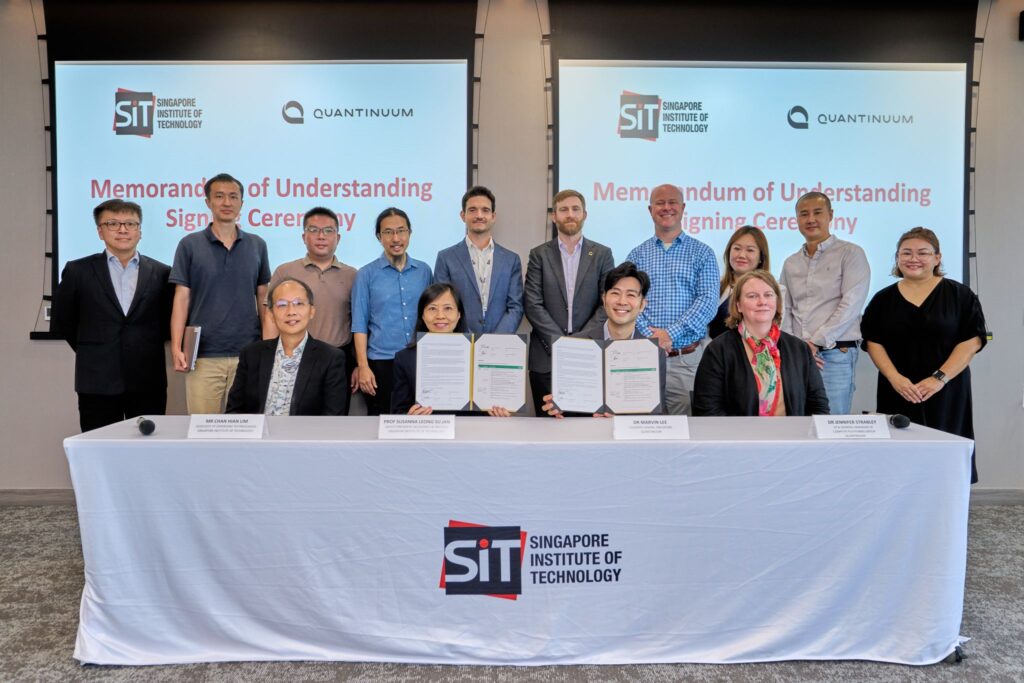
Quantinuum has signed a memorandum of understanding with the Singapore Institute of Technology (SIT) to collaborate on training students and professionals in quantum computing. The agreement is part of the company’s broader commitment to Singapore, where it has already established a research and operations center and plans to install a Helios quantum system in 2026.
The key points of Quantinuum and SIT in 20 seconds
- Quantinuum and SIT will collaborate on practical programs to develop talent in quantum technologies.
- Students will have access to the company’s software, simulators, and tools.
- The collaboration includes workshops, seminars, and university activities.
- Singapore is expected to receive a Helios quantum system in 2026.
- The agreement reinforces a national strategy that combines infrastructure, research, industrial applications, and training.
The memorandum focuses on one of the less visible challenges in the quantum race. Building increasingly powerful computers doesn’t mean much if companies and research centers lack engineers, developers, and specialists capable of utilizing them to solve real-world problems.
Quantinuum and SIT aim to bridge that gap through hands-on training. According to the company’s communication, both organizations will develop programs for students and professionals, provide access to quantum tools, and organize activities to bring this technology closer to the academic environment.
From learning quantum computing to working with real systems
The collaboration intends to go beyond teaching the theoretical fundamentals of qubits, quantum gates, or algorithms.
Students will gain access to Quantinuum’s software, simulators, and tools, while both organizations plan to develop practical training related to real-world applications of quantum computing.
Workshops, seminars, and campus events are also scheduled.
This approach is particularly relevant given the timing. Singapore is preparing to host one of Quantinuum’s most advanced commercial systems locally.
Helios was commercially launched in November 2025 and uses the company’s trapped-ion architecture. The system currently features 98 fully connected physical qubits and Quantinuum announces logical capacities of up to 50 qubits, along with a suite of software including Guppy, its high-level quantum programming language. The technical documentation describes a QCCD (Quantum Charge-Coupled Device) architecture based on ion transport between different regions for storage and operation.
The arrival of Helios in Singapore is not an isolated announcement. In November 2025, Singapore’s National Quantum Office (NQO) and Quantinuum announced a strategic partnership to install the system during 2026.
This project will make Singapore the first country outside the U.S. to host a Helios system, according to Quantinuum. While the physical deployment is underway, Singaporean researchers can already access Helios via the cloud.
This distinction is significant. Training specialists with access to simulators is valuable for learning programming and algorithms, but owning advanced hardware within the country broadens opportunities for research, developing hybrid applications, and collaborating with industry.
Singapore aims to cover the entire quantum value chain
Quantinuum launched its new R&D and Operations Center in Singapore in March 2026. From this facility, it intends to collaborate with researchers and companies in sectors such as pharmaceuticals, materials science, and financial services.
The center is supported by the Singapore Economic Development Board (EDB) and is part of the company’s collaboration with the National Quantum Office through the National Quantum Computing Hub.
This strategy helps clarify the nature of the agreement with SIT. Singapore is not solely focusing on acquiring quantum computing capacity. It is actively working to build infrastructure, research capabilities, industrial applications, and a skilled workforce simultaneously.
The country has been working along these lines for some time. In 2024, the NQO, A*STAR, the National University of Singapore (NUS), the National Supercomputing Centre (NSCC), and Quantinuum signed a memorandum to provide access to the H-Series and Helios systems, initially focusing on computational biology.
That agreement also included plans to explore hybrid architectures that combine classical and quantum computing infrastructure.
The next step came in 2025 with the commitment to physically bring Helios to Singapore and establish an R&D center. The collaboration with SIT now adds another piece: training professionals capable of operating this infrastructure.
This is not the only initiative in pursuit of that goal. In July, Quantinuum launched the SG Grand Challenge 2026, a three-month competition backed by the NQO and Aqora.
Participants work on areas such as chemistry and molecular simulation, optimization, AI applied to quantum systems, quantum error correction, and condensed matter. Finalists will gain hardware access and present their work in Singapore in November.
The quantum race will also be a race for engineers
Singapore’s efforts reflect a challenge that will likely grow as hardware advances.
The industry requires very diverse profiles. Not everyone needs to be a quantum physicist. Running these platforms also demands specialists in engineering, software, algorithms, hybrid systems, electronics, control, high-performance computing, and industry-specific applications.
Quantinuum’s strategy in Singapore centers on three elements: use cases, infrastructure, and qualified personnel. The collaboration with SIT directly impacts the third.
Furthermore, technological progress continues to accelerate. Quantinuum maintains Helios as its current platform, but plans include SOL for 2027 and Apollo for 2029, generations intended to be used in the company’s push toward fault-tolerant, larger-scale quantum systems.
This underscores the need to start training professionals before these systems are available.
It also explains why the partnership with a university focused on applied sciences extends beyond academic training. The challenge is not only to produce more scientific research but to ensure that some of that knowledge reaches engineers and companies capable of integrating quantum computing into industrial processes.
Singapore aims for Helios’ arrival not just to be the installation of another large computing system. If it can foster an ecosystem of developers, researchers, startups, and projects with tangible applications, the value of the infrastructure will be much greater.
The partnership between Quantinuum and SIT remains at the memorandum stage, and public details regarding investments, student numbers, or detailed program schedules have not been disclosed. Therefore, the agreement should not be interpreted as the immediate launch of new degrees or fully defined training programs.
It clearly indicates Singapore’s direction in quantum policy: advanced hardware combined with access, training, and application development.
Frequently Asked Questions
What have Quantinuum and Singapore Institute of Technology agreed upon?
They have signed a memorandum of understanding to collaborate on hands-on training in quantum technologies, provide access to tools and simulators, and organize workshops, seminars, and other activities.
What is Quantinuum Helios?
Helios is Quantinuum’s current generation of commercial quantum computers. It employs trapped-ion technology and features 98 fully connected physical qubits, along with architecture and tools for developing quantum and hybrid applications.
When will Helios arrive in Singapore?
Quantinuum and the NQO announced that the system is scheduled for installation during 2026. Researchers in Singapore already have access to Helios via the cloud.
Why is Singapore investing in quantum training?
The country aims to develop not only quantum infrastructure but also research, industrial applications, and a skilled workforce capable of utilizing these systems. Training is a key part of its National Quantum Strategy.
Sources:
- Quantinuum, announcement of collaboration with Singapore Institute of Technology.
- Quantinuum, Expands Global Footprint to Singapore with the Establishment of a New R&D Center, 11/03/2026.
- Quantinuum and Singapore National Quantum Office, agreement for Helios deployment, 06/11/2025.
- Quantinuum, technical documentation and specifications of Helios.
- Quantinuum, SG Grand Challenge 2026, 21/07/2026.
- Quantinuum and NQO, memorandum of collaboration from 2024.
via: LinkedIn
