
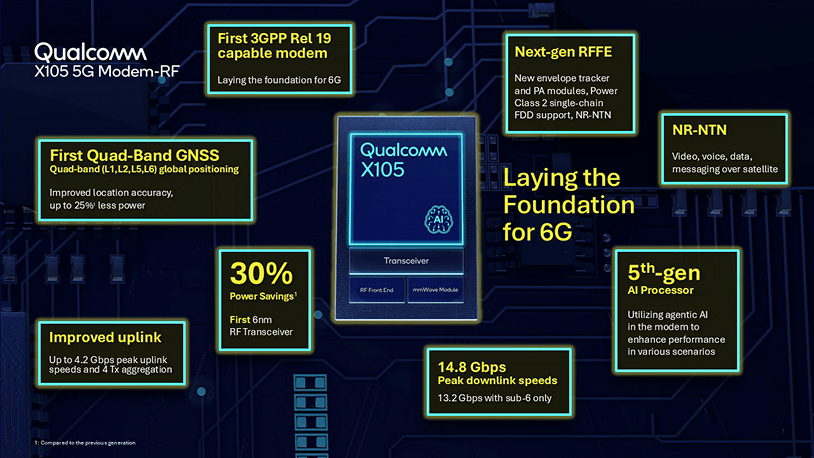
At the 2026 Mobile World Congress (MWC) in Barcelona, Qualcomm has decided that the headline should not be a vague promise about 6G, but rather a concrete component that, according to the company, aims to accelerate the journey towards this next generation: the Qualcomm X105 5G Modem-RF. The announcement comes with a clear message: 6G won’t start in 2030 but depends on design decisions made today in 5G-Advanced, with Qualcomm aiming to set the pace with a modem prepared for 3GPP Release 19.
The X105 is introduced as the industry’s first “R19-ready” modem-RF system, with Qualcomm seeking to get ahead in a terrain where much of the evolution of 5G-Advanced and the technical foundations of 6G will be defined. According to 3GPP itself, Release 19 represents the second phase of 5G-Advanced, continuing the work started in Release 18 and expanding improvements in radio, core, and service architecture. In other words: this isn’t a “patch,” but a complete evolutionary stage of the standard.
Peak speed and an uplink boost
In terms of performance, Qualcomm positions the X105 with figures that aim to reinforce the idea of “5G without compromises”: 14.8 Gbps peak download and 4.2 Gbps peak upload, with an additional note on up to 13.2 Gbps in sub-6 GHz bands. The emphasis on uplink isn’t accidental: an increasing number of applications (live video, telepresence, XR, industrial telemetry) are shifting from just “download-only” use to demanding sustained upload capacity. Qualcomm’s messaging indicates that the X105 responds to this trend with specific improvements designed to boost uplink throughput.
Integrated satellite (NR-NTN) beyond “emergency only”
One of the most striking points of the announcement is the integration of NR-NTN (New Radio Non-Terrestrial Networks), meaning 5G connectivity via non-terrestrial networks such as satellites. Qualcomm highlights that with the X105, satellite communication is no longer limited to messages or SOS signals but is oriented towards voice, data, and video over NR-NTN.
The significance here is twofold. First, NTN has been a focus area for years in 3GPP, working to integrate satellite and mobile networks into a common ecosystem (with various orbit types and architectures). Second, in the consumer market, satellite has mainly been associated with specific functions; Qualcomm aims to position satellite as enabling more continuous connectivity, where the device maintains options when terrestrial networks degrade or disappear.
A 6 nm RF transceiver to push power efficiency
Qualcomm claims that the X105 incorporates the industry’s first 6 nm RF transceiver, a shift that, according to their estimates, translates to up to 30% less power consumption and a 15% reduction in board footprint compared to the previous generation. Such improvements are often decisive in mobile devices but are also critical in categories where thermal margins are tight or where connectivity must coexist with other high-power components (XR, ultraportable PCs, automotive).
In practice, the “ modem” of today is not just a communications chip — it’s a complete radio frequency system where balancing performance, temperature, and battery life shapes real-world experience. That’s why Qualcomm emphasizes that this leap isn’t just about speed, but about efficiency.
Quad-band GNSS: finer positioning in more locations
Another less-publicized but potentially important feature is the upgrade in positioning: Qualcomm guarantees that the X105 integrates quad-band GNSS (L1, L2, L5, L6) with multi-constellation support, aimed at improving accuracy. In an ecosystem where location services are no longer just for maps (encompassing logistics, mobility, urban services, security, or augmented reality), gaining precision and robustness in difficult environments can be as impactful as increasing Mbps by a few hundred.
“AI-native” inside the modem: from network to experience
The X105 also introduces a feature that Qualcomm is heavily promoting in 2026: the use of edge AI (on-device) to enhance user experience. The company speaks of a fifth-generation AI processor integrated within the modem, designed to detect and classify traffic types according to the user’s scenario (e.g., gaming, video calls, social media) and optimize connectivity behavior accordingly.
While this isn’t entirely new — networks already apply some optimizations — Qualcomm seeks to bring part of this intelligence directly to the device to react faster, with lower control latency and more context-aware decisions. From an external perspective, it’s a consistent step with an industry that envisions 6G as “AI-native”: if the future demands smarter networks, the device must also participate in that intelligence.
A modem for more than just smartphones
Qualcomm frames the X105 as a platform to boost 5G-Advanced not only in smartphones but also in fixed wireless access (FWA), mobile broadband, automotive, XR, PCs, robotics, and industrial IoT. This matches market trends: mobile connectivity is becoming a cross-sector layer, with the modem evolving from a “phone component” to a “product layer”.
Additionally, the announcement highlights backing from global operators such as China Telecom, China Mobile, China Unicom, Deutsche Telekom, KDDI, Telstra, T-Mobile, and NTT DOCOMO. This indicates the ecosystem’s interest in beginning to test Release 19 as soon as hardware is ready.
Timeline: sampling now, devices in H2 2026
Qualcomm states that the X105 is already being supplied as samples to customers, and commercial devices incorporating it are expected in the second half of 2026. This is a crucial detail because it situates Release 19 as something beginning to reach real products, not just standardization documents.
Summary table of the Qualcomm X105 (according to Qualcomm)
| Feature | Implication |
|---|---|
| 3GPP Release 19-ready | Foundation for testing and deploying 5G-Advanced and transitioning to 6G |
| Peak download speed | 14.8 Gbps |
| Peak upload speed | 4.2 Gbps |
| Integrated NR-NTN | Voice, data, and video via satellite (beyond terrestrial connectivity) |
| RF transceiver at 6 nm | Up to 30% less power consumption and 15% smaller footprint |
| Quad-band GNSS | L1, L2, L5, L6 for enhanced precision and robustness |
| AI inside the modem | Traffic classification and optimization based on usage scenarios |
Overall, the X105 functions as a statement of intent: 5G-Advanced will not be just a “simple update,” but a platform where how we test and accelerate the leap to 6G will be shaped. Qualcomm aims for that transition to start within the modem itself—integrating satellite, boosting RF efficiency, and layering local AI to make connectivity more adaptive.
Frequently Asked Questions
What does it mean for a modem to be “Release 19-ready” in 5G-Advanced?
It means that it is prepared to implement and test functions aligned with 3GPP Release 19, the second phase of 5G-Advanced, facilitating early validation and progressive deployments.
Is NR-NTN the same as “satellite messages”?
Not exactly. NR-NTN is 5G New Radio over non-terrestrial networks (satellites, HAPS, etc.). Qualcomm states that the X105 supports voice, data, and video over NR-NTN, not just emergency messaging.
What is quad-band GNSS (L1, L2, L5, L6) used for in a phone or connected device?
To improve positioning accuracy and reliability, especially in challenging environments (dense cities, indoors, mobility), by combining multiple bands and constellations.
When will phones or devices with Qualcomm X105 be available?
Qualcomm indicates that the modem is already in sampling phase for clients, with commercial devices expected in the second half of 2026.
Source: Qualcomm