
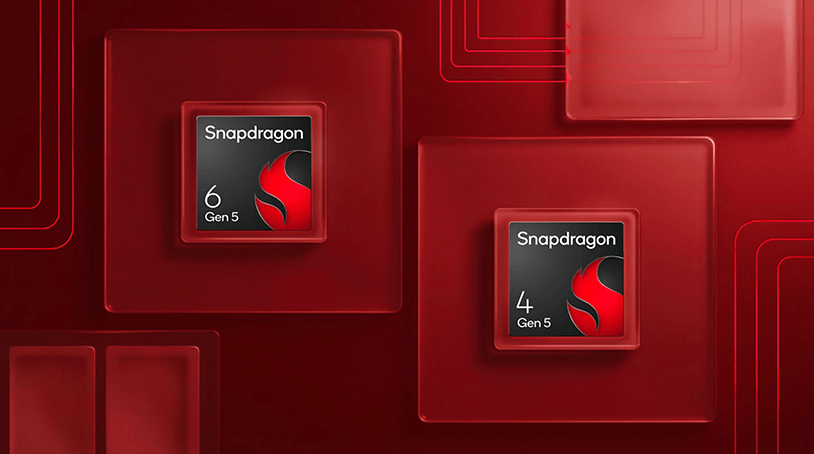
Qualcomm has announced the Snapdragon 6 Gen 5 and Snapdragon 4 Gen 5, two new mobile platforms designed to bring improvements in performance, connectivity, and user experience to mid-range and entry-level phones. The first commercial devices are expected to arrive in the second half of 2026 from manufacturers such as Honor, OPPO, realme, and REDMI.
This news isn’t focused on the high-end segment, where Qualcomm already competes with its Snapdragon 8 and 8 Elite. The emphasis is on the phones most users buy: more affordable devices where a fluid interface, good gaming performance, AI-powered camera features, stable 5G, fast Wi-Fi, and all-day battery life are expected. Qualcomm aims to strengthen its position against MediaTek and other competitors in this segment.
Snapdragon Smooth Motion UI: fewer jitters in daily use
One common feature shared by both chips is Snapdragon Smooth Motion UI, a technology aimed at enhancing the perception of fluidity when navigating the system, opening apps, and browsing menus. According to Qualcomm’s internal data, the Snapdragon 6 Gen 5 enables 20% faster app launches and reduces screen jitters by 18% compared to the Snapdragon 6 Gen 4. In the Snapdragon 4 Gen 5, the improvements are even more pronounced: a 43% faster app launch and a 25% reduction in stuttering compared to the previous generation.
These figures come from Qualcomm’s internal testing on reference designs and should not be taken as guarantees for every device. Actual performance will depend on the manufacturer, memory choices, storage, software layers, cooling systems, and software optimization. Nonetheless, the approach makes sense: in mid-range and entry-level phones, the difference between a pleasant and frustrating user experience often hinges not just on raw power but on how the system responds after months of use.
The Snapdragon 6 Gen 5 is the more ambitious of the two. Qualcomm targets users wanting better cameras, more stable gaming, and advanced connectivity without the premium price tag. The platform features AI-assisted camera functions, Qualcomm Adaptive Performance Engine 4.0 for longer gaming sessions, up to 21% more GPU performance, and support for 5G and Wi-Fi 7.
According to technical sheets from specialized media, the Snapdragon 6 Gen 5 uses an octa-core CPU with four performance cores up to 2.6 GHz and four efficiency cores up to 2.0 GHz, built using a 4 nm process. It also supports FHD+ displays up to 144 Hz, cameras up to 200 MP, LPDDR5 or LPDDR4X memory, and UFS 3.1 storage, though each manufacturer will choose which features to enable on their devices.
Snapdragon 4 Gen 5: boosted gaming for budget phones
The Snapdragon 4 Gen 5 targets a more affordable segment, with a significant leap in graphics performance—up to 77% more GPU power—and introduces 90 FPS gaming for the first time in the Snapdragon 4 series. For budget-conscious users, this could mean smoother gameplay, better graphics, and a more solid multimedia experience.
It also features Dual SIM Dual Active with 5G + 5G/4G, a useful function in markets where many users manage personal and work lines or use multiple carriers to improve coverage and plans. In the entry-level segment, this connectivity option can be just as important as CPU improvements, as it directly impacts daily usage.
Based on technical reports, the Snapdragon 4 Gen 5 is also built on a 4 nm process and combines two performance cores up to 2.4 GHz with six efficiency cores up to 2.0 GHz. It is expected to support cameras up to 108 MP, FHD+ screens at 144 Hz, UFS 3.1 storage, and 4K video recording—marked improvements over previous generations in this series.
Qualcomm’s clear strategy is to make distinctions between tiers less noticeable in the tasks that matter most. Not all users need the most powerful chip on the market, but they do want WhatsApp, the camera, the browser, social media, light gaming, and mobile payments to work smoothly without constant delays. If these Snapdragon chips deliver on their promises, 2026 devices could provide a more balanced experience even at moderate prices.
More connectivity options, but product decisions matter
The new chips also show that mid-range devices are inheriting features once exclusive to more expensive models. Wi-Fi 7 on the Snapdragon 6 Gen 5 is a good example. This connectivity can improve latency, speed, and stability on compatible networks, but to take full advantage, a suitable router and low-congestion environment are needed.
Preliminary analyses indicate that Qualcomm has introduced both upgrades and cutbacks based on the segment. Notebookcheck notes that the Snapdragon 6 Gen 5 gains Wi-Fi 7 and Bluetooth 6.0 but loses support for mmWave 5G, GPS band L2, and drops to USB 2.0 from previous capabilities. For the Snapdragon 4 Gen 5, the significant graphics and video improvements may come with some memory limitations compared to higher-end models.
This isn’t necessarily negative if the price is right. In mid-range devices, manufacturers often balance cost, battery, modem, camera, display, and storage. What matters most is that brands clearly communicate what each phone offers. Two devices with the same chip can have very different user experiences depending on memory, display quality, cooling, or software optimization.
Honor and REDMI will be among the first to use Snapdragon 6 Gen 5, while OPPO, realme, and REDMI will debut devices with Snapdragon 4 Gen 5. Availability in the second half of 2026 will reveal whether these platforms are aimed at global markets or if, as often happens, they have a special focus on markets like India, China, and other countries where mid-range dominates sales.
The competitive landscape will be intense. MediaTek has gained considerable ground with its Dimensity series in mid-range, and Chinese manufacturers have shown they can quickly adjust prices and specs. Qualcomm responds by emphasizing smoothness, GPU performance, connectivity, and efficiency, rather than just chasing big CPU benchmarks.
For users, a positive aspect is that fierce competition pushes improvements downward. Features like high-refresh-rate screens, 5G, fast storage, high-resolution cameras, local AI, and better gaming performance are becoming standard rather than exclusive to high-end models. A less obvious point is that the chip’s name alone no longer guarantees a good device—you’ll need to look at the whole package.
The Snapdragon 6 Gen 5 and 4 Gen 5 are not chips meant to set records—they’re designed to make more affordable phones feel faster, last longer, and support current applications better. In a market where many users keep their phones for several years, these daily experience improvements can outweigh any benchmark score.
Frequently Asked Questions
What has Qualcomm announced?
Qualcomm has unveiled the Snapdragon 6 Gen 5 and Snapdragon 4 Gen 5 mobile platforms intended for mid-range and entry-level smartphones arriving in the second half of 2026.
What improvements does the Snapdragon 6 Gen 5 bring?
Qualcomm states that it offers 20% faster app launches, 18% fewer screen jitters, up to 21% more GPU performance, AI-enhanced camera features, Wi-Fi 7, and 5G support.
What does the Snapdragon 4 Gen 5 offer?
It promises up to 77% more GPU performance, 90 FPS gaming for the first time in the Snapdragon 4 series, smoother system response, and Dual SIM Dual Active connectivity.
Which brands will use these chips?
Qualcomm has named Honor and REDMI for devices with Snapdragon 6 Gen 5, and OPPO, realme, and REDMI for the first phones featuring Snapdragon 4 Gen 5.
