
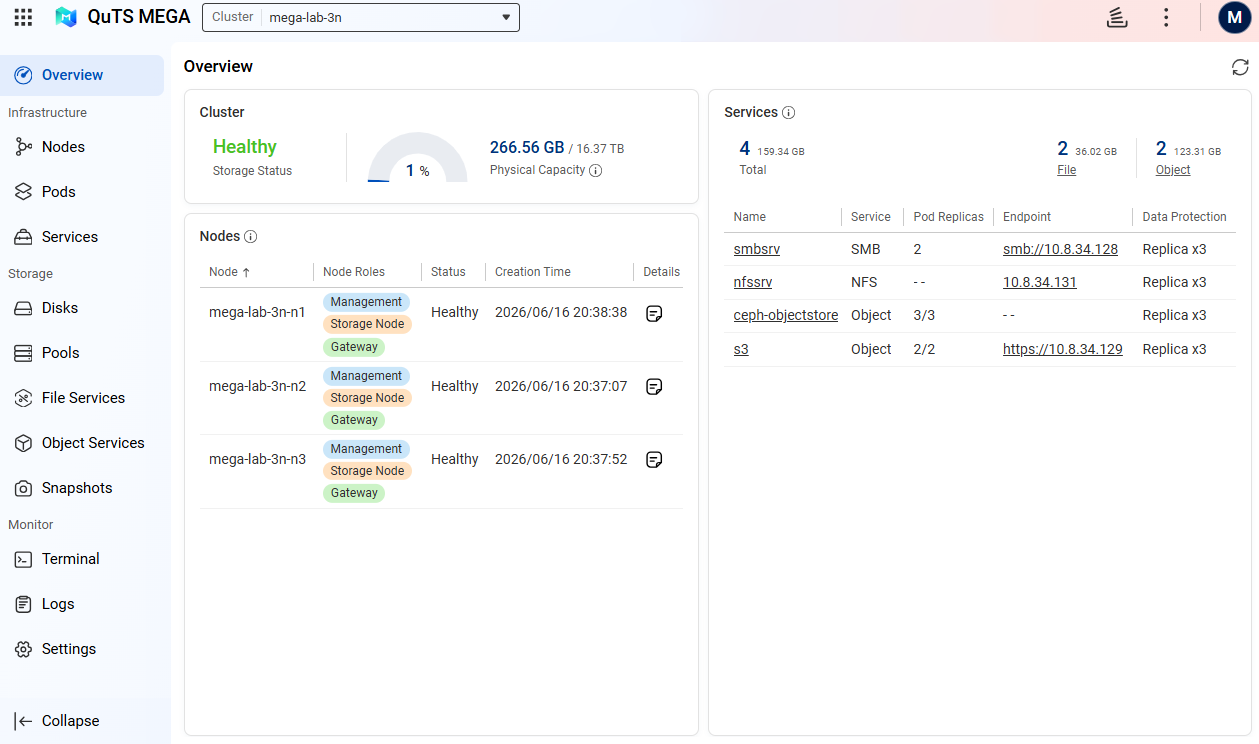
QNAP has announced QuTS MEGA 2.0, a new version of the operating system for its MEGA Scale-out NAS platform, aimed at large-capacity enterprise storage. The update adds two features that matter a lot for business continuity: snapshots and Cross-Cluster Mirroring, which capture point-in-time copies and replicate them to another cluster so there’s a backup infrastructure if the main system fails.
QNAP QuTS MEGA 2.0 in 30 seconds
- QuTS MEGA 2.0 adds snapshots and inter-cluster replication to improve disaster recovery.
- MEGA Scale-out NAS uses a distributed, Ceph-based architecture that scales from 3 to 96 nodes.
- Administrators can pick replication or Erasure Coding depending on the workload.
- Data and services are spread out to reduce single points of failure.
- QCommander centralizes node and cluster management in a single interface.
The launch comes when storing huge amounts of data is only part of the challenge. AI workloads, high-resolution video surveillance, research, or business analysis can build repositories that grow to several petabytes (PB), but adding capacity without planning how to recover data after an incident leaves the architecture incomplete.
QNAP wants to cover both needs with a platform that scales by adding nodes and now builds protection and recovery straight into QuTS MEGA.
From 3 to 96 nodes on a Ceph-based architecture
MEGA Scale-out NAS is built on a distributed architecture based on Ceph, an open-source storage technology widely used to build systems that spread data across many servers.
Instead of relying on a single NAS whose capacity is capped by the disks it can physically hold, the scale-out model lets you add new nodes to the cluster.
QNAP sets its platform to grow from 3 up to 96 nodes, grouped into a single cluster and storage pool.
Per the manufacturer, each new node brings linear increases in capacity and performance while keeping a high-availability (HA) architecture.
That fits organizations with fast-growing data. Instead of replacing a whole enclosure when it gets too small, they just add nodes to the distributed system.
Using Ceph also spreads data across different machines. Losing one component doesn’t necessarily mean losing access to storage, as long as the architecture has been scaled and configured to handle such failures.
Snapshots now in QuTS MEGA
One of the main new features in QuTS MEGA 2.0 is snapshot support.
A snapshot preserves the state of data at a point in time. It’s useful after an accidental deletion, unwanted changes, or a ransomware incident, giving you earlier points to recover from.
But a snapshot isn’t the same as a full backup strategy.
If all the snapshots stay inside the same infrastructure and that infrastructure suffers a major incident, they can be compromised too. That’s exactly why the second big addition in QuTS MEGA 2.0 matters.
Cross-Cluster Mirroring lets you replicate snapshots to another cluster, which can sit off the primary site.
So a company can keep a primary cluster for production and another for disaster recovery (DR). If the first site goes down, the second holds the replicated information for recovery.
QNAP talks about continuous replication and fast recovery from site failure. As with any DR solution, the real recovery times and possible data loss depend on the design, connectivity between sites, configuration, and organizational policies.
So it’s important to separate these capabilities from an automatic guarantee of RPO 0 or RTO 0. QNAP’s announcement doesn’t set those targets for every deployment.
Replication or Erasure Coding, depending on the workload
QuTS MEGA 2.0 lets you choose between two strategies to protect data on the platform: replication and Erasure Coding.
With replication, multiple copies of the data live across different cluster resources. It’s a fairly simple model and can perform well, but it needs extra capacity to store those copies.
Erasure Coding takes a different route. Data is split and paired with distributed redundancy information across several devices. That lets you rebuild data even if parts of the infrastructure fail, and it can use available capacity better than keeping full copies.
The trade-off is that the encoding and reconstruction processes need more compute and access resources.
There’s no single right option. The choice depends on each workload’s priorities for performance, capacity, resilience, and cost.
Having both lets you apply different policies to different kinds of data.
High availability for data and services
The distributed architecture also aims to keep a single server failure from stopping the whole storage system.
QuTS MEGA spreads data and services across multiple nodes to cut single points of failure.
That design matters more as storage increasingly backs services that need constant access to large volumes of data.
An AI analytics platform, for instance, may depend on repositories with millions of documents, images, or videos. The compute may stay up, but it’s useless if storage access is lost.
The same goes for video surveillance, scientific research, or certain enterprise systems.
QNAP ties the growth of these scenarios to the need for petabyte-scale storage.
QCommander simplifies managing a growing node count
Scale-out architectures solve some limits of traditional storage but add others.
Managing three nodes is fairly simple. Doing it with dozens of nodes, multiple clusters, and a secondary DR site sharply raises the number of elements to watch.
QNAP includes QCommander, a centralized platform to manage nodes and clusters from one interface.
Its goal is a unified view of the infrastructure instead of managing each component on its own.
That operational layer becomes important as distributed storage moves from very specialized environments toward a more accessible enterprise platform.
The main advance in QuTS MEGA 2.0 is exactly about the dual challenge of data growth: scaling storage to multiple petabytes is worth little if protection and recovery don’t grow at the same pace.
Snapshots provide recovery points, while Cross-Cluster Mirroring extends that protection to another infrastructure. The Ceph-based architecture provides the distributed model QNAP builds the rest of the platform on.
That said, the commercial availability of QNAP MEGA Scale-out NAS and its deployment options vary by region, so the company recommends checking local configurations in each market.
Frequently Asked Questions
What is QNAP QuTS MEGA 2.0?
It’s the new version of the operating system used by QNAP MEGA Scale-out NAS, a distributed enterprise storage platform based on Ceph and built to scale to several petabytes.
How many nodes does QNAP MEGA Scale-out NAS support?
Per QNAP, the architecture can scale from 3 to 96 nodes, grouped into a single cluster and pool.
What does Cross-Cluster Mirroring provide?
It replicates data to another cluster, giving you additional infrastructure for data protection and disaster recovery.
Does a snapshot replace a backup?
Not necessarily. Snapshots give you earlier data points, but a complete protection strategy also has to account for storage failures or site-wide incidents. QuTS MEGA 2.0 complements snapshots with inter-cluster replication.
