
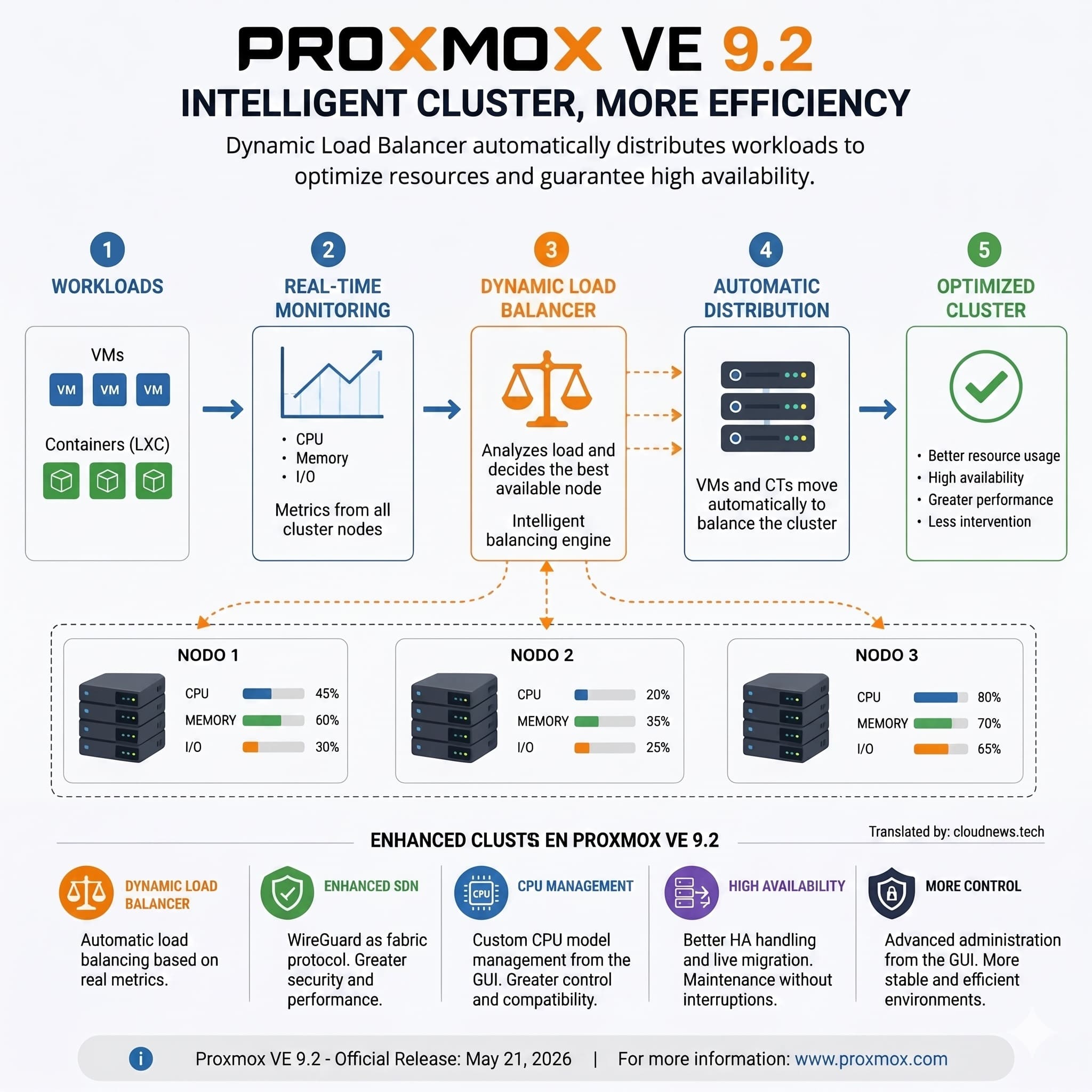
Proxmox VE 9.2 now has a technical guide in Spanish that brings together, in a single document, much of the information needed to install, configure and manage this virtualization platform. The translation, which is unofficial, is aimed at people who work with Proxmox servers, virtual machines, containers and clusters and prefer to consult documentation in Spanish.
Proxmox VE 9.2: the key facts in 20 seconds
- The Spanish-language guide brings together nearly 500 pages on Proxmox VE 9.2.
- Version 9.2 arrived in May 2026 with Debian 13.5 and Linux 7.0.
- It includes QEMU 11.0, LXC 7.0 and ZFS 2.4, along with Ceph Tentacle 20.2.
- The platform adds improvements for clusters, SDN networking and load balancing.
- The documentation could be especially useful for administrators who normally work in Spanish.
Proxmox VE has established itself as one of the most widely used open-source alternatives for managing virtualized infrastructure. The platform lets administrators manage virtual machines through KVM and Linux containers (LXC) from a single interface, while also offering features for storage, backups, networking and high availability.
Version 9.2 expanded several of those capabilities. Proxmox released this update on May 21, 2026, building it on Debian 13.5, with Linux 7.0 as the default stable kernel. It also brought new versions of essential components such as QEMU 11.0, LXC 7.0 and ZFS 2.4.
The arrival of extensive documentation in Spanish carries a different kind of interest than a simple translation of menus or commands. For a systems administrator, a guide running to hundreds of pages makes it possible to look up everything from initial installation to more specific configurations without constantly switching between English-language documentation, forums and third-party resources.
What Proxmox VE 9.2 Offers Administrators
One of the most notable changes in this version relates to resource management within clusters. Proxmox VE 9.2 continues a broader shift that’s made the platform look less like VMware’s budget alternative and more like a serious contender on its own, and it adds a Dynamic Load Balancer designed to distribute workloads across available nodes and improve virtual machine management in environments with multiple servers.
The update also expands the possibilities of software-defined networking, known as SDN. New features include capabilities related to WireGuard and BGP, along with improvements for BGP/EVPN configurations through route maps and prefix lists.
Storage also gets new pieces. Proxmox VE 9.2 includes Ceph Tentacle 20.2 as the stable version, while Ceph Squid 19.2 remains available as an alternative. Ceph makes it possible to build distributed storage for setups where several nodes need to work with shared resources.
The platform also keeps its integration with technologies such as ZFS, NFS, SAN and iSCSI, depending on the configuration and needs of each infrastructure.
Another change in this version affects cluster administration and node maintenance. Proxmox has added mechanisms to better manage maintenance tasks and high-availability operations, along with new options related to the CPU models that virtual machines can use.
All of this means Proxmox VE 9.2 isn’t just a component update. Part of what’s new is concentrated in the tools administrators use once an installation stops being a single server and becomes infrastructure spanning multiple nodes.
A Guide Meant to Go Beyond Installation
The Spanish-language documentation makes particular sense in that scenario. Installing Proxmox VE is only the first step. From there come decisions about storage, networking, backups, permissions, virtual machines, containers, clusters and high availability that require consulting technical documentation fairly often.
A guide running close to 500 pages makes it possible to cover many of those scenarios in more depth than an introductory tutorial. It also makes it easier to look something up quickly when a specific problem comes up while managing a server.
Proxmox’s official documentation for the 9.x branch is still available in English and covers the platform’s features and procedures. The 9.2 version of that documentation was officially updated in August 2026.
The Spanish-language guide doesn’t replace the official documentation and shouldn’t be mistaken for a publication from Proxmox itself. Its value lies in bringing that technical content closer to administrators and professionals who normally work in Spanish and want a broad reference for Proxmox VE 9.2.
For people already using the platform, it can also serve as reference material for understanding what’s new in version 9.2. For newcomers, it offers a broader starting point than the usual quick installation guides.
Proxmox has also kept expanding the platform’s reach throughout 2026. In August, it announced official support for ARM64 in Proxmox VE 9.2, making it the first additional CPU architecture officially supported alongside x86-64. That kind of platform growth is also drawing more migration tooling built specifically to move workloads over from VMware. The ARM64 edition uses the same codebase, package repositories and release cycle as the conventional version.
That move widens Proxmox’s deployment options, although the specific documentation and requirements should be checked against the hardware being used. In professional infrastructure, each component’s compatibility still depends on the configuration and the support available.
The arrival of a complete guide in Spanish thus comes at a time when Proxmox VE 9.2 is piling up new features in virtualization as well as networking, storage and cluster management. For Spanish-speaking systems administrators, having that translated content can reduce reliance on documentation in other languages without changing the platform’s technical reference.
Frequently asked questions
What is Proxmox VE 9.2?
Proxmox Virtual Environment 9.2 is an open-source platform for managing virtual machines and containers. Version 9.2 is based on Debian 13.5 and includes QEMU 11.0, LXC 7.0 and ZFS 2.4.
Is the Spanish-language guide to Proxmox VE 9.2 official?
No. The Spanish-language guide is an unofficial translation of the documentation and should be distinguished from documentation published directly by Proxmox.
What’s new in Proxmox VE 9.2?
Among other improvements, it includes a Dynamic Load Balancer, new SDN capabilities with WireGuard and BGP, support for Ceph Tentacle 20.2, and improvements to cluster management, maintenance and CPU models.
Does Proxmox VE 9.2 run on ARM64?
Yes. Proxmox announced official support for ARM64 in Proxmox VE 9.2 in August 2026, alongside the x86-64 architecture.
