
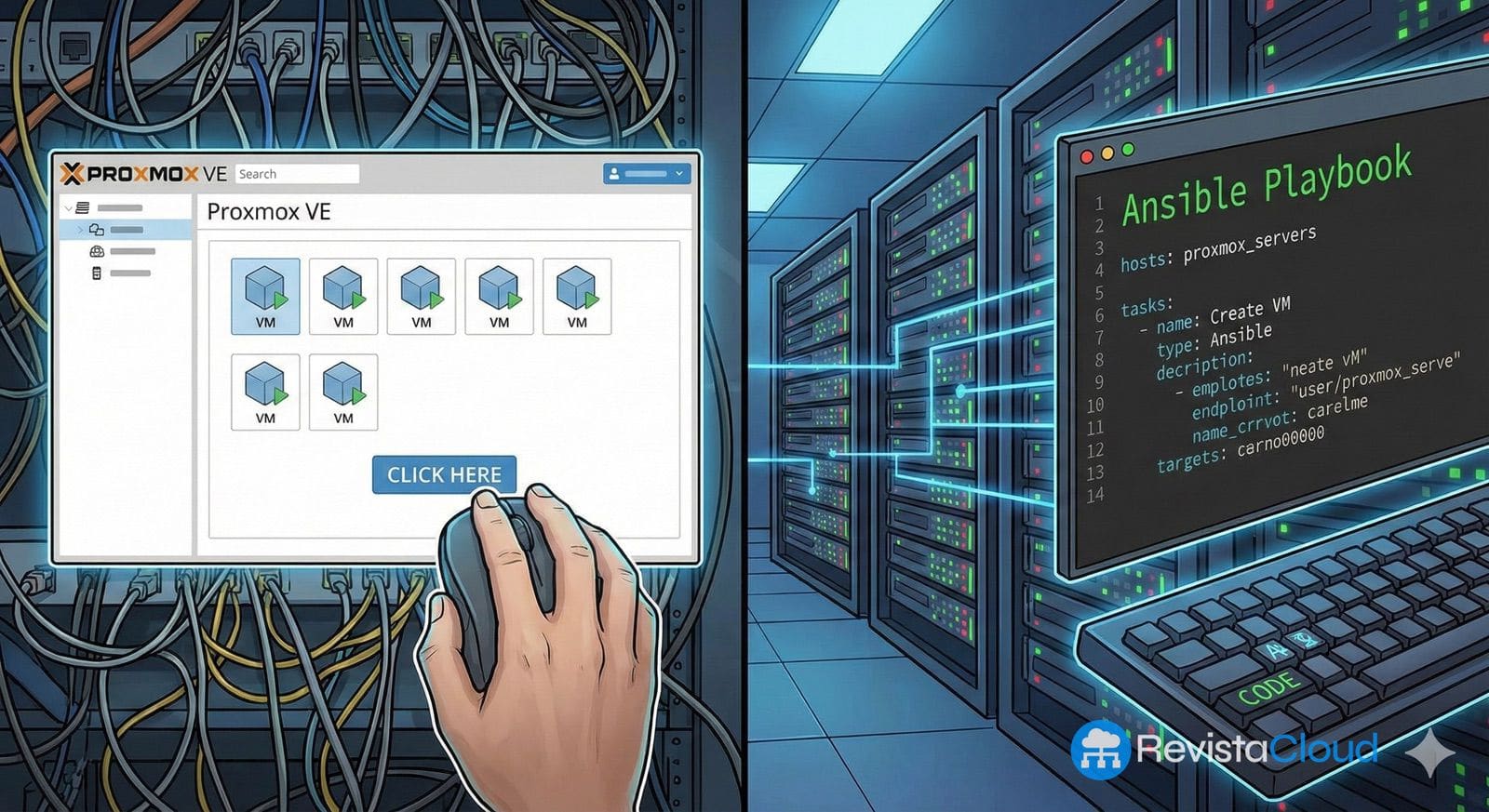
The management of virtualized infrastructures is undergoing a quiet but profound change: fewer tasks are performed manually, and more are becoming repeatable, auditable processes that are easy to replicate. In the ecosystem of Proxmox Virtual Environment (Proxmox VE), this trend is especially evident in operations that recur repeatedly in real-world environments: host installation, initial deployment, cluster creation, network and storage configuration, and standardization of settings on nodes that have grown over time. For many administrators, the question is no longer whether to automate, but how much to automate and what tools to use.
In this context, Ansible emerges as one of the most straightforward allies. Its popularity isn’t the only reason; it’s its practical approach: agentless, relying on SSH to connect to target systems and avoiding the introduction of additional services that could complicate operations. For organizations looking to get started with automation without building a “platform within a platform,” this simplicity lowers barriers: install it on a workstation (for example, on Debian or Ubuntu) and from there, deploy playbooks, modules, and inventories to orchestrate changes in a structured way.
Less “memory operations,” more reproducible procedures
The promise of automating Proxmox with Ansible is clear: transforming a long list of manual steps — some routine, others delicate — into a defined, repeatable, and documented sequence. It’s the difference between “remembering how it was done” and “executing the standard procedure.”
Proxmox administrators often face similar scenarios: new nodes that need to be added to a cluster, network changes that must be replicated without disrupting production, storage adjustments that need to be consistent across servers, or a “refresh” phase where hosts configured manually over many years must converge toward a common pattern.
Ansible fits here for operational reasons: each task is executed in a structured and traceable manner, clearly showing what has been changed, in what order, and with what result. Instead of a long terminal session, loose commands, and on-the-fly decisions, the system follows a script.
Inside how it works: Python, SSH, and controlled changes
Technically, Ansible’s approach involves preparing code (usually Python), connecting via SSH to the target, and executing the necessary actions to bring the host to the desired state. That nuance — the “desired state” — is key: automation isn’t just running commands; it’s about defining a target configuration and applying it in a controlled manner.
This makes the tool useful for both new installations and existing environments. In fact, one of the most cited values in infrastructure teams is the ability to normalize: even servers configured manually can be brought up to a common standard, reducing invisible differences that often cause issues when incidents occur.
Community roles: transforming Debian into a Proxmox host
Within the Ansible ecosystem, roles are a foundational element: reusable packages that encapsulate steps and best practices to achieve a specific goal. For Proxmox, community-developed roles are available that automate much of the process: from preparing a Debian system to become a virtualization host, to applying consistent configurations across nodes.
This capability is especially valuable in rapid deployments or in companies building infrastructure from scratch, aiming to prevent each technician from “installing Proxmox in their own way.” Automation doesn’t just speed things up: it standardizes.
Scaling without losing control: large clusters, resources, and Ceph
As environments grow, automation shifts from being a convenience to a necessity. Manually configuring a handful of nodes may be manageable; doing it at scale isn’t. Here, the approach gains strength: Ansible can manage configurations across multiple hosts, coordinate changes, and help integrate resources like distributed storage, including Ceph, when part of the design.
The benefits are twofold: initial deployment becomes more consistent; and subsequent changes are less risky because they are executed under a repeatable procedure that can be reviewed, versioned, and improved.
VMs as the next step: automating the entire lifecycle
The natural next step, once hosts are standardized, is managing what runs on top. The presented extract highlights an important point: beyond host and resource configuration, virtual machines can be controlled from Ansible using a community module that interacts with the Proxmox API.
This opens a highly relevant avenue for DevOps and platform infrastructure teams: the ability to treat VMs (and, by extension, parts of their lifecycle) as manageable elements from an automation flow. Infrastructure ceases to be a set of manual decisions and becomes a system where actions are defined and can be reliably repeated.
The human aspect: automating to reduce errors, not to “cut work”
Behind this approach lies a very down-to-earth motivation: reducing human error sources in repetitive tasks. Automation isn’t just about speed; it’s a way to relieve pressure on administrators during critical moments. When rapid deployment, configuration recovery, or environment setup is needed, what’s most valued isn’t just doing it in 10 minutes, but doing it right and consistently.
In virtualized infrastructures, where small network or storage mismatches can cause hard-to-diagnose problems, discipline in automation acts as a safety net. At the same time, it functions as a learning mechanism: every improvement added to the playbook becomes shared knowledge for the entire team.
Frequently Asked Questions
What can be automated with Ansible in Proxmox VE beyond installing the host?
Beyond the initial installation and basic configuration, common automations include cluster bootstrap, network setup, storage configuration, and standardization of parameters across nodes.
Why is Ansible “easier to adopt” in some systems teams?
Because it is agentless, relies on SSH, and does not require deploying extra services: you can start from a workstation with playbooks and inventory and grow from there.
Can Ansible be applied to already manually configured Proxmox hosts?
Yes. One of the most common uses is elevating manually configured hosts to a common standard, reducing divergence and improving operational consistency.
Is it possible to manage Proxmox virtual machines from Ansible?
According to the described approach, yes: there is a community module that allows managing VMs via the Proxmox API from Ansible, integrating them into automation workflows.