
The Pisces project will deploy a new 3,125-kilometer fiber-optic submarine cable to connect Ireland with continental Europe through four landing points in Galway, Saint-Hilaire-de-Riez, Sopelana, and Carcavelos. Orange, Equitix, and MDM have formed the joint venture PISCES Cable System Limited to develop this infrastructure, which aims to diversify Atlantic data traffic routes and strengthen the resilience of European communications.
The Pisces submarine cable in 20 seconds
- The cable will run 3,125 kilometers and carry 16 fiber pairs.
- It will connect Galway, in Ireland, with three landing points in France, Spain, and Portugal.
- Orange, Equitix, and MDM are partners in the joint venture set up to develop the project.
- Deployment is planned for 2028, with support from the European Connecting Europe Facility program.
- The infrastructure will offer wholesale dark-fiber capacity and connections to international networks.
The new route is designed to carry large volumes of data between Ireland and the continent without relying solely on existing submarine corridors. It will also connect data centers run by major cloud providers based in Ireland with networks in continental Europe. The initiative arrives at a time when international communications capacity and route diversity are important factors for keeping digital services running through outages, congestion, or disruptions.
Sopelana Puts Spain on the New Atlantic Route
The announced route includes four landing points: Galway, in Ireland; Saint-Hilaire-de-Riez, in France; Sopelana, in Bizkaia; and Carcavelos, in Portugal. In Spain’s case, Orange España will build a new landing station to connect the submarine cable to terrestrial networks.
The landing at Sopelana brings Spain into an infrastructure that will directly link Ireland with several European markets. A landing station allows traffic to be transferred between the cable laid under the sea and terrestrial telecommunications networks. From there, connectivity can extend to data centers, operators, and other interconnection points, depending on commercial agreements and available terrestrial infrastructure. Spain already hosts other recent additions to its submarine network, such as Canalink’s newly completed cable strengthening the Canary Islands’ connectivity.
Pisces will have 16 fiber-optic pairs. This configuration provides substantial physical capacity for carrying data traffic, although actual performance will depend on the optical equipment installed, the transmission technology used, and how demand evolves. The announcement doesn’t detail total capacity in terabits per second or the commercial speeds that will be offered to customers.
The project is positioned as an open-access, scalable infrastructure with dark-fiber links. This model lets wholesale customers who lease capacity use unlit fibers with their own transmission equipment, rather than relying solely on services managed by the cable’s owner. The specific availability, access terms, and commercial services will depend on the offering eventually set up for Pisces.
An Additional Corridor for Data Centers and International Networks
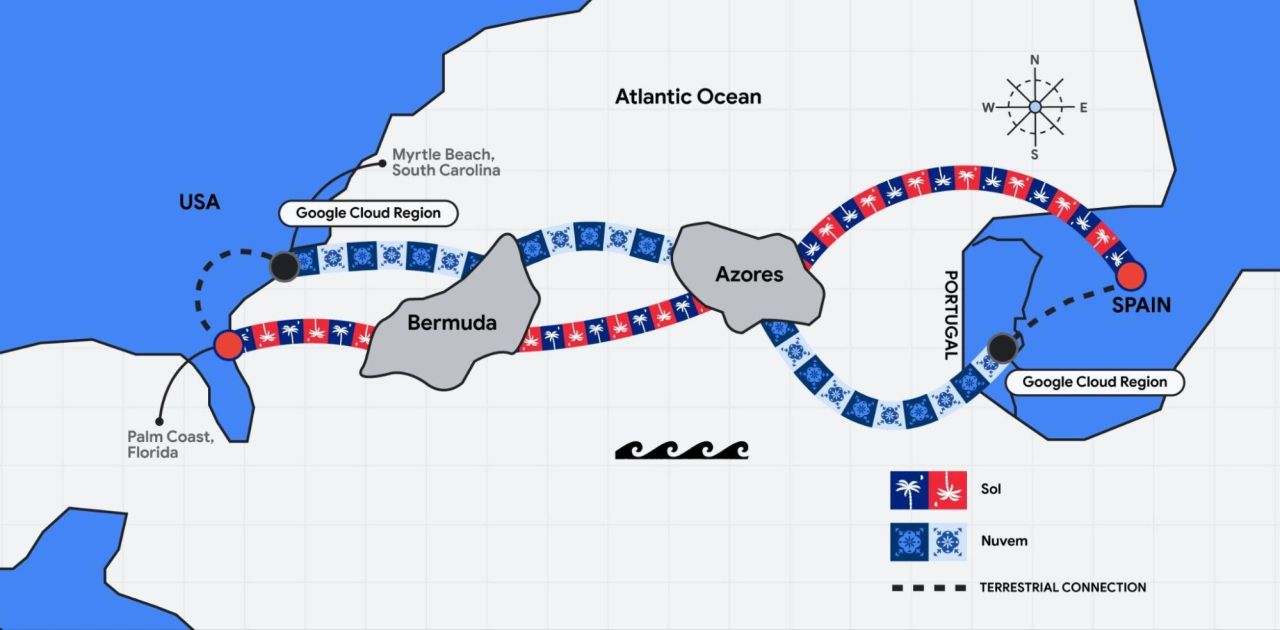
Ireland is home to major data center and cloud facilities. A direct connection to continental Europe can give operators and infrastructure providers another option for moving data between the two territories. The cable is also expected to interconnect with existing transatlantic and international submarine systems, which would expand traffic routing options — following a similar logic to Google’s Nuvem and Sol cables, its twin Atlantic routes for cloud and AI traffic.
Route diversification is useful because international communications depend on physical infrastructure exposed to accidental damage, technical failures, and other incidents. Having alternative paths can help keep service running when one connection goes down, as long as the networks are set up to reroute traffic and there’s enough capacity in the remaining links. The cable alone doesn’t guarantee that continuity: terrestrial network configuration, agreements between operators, and redundancy mechanisms also play a role.
The initiative is also presented as a contribution to European resilience and digital sovereignty. In this case, those goals relate to expanding connectivity options under European infrastructure and reducing reliance on a limited number of routes. That doesn’t mean traffic will be restricted to Europe, or that the project eliminates dependence on international systems, since its design specifically includes interconnection with other submarine networks.
EU backing is channeled through the Connecting Europe Facility, the bloc’s funding mechanism for connectivity infrastructure. The announcement identifies that support but doesn’t specify the funding amount, Pisces’ total budget, or how the investment is split among the partners.
Deployment Is Planned for 2028
Marine survey work, carried out by Elettra Tlc and Orange Marine, was completed in August, according to the project’s announcement. Engineering and permitting are still underway, while cable-laying is scheduled for 2028. The infrastructure is therefore not yet operational, and its timeline will depend on how that work and the necessary procedures for carrying out the deployment progress.
The joint venture PISCES Cable System Limited brings together Orange, Equitix, and MDM to carry out the project. Orange contributes telecommunications and submarine-operations expertise, while the initiative includes partners from the investment and engineering fields. The information released doesn’t specify the equity split or the final construction cost.
Once operational, Pisces will add a new fiber corridor between Ireland and several points along Europe’s Atlantic coast. Its real usefulness will be measured by the capacity available, its connections to other networks, the access terms for operators, and how data center and digital-service providers put it to use.
Frequently asked questions
What is the Pisces submarine cable?
It’s a 3,125-kilometer fiber-optic cable project that will connect Ireland with France, Spain, and Portugal to expand communication capacity between those markets.
Where will the Pisces cable come ashore?
It will have four landing points: Galway, in Ireland; Saint-Hilaire-de-Riez, in France; Sopelana, in Spain; and Carcavelos, in Portugal.
When will the Pisces cable be operational?
Cable-laying is scheduled for 2028. Engineering and permitting are still underway, so the announcement doesn’t confirm an entry-into-service date.
What capacity will the Pisces cable have?
The announced design includes 16 fiber-optic pairs, but no total capacity figure in terabits per second has been published.
