
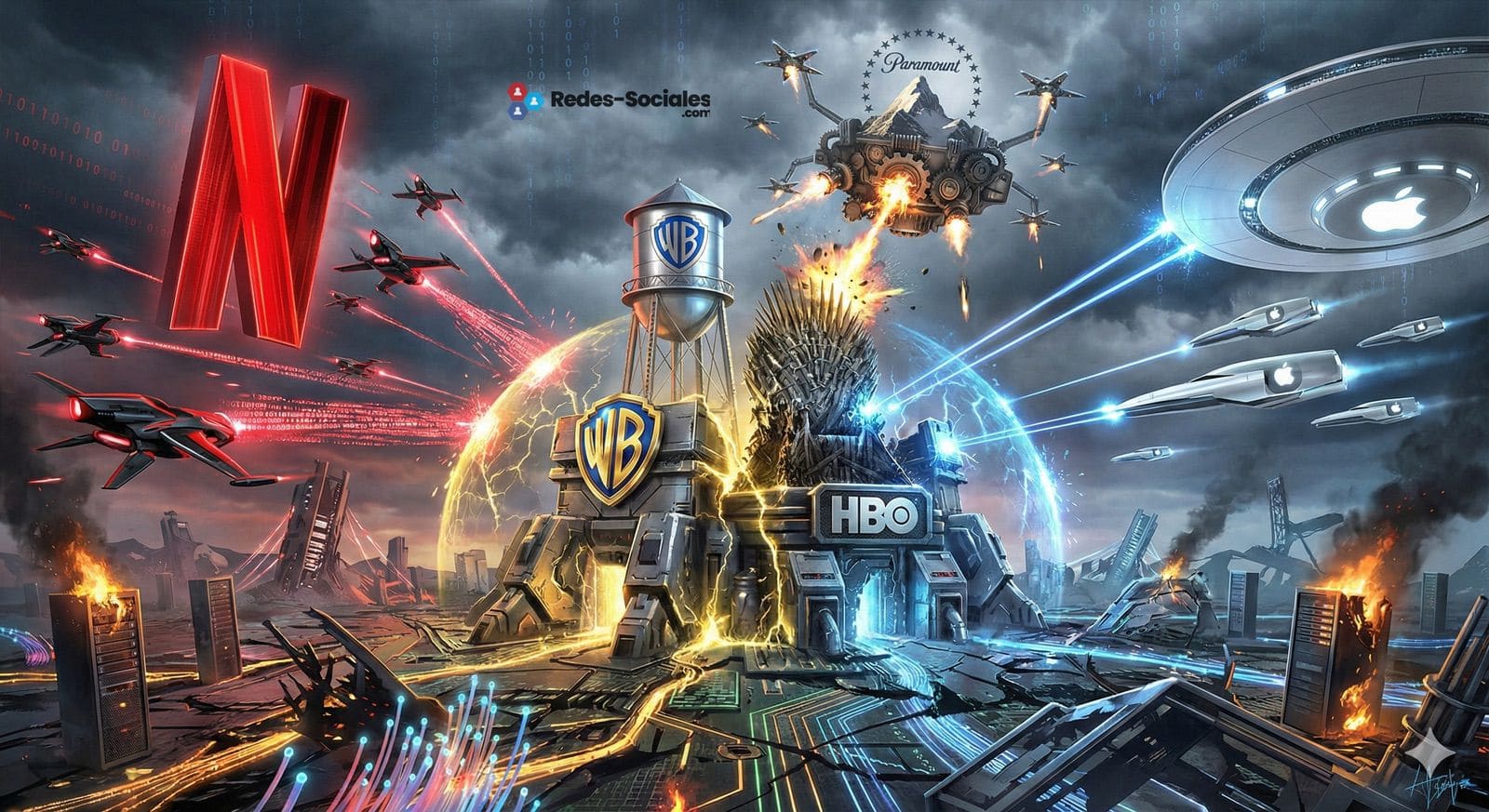
The battle for control of Warner Bros. Discovery is no longer just Hollywood’s concern; it has become one of the corporate moves with the greatest potential impact on the global tech industry. Following the announcement of the agreement between Netflix and Warner Bros. Discovery, now Paramount Skydance enters the scene with a hostile takeover bid valued at $108.4 billion, entirely in cash, aiming to snatch the target from the streaming giant.
This move would not only reshape the landscape of studios and platforms but also realign cloud infrastructure, recommendation algorithms, digital advertising, and data ecosystems that support the streaming-on-demand business.
From “historic agreement” to open bidding war
In early December, Netflix and Warner Bros. Discovery announced a merger agreement valued at approximately $82.7 billion. The deal included Warner Bros. film and TV studios, HBO, and its streaming service Max, as well as DC Entertainment, but excluded linear TV networks, which would remain under Discovery Global’s umbrella.
Just three days later, Paramount Skydance struck: it launched a hostile public tender offer for the entire Warner Bros. Discovery, valued at $108.4 billion, at $30 per share, all in cash.
The difference isn’t just about price:
- Netflix offers $27.75 per share, combining cash and its own stock, and only targets the studios and streaming part.
- Paramount Skydance offers $30 per share, all cash, aiming to acquire the entire group: studios, Max, and linear TV networks.
From the shareholders’ perspective, the choice is clear: more money, less risk tied to future Netflix stock performance, and no prior business fragmentation. It’s no surprise that Warner Bros. Discovery’s board has confirmed they will evaluate this counteroffer, igniting a true “bidding war” for the historic conglomerate.
Technology, data, and cloud: what’s really at stake
While the story is told through franchise films, catalogs, and iconic brands, the core is deeply technological:
- CDN and data centers: Both Netflix, Warner, and Paramount operate on massive content delivery infrastructures supported by agreements with hyperscalers and their own caching networks. Large-scale integration concentrates bandwidth consumption, cloud negotiating power, and capacity to invest in new codecs, adaptive streaming, and low latency.
- Recommendation algorithms and AI: Combining behavioral data from hundreds of millions of users across platforms creates a “super laboratory” for machine learning. More usage signals lead to more precise recommendations, finer ad targeting, and potentially, a concentration of algorithmic power in very few hands.
- Advanced digital advertising: Warner Bros. Discovery has long been investing in hybrid models with ad-supported plans. Integrating advertising inventory from HBO Max, Netflix, or a future conglomerate with Paramount+ allows for the creation of proprietary adtech tools to compete directly with Google and Meta.
In this context, Paramount Skydance’s bid is not just a content move but the creation of a “super operator,” capable of unifying studios, streaming, and traditional TV under a single technological strategy.
Regulators on guard: Is Paramount more digestible than Netflix?
The other major front is regulation. In recent years, competition authorities in the US and Europe have toughened their stance against mergers that concentrate excessive power in key digital sectors, including audiovisual content and online platforms.
This is where Paramount Skydance aims to establish its profile:
- It claims that its all-cash offer for the entire company provides more clarity and less financial engineering than Netflix’s proposal.
- It hints that integrating Warner’s assets into Netflix could be seen as a merger between the largest global streaming service and one of the most valuable premium catalogs on the market, reducing direct competition in subscription video platforms.
- In contrast, Paramount argues that its structure would allow for operational separation between linear TV and streaming, at least in the short term, avoiding a total absorption of Max into another major platform.
Nonetheless, any winner will face months of scrutiny: from sports rights and major franchises to the impact on local advertising markets and distribution deals with telecom operators.
Could other giants enter the race? The big question mark for Apple (and others)
With two bids on the table, the big question is whether other players—particularly tech giants—might join the fray. Apple, with its large cash reserves and its focus on Apple TV+, is always considered when big studios are involved. The same, to a lesser extent, applies to Amazon or even major telecom groups.
Currently, there are no public signs of alternative offers or formal moves from Apple or other giants to acquire Warner Bros. Discovery. But in investment banks and M&A consulting rooms, the scenario is being contemplated:
- Apple could drastically boost Apple TV+ and its ecosystem of services by adding a catalog as deep as Warner’s, from HBO to DC.
- Amazon would strengthen its commitment to Prime Video and streaming sports, although it has already invested heavily in rights and original productions.
- Other potential bidders would need to justify their massive financial effort and overcome additional regulatory resistance to another tech giant acquiring more strategic content assets.
The key point is that the price tag is already astronomical. Any new bidder would have to top Paramount’s $108.4 billion in cash or present a compelling creative structure to convince shareholders and authorities.
What it means for the future of streaming (and why it matters to tech)
Whoever wins, the outcome will reshape the streaming landscape and, consequently, large parts of the entertainment tech industry:
- Fewer players with massive catalogs and increased pricing power.
- Greater capacity to invest in proprietary infrastructure (CDN, codecs, generative AI for localization, dubbing, and virtual production).
- Stronger integration between video services and other tech products: smart TVs, set-top boxes, voice assistants, subscription ecosystems, and bundled services.
For users, the impact could range from price hikes and less platform diversity to more advanced experiences: better streaming quality, more accurate recommendations, and new AI-driven interaction modes.
Meanwhile, the boards of Warner Bros. Discovery, Netflix, and Paramount Skydance continue the game. What today looks like a Hollywood corporate war is, in reality, one of the most significant strategic moves of the decade for the global technology, data, and audiovisual infrastructure ecosystem.
Source: Redes Sociales News