
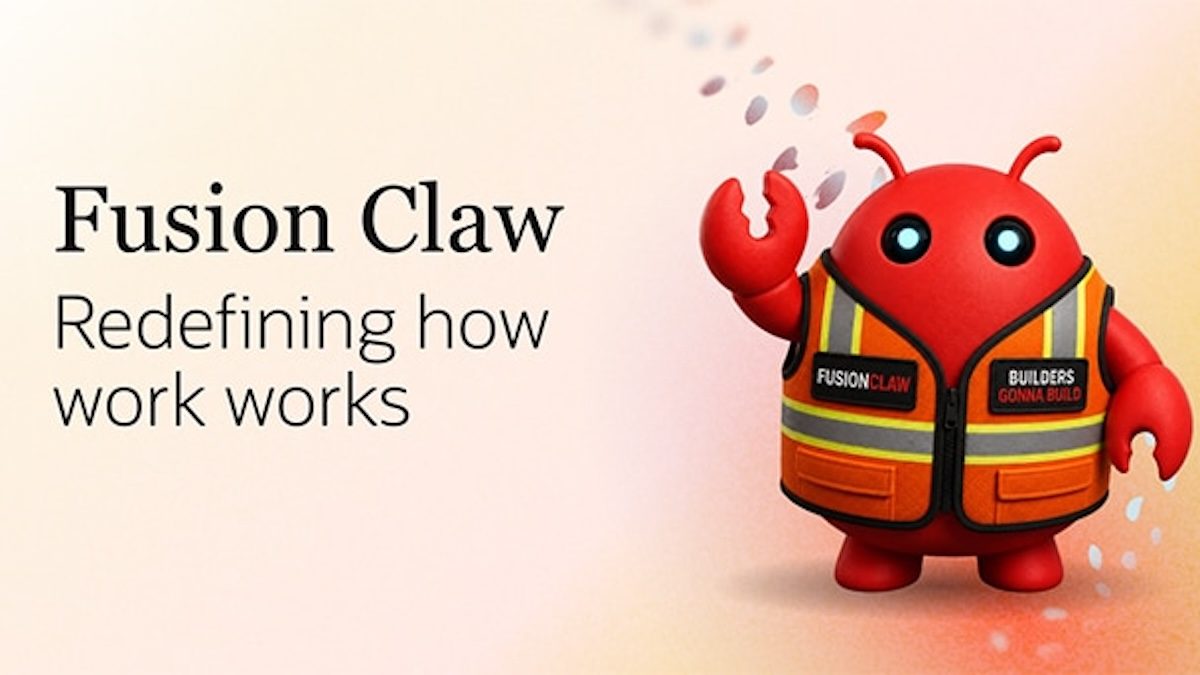
Oracle has launched Fusion Claw, a new execution environment designed to let its artificial intelligence agents carry out complex, long-running enterprise work, from financial calculations to workforce planning, logistics, or sales. The offering combines AI models capable of reasoning with deterministic computing and a permissions and auditing system meant to keep control in place as agents move from suggesting actions to actually carrying them out.
Oracle Fusion Claw in 20 seconds
- Oracle introduces Fusion Claw as a runtime for executing enterprise work with AI agents.
- The system combines model reasoning with deterministic calculations.
- 25 new agentic applications arrive for finance, HR, logistics, and sales.
- Companies can define permissions, limits, approvals, and levels of autonomy.
- Every execution generates an auditable record of decisions, evidence, and actions taken.
The launch of Fusion Claw reflects one of the shifts under way in enterprise software. Until now, much of enterprise AI software has focused on answering questions, summarizing documents, or helping employees complete tasks. Oracle wants to take that model a step further: letting an agent receive a goal, analyze conditions, make decisions within set limits, and carry out the work required.
The key is that Oracle doesn’t frame that autonomy as unlimited access to corporate systems. Fusion Claw includes a governance structure that determines what each agent can do, with what data, under what conditions, and when it needs human approval.
From enterprise chatbot to an agent that executes processes
Oracle describes its Fusion Agentic Applications as outcome-oriented applications. Rather than simply offering a specific function, they coordinate different steps to achieve a business goal.
Fusion Claw provides the execution environment that lets those applications take on more complex work, with processes that can run longer and require continuously reviewing conditions.
The architecture separates two kinds of work. On one side is the reasoning done by the AI model, which can analyze a situation, draw up a plan, and adapt it as circumstances change. On the other is deterministic execution, used for operations where the outcome has to follow precise rules and calculations.
That separation is one of the most notable technical features of the announcement. Oracle argues it doesn’t make sense to use AI reasoning for every operation when part of the process can be solved with conventional computing.
In a financial process, for example, an agent might investigate an anomaly and decide what information it needs to check, while certain calculations run through deterministic business logic.
Oracle believes this model can cut the cost of running complex processes by using advanced models only where they actually add value, and reserving conventional computing for repetitive, high-volume tasks.
25 applications to put agents to work
Fusion Claw arrives alongside 25 new agentic applications, according to Oracle. The company is aiming them at different areas of its Fusion applications, building on the agentic applications it began bringing to the core of Fusion Cloud earlier this year.
One of them is Ledger, aimed at finance. It can work through large volumes of accounting entries to reconcile information, investigate exceptions and anomalies, and run financial analysis.
In human resources, Workforce Staffing generates staffing plans that factor in skills, certifications, availability, shifts, costs, labor rules, coverage, and service requirements. It can also compare alternatives and re-plan if conditions change, extending the agentic work Oracle had already brought to human resources to anticipate talent needs.
For the supply chain, Shipping Consolidation analyzes different options for consolidating shipments. The system weighs factors such as capacity, dates, costs, and service commitments before moving the selected plan into governed execution once it has authorization.
In sales, Account Territory Growth Plan can compare different sales-territory configurations and analyze their effects on coverage, opportunities, capacity, and other business constraints.
These are examples of the kind of work Oracle wants to delegate to its agents. It isn’t just about generating content or answering a query, but analyzing a problem with multiple variables and carrying a decision through to execution.
Autonomy comes with permissions and limits
The most delicate point of this strategy is precisely autonomy.
An agent that can execute a transaction needs different controls than an assistant that simply answers a question. For Fusion Claw, Oracle has created what it calls the Enterprise Operating Envelope, a framework that brings together an organization’s objectives, procedures, policies, restrictions, permissions, risk thresholds, decision rights, approval requirements, and escalation limits.
That framework is applied to each execution through an Outcome Trust Harness. According to Oracle, this mechanism controls identity, available capabilities, the data an agent can use, and the actions it can carry out.
The company also allows configuring different degrees of autonomy. A process can stay in assistance mode, require approvals at certain steps, or reach fully automatic execution as long as the actions fall within delegated authority.
That last part matters especially in enterprise applications. The question is no longer simply whether a model can perform a task, but what permissions it has to do so without human intervention.
Oracle is trying to move that distinction into the runtime itself, so autonomy can be configured according to risk and process type.
Every outcome leaves an audit trail
Fusion Claw also includes a system called Outcome Receipt, which records what happened once an execution finishes.
Oracle explains that this record captures the authority applied to the process, the evidence used, the decisions made, the actions and transactions carried out, and the result obtained.
In practice, this aims to answer one of the questions that comes up as agents start making business decisions: what exactly did the system do, and why.
That traceability can matter especially in financial, HR, or supply-chain processes. A company may need to reconstruct what information an agent used, what rules it had available, and what operations it performed.
The record doesn’t automatically make an AI decision correct, but it provides a way to document execution within the enterprise environment.
Oracle also includes observability capabilities, ROI measurement, and security controls within its agent ecosystem.
Gemini and OpenAI are part of the new architecture
Fusion Claw runs on Oracle Cloud Infrastructure (OCI) and uses frontier models from different providers. Oracle specifically mentions Gemini and OpenAI, and says it plans to add other models later.
That separates the model’s intelligence from the enterprise infrastructure that controls execution. The model provides reasoning and the ability to adapt, while Fusion Claw supplies the business context, the permissions, the rules, and the mechanisms for carrying out actions.
The offering also connects with Oracle AI Agent Studio for Fusion Applications, which lets companies build and manage agents using no-code and pro-code tools. Oracle also offers an Agentic Applications Builder for combining its own agents with those from partners and third parties.
The goal is for companies to be able to build agent systems on top of their existing applications without having to build from scratch all the infrastructure needed to govern their actions.
The announcement also includes statements from Accenture, Deloitte, Google Cloud, IDC, KPMG, and PwC backing the shift toward agents capable of executing more complex business processes. These are assessments included by Oracle in its own communications, not an independent evaluation of the product.
What Fusion Claw represents, in any case, is a clear evolution of the enterprise agent concept. An assistant that answers questions is relatively easy to picture. The next step is a system that receives a goal, analyzes constraints, compares scenarios, calculates alternatives, asks for approval when needed, and carries out the authorized operations.
Oracle is trying to turn that process into a piece of enterprise infrastructure.
The difference between an interesting agent and one that’s genuinely useful to a company will no longer rest solely on how well it reasons. It will also depend on what data it can access, what systems it can modify, what limits it has, and how everything it does gets recorded.
Frequently Asked Questions
What is Oracle Fusion Claw?
It’s an execution environment for Oracle Fusion’s agentic applications that combines AI model reasoning with deterministic computing and enterprise controls to run complex processes.
How many applications does Fusion Claw include?
Oracle has introduced 25 new agentic applications based on Fusion Claw, including solutions for finance, human resources, logistics, and sales.
Can Fusion Claw execute actions automatically?
Yes. Oracle allows configuring different levels of autonomy, from assistance to fully automatic execution, within the permissions and limits set by the organization.
What is an Outcome Receipt?
It’s an audit record that, according to Oracle, documents the authority applied, the evidence used, the decisions made, the actions and transactions carried out, and the result of an execution.
