
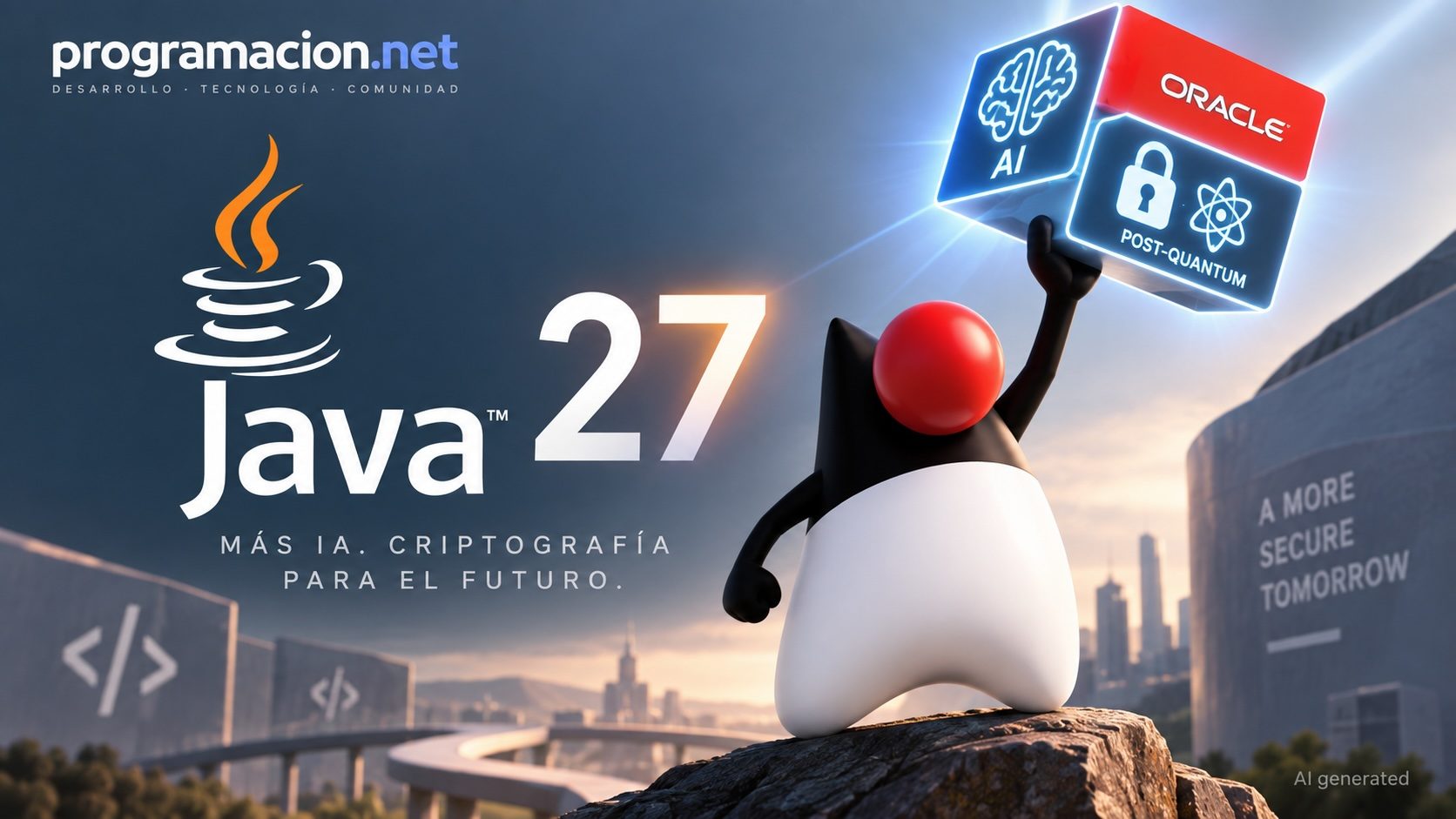
Oracle has announced Java 27, the new version of its development platform, with performance, security, and productivity improvements and special attention to two areas gaining weight in enterprise applications: artificial intelligence and post-quantum cryptography. The update adds a hybrid key exchange for TLS 1.3 and new features aimed at improving the efficiency of data applications, microservices, and AI workloads.
Java 27 and AI in 20 seconds
- Java 27 ships JEP 527, adding a hybrid post-quantum key exchange for TLS 1.3.
- The Vector API reaches its 12th incubation round to speed up processing, analytics, and AI inference.
- Structured Concurrency advances to its seventh preview for applications that coordinate multiple tasks.
- Compact object headers are now enabled by default to cut JVM memory usage.
- Oracle is also previewing JDK 28 with Project Valhalla progress and continues work on Project Leyden.
The update arrives at a time when Java remains present across a significant share of enterprise software, as development teams bring in AI models, distributed services, and applications that coordinate multiple operations at once.
Oracle has placed exactly that combination at the center of Java 27. The company doesn’t present the new version as an AI-specific language, but as an evolution of the platform for running enterprise applications that integrate models, agents, data, and distributed services.
One of the most significant changes sits outside AI proper. Java 27 adds post-quantum cryptography advances, an area aimed at preparing today’s systems against future quantum computers capable of breaking certain cryptographic algorithms in use today.
Java 27 adds a hybrid post-quantum key exchange
JEP 527, Post-Quantum Hybrid Key Exchange for TLS 1.3, adds a hybrid post-quantum key exchange for TLS 1.3. TLS is the protocol used to secure communications between applications and services.
Oracle ties this feature to the risk known as harvest now, decrypt later, in which an attacker can collect communications that are currently encrypted with the expectation of decrypting them once sufficient computing power becomes available.
The hybrid approach allows current cryptographic mechanisms to be combined with algorithms designed to withstand attacks from quantum computers. Oracle says this shift could matter for communications between services, AI models, agents, APIs, cloud platforms, and distributed applications, a theme it has also pursued in post-quantum security work for its critical databases.
Java 27 also ships JEP 538, covering PEM encodings for cryptographic objects, now in its third preview. The goal is to improve the handling of cryptographic material and interoperability with security tools and certificate management systems.
JEP 536, meanwhile, introduces in-process data redaction via Java Flight Recorder (JFR). This feature aims to reduce the exposure of sensitive information during diagnostic work on production applications.
Security gains an additional dimension with Oracle Jipher 20, now part of the Java Verified Portfolio. Jipher integrates an OpenSSL cryptographic module validated to FIPS 140-3 and adds support for post-quantum algorithms such as ML-KEM and ML-DSA.
Vector API and concurrency target AI workloads
Java 27 also brings changes that can directly affect data-intensive processing applications.
JEP 537, Vector API, reaches its 12th incubation round. This API lets developers tap into a processor’s vector instructions to run certain operations more efficiently without necessarily having to resort to specific native code.
Oracle points to analytics, AI inference, scientific computing, and multimedia processing among its possible uses. The goal is to boost data-processing performance while preserving the portability that defines the Java ecosystem.
Another important piece is JEP 533, Structured Concurrency, now in its seventh preview.
Structured concurrency is designed to simplify applications that run several related tasks in parallel. In an AI application, for example, a service might need to simultaneously call models, retrieve information, enrich data, and process results.
Java 27 provides tools to manage these tasks in a more structured way, with mechanisms aimed at improving aspects such as cancellation, error handling, and observability.
JEP 532, Primitive Types in Patterns, instanceof, and switch, also reaches a fifth preview, extending uniform handling of primitive types and objects in certain language constructs.
JEP 531, Lazy Constants, reaches its third preview and allows finer control over when certain constants are initialized. Oracle ties it to scenarios where resource usage and response time matter.
These features don’t turn Java into an AI platform on their own. Their role is more about efficiently running the applications that incorporate AI models and services.
Less memory, and a path toward JDK 28
One of the most visible performance changes is JEP 534, Compact Object Headers by Default. Java 27 enables compact object headers by default.
The change reduces the amount of memory tied to certain objects managed by the Java Virtual Machine (JVM). Oracle expects this to help increase application density on servers and reduce memory consumption in certain scenarios.
For large Java deployments, the change can matter especially when multiple microservices or applications run simultaneously. Oracle also ties it to data-intensive workloads and AI-enabled applications.
JEP 523 also sets G1 as the default garbage collector across all environments. G1, or Garbage-First Garbage Collector, is the system responsible for managing JVM memory by collecting objects the application no longer uses.
The change aims to deliver more consistent behavior across different runtime environments and simplify certain migrations to Java 27.
While Java 27 reaches general availability, Oracle is already showing part of what it’s preparing for JDK 28 through its early-access program.
One of the featured projects is Project Valhalla, which works on how Java represents data through value classes and objects. The goal is to narrow the gap between objects and primitive types and achieve denser, more efficient representations.
Oracle points to analytics, financial services, scientific computing, and artificial intelligence as possible beneficiaries of these advances. JDK 28 Early Access lets developers try these features before they eventually land in a final release.
Project Leyden also continues, aimed at reducing startup time, reaching peak performance faster, and shrinking memory footprint, among other approaches, through ahead-of-time compilation.
The release is rounded out with updates to other components of the ecosystem. Helidon 27, Oracle’s open-source Java framework for cloud-native microservices, gets a foundation built on virtual threads, declarative APIs, and modules for gRPC and messaging — continuing the same platform lineage covered in our look at Java 25’s 30th-anniversary release.
JavaFX 27 continues the evolution of the Java framework for graphical interfaces, with improvements that include a new Metal rendering pipeline on macOS and accessibility advances.
Oracle also notes that Java 27 is compatible with its Java Verified Portfolio offering, which bundles components with commercial support from Oracle.
For developers building AI applications, the update delivers several pieces that fit these systems’ needs: vector processing, structured concurrency, lower memory usage, and communications ready for post-quantum cryptographic algorithms. None of them is designed exclusively for AI, but together they’re part of Java’s evolution toward enterprise applications that handle more data and distributed services.
Frequently Asked Questions
What AI-related features does Java 27 include?
Java 27 includes the Vector API, aimed among other uses at data processing and AI inference, and Structured Concurrency, which simplifies coordinating the multiple parallel tasks common in modern applications.
What does Java 27 add against quantum threats?
JEP 527 adds a hybrid post-quantum key exchange for TLS 1.3. Oracle has also added post-quantum algorithms such as ML-KEM and ML-DSA in Jipher 20.
Does Java 27 use less memory?
Java 27 enables compact object headers by default, a change designed to reduce JVM memory consumption in certain scenarios.
What is Oracle preparing for Java 28?
JDK 28 Early Access lets developers try advances related to Project Valhalla. Oracle also continues developing Project Leyden to improve the startup time, performance, and memory footprint of Java applications.
