
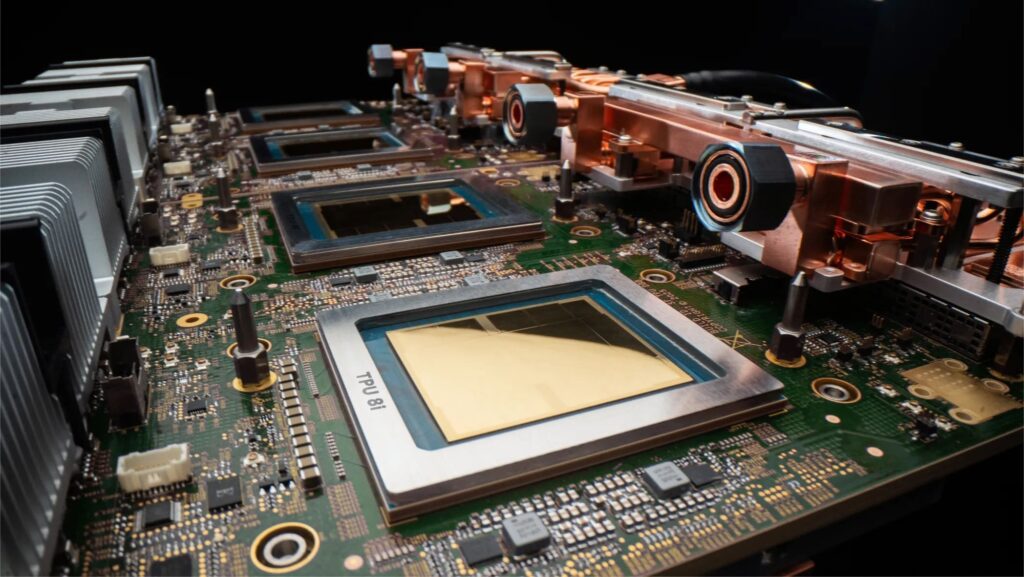
Oracle will offer Google’s TPUs, the AI accelerators Google designs for its own data centers, within Oracle Cloud Infrastructure (OCI) starting in 2027. According to the announcement, this is the first time these chips will be available on a hyperscale cloud platform outside Google. The companies announced it on October 27, 2026, at Oracle AI World in Las Vegas.
Google’s TPUs on Oracle Cloud in 20 seconds
- OCI will offer Google’s eighth-generation TPUs: TPU 8t for training and TPU 8i for inference.
- They will arrive in 2027, with deployment growing over several years.
- Oracle provides the power, cooling, and networking of its data centers.
- No pricing, regions, or customers have been announced yet.
TPUs (tensor processing units) are Google’s alternative to NVIDIA’s GPUs for training and running AI models. Until now, anyone wanting to use them in the cloud had to go through Google Cloud. Oracle’s announcement changes that: OCI customers will be able to choose TPUs within the same cloud where they already have GPUs, depending on the workload, performance, and cost.
TPU 8t and TPU 8i, the Eighth Generation
Oracle will bring to OCI both variants of the eighth generation, which Google unveiled in April and which cloudnews.tech covered as designed for the AI agent era. TPU 8t is geared toward training: according to Google, it cuts frontier-model development cycles from months to weeks and delivers almost three times more compute capacity per pod than the previous generation. TPU 8i is designed for inference, particularly for the iterative workload of many specialized agents.
The workloads the companies mention are training and post-training of large models, both dense and mixture-of-experts (MoE), and production inference for reasoning, agents, and long-context applications. Oracle contributes the physical infrastructure: the power, cooling, and networking of its data centers to deploy TPUs at scale.
A Cloud With Multiple AI Architectures
Mahesh Thiagarajan, president of Oracle Cloud Infrastructure, argues that bringing TPUs to OCI gives customers access to several of the leading AI compute architectures within a single cloud. Amin Vahdat, Google’s senior vice president and chief AI and infrastructure technologist, presents TPUs as a powerful option purpose-built for demanding training and inference workloads.
For Oracle, the deal expands an AI catalog that until now has centered on GPUs, a business in which the company delivered more than 300,000 GPUs in three months. For Google, it’s a way to bring its chips to more customers without requiring them to migrate to its cloud, at a time when TPUs are being positioned as a cost-based alternative to NVIDIA, as cloudnews.tech analyzed in Google’s TPUs challenge NVIDIA. Tools like TorchTPU, which runs PyTorch natively on TPUs, point in the same direction: reducing the friction for those who don’t develop on Google’s own software.
The announcement leaves many questions open. The companies have not detailed pricing, regions, capacity volumes, or customers, and availability for now is limited to 2027, with deployment set to grow over the following years.
Frequently Asked Questions
What has Oracle announced with Google?
That it will offer Google’s TPUs, the eighth-generation TPU 8t and TPU 8i, within Oracle Cloud Infrastructure.
When will TPUs be available on OCI?
In 2027, with deployment growing over several years.
What’s the difference between TPU 8t and TPU 8i?
TPU 8t is designed for training models, and TPU 8i for inference and agent workloads.
Is this the first time TPUs have left Google Cloud?
According to Oracle’s announcement, which includes statements from Google, this is the first time they have been offered on a hyperscale cloud other than Google’s own.
Sources:
