
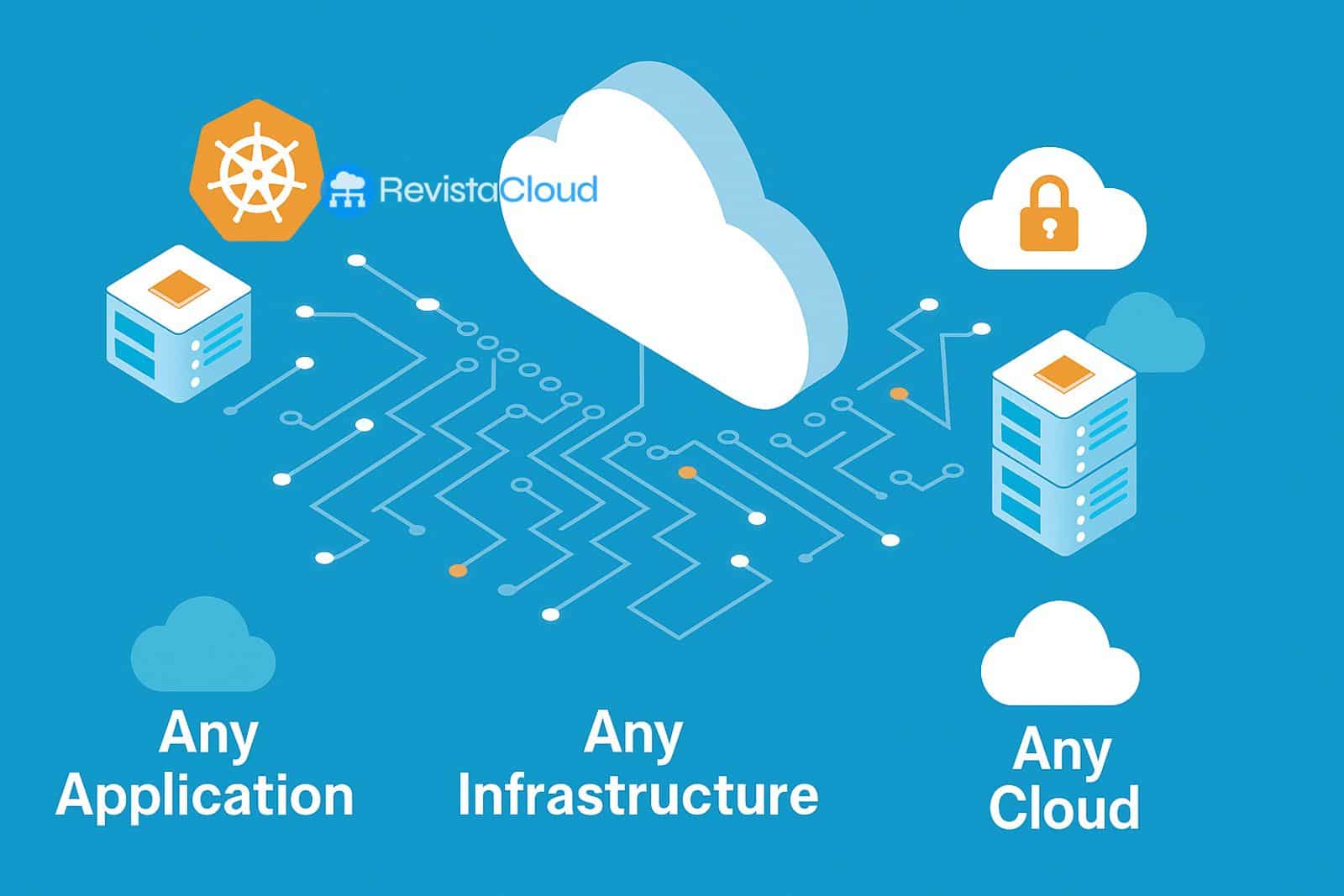
OpenNebula Systems has joined VAST Cosmos, the tech community driven by VAST Data, to develop joint infrastructure for AI factories and gigafactories. The collaboration aims to integrate OpenNebula’s cloud, GPU, virtual machine, Kubernetes, and bare-metal management with VAST’s data platform — a combination designed for large-scale AI deployments that require resource sharing among multiple users and running training and inference at scale.
The key points of the OpenNebula and VAST Data partnership in 20 seconds
- OpenNebula Systems joins VAST Cosmos as a technology partner.
- The integration combines cloud and GPU infrastructure management with VAST AI Operating System data platform.
- It targets AI factories, gigafactories, HPC, and new GPU cloud providers.
- Both companies will prepare reference architectures and joint deployment models.
- Europe plans to deploy 19 AI factories and up to five gigafactories.
This alliance comes at a time when building AI infrastructure is no longer just about accumulating GPUs. Training models, fine-tuning them, and maintaining inference applications in production require compute, network, and storage to work as a unified environment — especially when different companies, researchers, or departments share the same hardware.
That’s precisely the space these two companies aim to address. OpenNebula will serve as the resource management layer for infrastructure, while VAST will provide data services for models and applications.
The collaboration also has a European dimension. OpenNebula Systems is based in Madrid and has emphasized technological sovereignty and open infrastructure as key pillars of its platform. Meanwhile, the European Union is investing public and private resources to create its own AI computing infrastructure network.
An AI factory needs much more than just GPUs
Early large AI infrastructures were heavily dependent on accelerators, mainly GPU availability. While acquiring enough GPUs remains critical for training large models, the growth of these systems has shifted some of the infrastructure challenges to other areas.
Thousands of accelerators need continuous data flow. Models must be stored, checkpoints saved during training, datasets accessed, information retrieved during RAG (Retrieval-Augmented Generation), and results served through inference.
Meanwhile, commercial infrastructure must allocate resources among different clients efficiently.
OpenNebula and VAST Data propose an architecture that addresses both needs through differentiated functions:
OpenNebula manages the provisioning and lifecycle of compute resources, including VMs, Kubernetes clusters, physical servers, and GPU-accelerated systems. VAST AI Operating System supplies the data layer needed for these workloads.
The integration also includes various strategies for connecting storage and compute.
Performance-sensitive workloads can have direct high-speed access to data platforms. In shared environments, storage can be integrated via virtualization layers, with OpenNebula managing isolation, policies, and VM lifecycle.
Services for shared storage access directly to VMs, containers, and AI applications are also planned.
This approach avoids all workloads requiring identical storage access models. Intensive training on hundreds or thousands of GPUs has different needs compared to inference applications, development environments, or multi-tenant services.
From GPU clusters to shared infrastructure
The agreement reflects how the concept of AI infrastructure is evolving.
An organization might start by deploying a dedicated GPU cluster for training. The challenge is converting this hardware into a platform used daily by different teams or even as a service offering.
This requires traditional cloud features: multi-tenancy, isolation, automation, virtual networks, VM management, Kubernetes, access policies, and on-demand resource provisioning.
AI-specific considerations then come into play.
GPU resources are costly and should be kept busy as much as possible. Storage must feed accelerators rapidly to prevent idle time. Checkpoints are needed for recovery, and inference systems require continuous access to models and knowledge bases.
OpenNebula and VAST aim to develop a reference architecture that integrates these components.
They will create deployment models combining accelerated compute, AI data services, virtualization, Kubernetes, automation, and workload orchestration.
The joint platform is designed to support NVIDIA’s accelerated systems, including Grace Blackwell-based environments, according to both companies.
It’s not limited to a single data center type. The architecture includes on-premises facilities, sovereign clouds, hybrid infrastructures, commercial GPU providers, research centers, and geographically distributed AI factories.
Europe is preparing a new generation of large-scale AI infrastructure
The timing of this alliance is especially relevant in Europe.
The European Commission is currently deploying 19 AI factories across 16 EU countries, most operational before the end of 2026. These facilities leverage European supercomputing infrastructure to provide capacity to startups, industry, and researchers.
The next step is gigafactories.
The «Continent of AI» Action Plan envisions creating up to five AI gigafactories, much larger facilities designed to train and run the most demanding AI models. The InvestAI initiative aims to mobilize €20 billion specifically for these infrastructures, as part of a broader goal to raise €200 billion for AI in Europe.
European strategy also aims to at least triple the capacity of the Union’s data centers over the next five to seven years.
This creates a market that extends well beyond accelerator manufacturers.
A gigafactory requires servers, ultra-high-capacity networks, storage, power, cooling, management software, cybersecurity, and systems capable of allocating infrastructure across multiple projects.
Within this, virtualization platforms, Kubernetes, infrastructure managers, and AI-specific technologies compete for adoption.
OpenNebula aims to occupy part of this space as an open, vendor-neutral platform. It offers technology as an control plane capable of managing traditional virtualized infrastructure, GPU clusters, and AI factories.
VAST Data addresses one of the most demanding pieces: moving and maintaining data availability for these accelerators.
Technological sovereignty and new GPU cloud providers
This collaboration also targets an emerging market: the so-called Neoclouds, providers specializing in delivering accelerated infrastructure via GPUs.
Unlike the major hyperscalers, these companies often focus heavily on AI and high-performance computing (HPC).
For them, GPUs alone are not enough. They need to turn physical servers into services that can be assigned to different clients, control their isolation, and provide storage and networking matching the cost of the accelerators.
OpenNebula and VAST see these providers as key markets for their joint architecture, alongside HPC centers, enterprise platforms, scientific projects, and national AI infrastructures.
Sovereignty also matters, especially within the EU. The European Commission prioritizes reducing dependencies in areas like AI, cloud, semiconductors, and open-source software.
Their architecture doesn’t eliminate dependencies but offers flexibility: it’s compatible with systems like NVIDIA’s accelerators and can be deployed in data centers owned by different providers, rather than being tied to a single public cloud.
OpenNebula reports its technology is in over 5,000 cloud deployments and capable of managing thousands of hosts and tens of thousands of GPUs, according to the company’s own data.
Next steps include moving from this joint effort to specific projects. Both OpenNebula Systems and VAST Data are working together on commercial opportunities in Europe and beyond, especially around AI factories, gigafactories, HPC, and Neoclouds.
Beyond the partnership, this movement indicates where AI infrastructure is heading. The initial race was about acquiring GPUs; the next is about enabling thousands of accelerators, petabytes of data, and multiple users to operate as a shared platform — a true cloud service.
Frequently Asked Questions
What have OpenNebula Systems and VAST Data announced?
OpenNebula Systems has joined VAST Cosmos as a technology partner. Both companies will develop an architecture that combines OpenNebula’s cloud and GPU management with VAST’s AI data platform (VAST AI Operating System).
What is this infrastructure used for?
It’s designed for model training and tuning, inference, RAG, scientific computing, and other workloads that are data and GPU intensive. It will also support managing shared environments for multiple users or clients.
What’s the difference between an AI Factory and an AI Gigafactory?
European AI factories provide supercomputing capacity, data, and services to companies, researchers, and industry. Future gigafactories will be much larger facilities aimed at training and running highly complex AI models.
How many AI factories does Europe plan to deploy?
The European Commission is working on 19 AI factories across 16 member states and plans to create up to five gigafactories. InvestAI aims to mobilize €20 billion to support these giga-scale facilities.
