
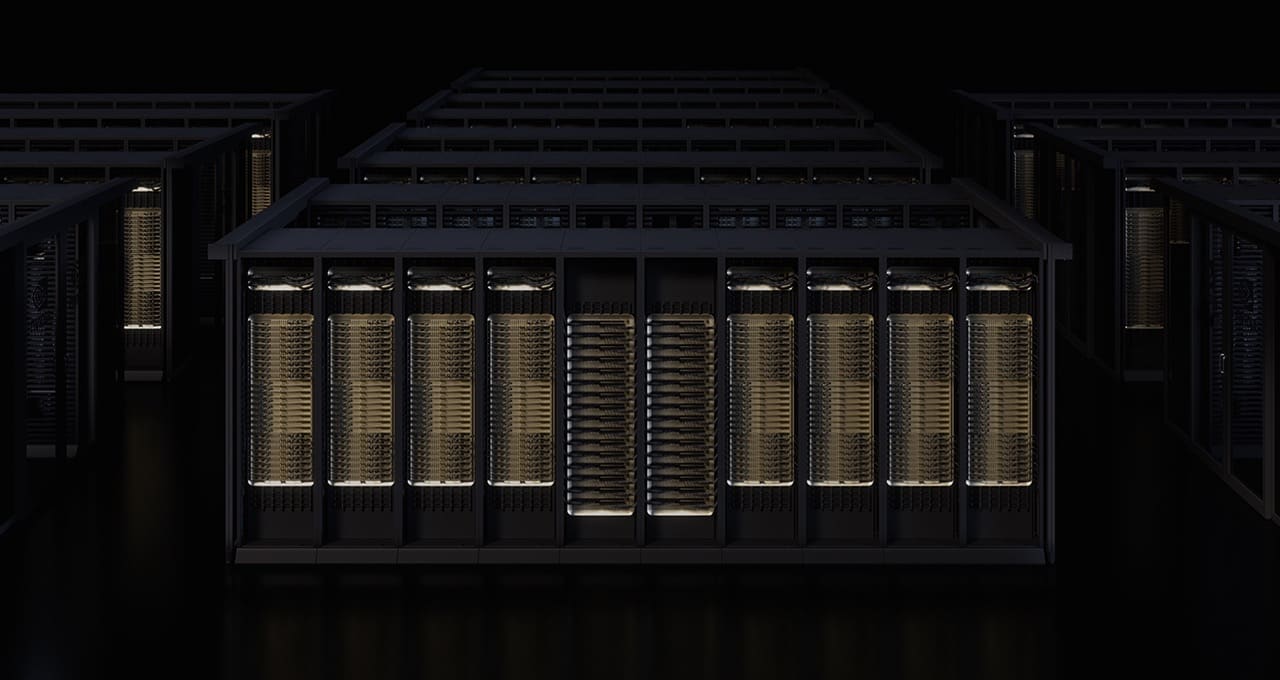
The race for Artificial Intelligence is no longer solely decided by training giant models. The focus has shifted to a less visible but more business-critical area: inference, that is, the ability to respond to millions of queries in real-time with low latency and controlled costs. In this context, several recent reports point to a high-profile movement: NVIDIA might be preparing a new inference-oriented processor that incorporates Groq’s design/technology and will be showcased at GTC 2026. Meanwhile, OpenAI has already announced that it has secured 3 GW of dedicated inference capacity with NVIDIA, positioning itself among the main clients of this new platform.
The news comes just days after OpenAI confirmed a $110 billion funding round, elevating its valuation to $730 billion “pre-money” and $840 billion “post-money”, with Amazon, SoftBank, and NVIDIA as key investors. The subtext is clear: money not only fuels growth but also pays for power, racks, chips, and priority access.
From training models to serving responses: why inference has become the bottleneck
In 2026, training remains expensive, but inference has become a persistent and massive cost. An assistant like ChatGPT doesn’t turn off: it handles peaks, supports enterprise deployments, integrates agents and automations, and competes in a market where user patience is measured in seconds.
Therefore, manufacturers are trying to separate the “training chip” from the “serving chip.” According to the Wall Street Journal, NVIDIA is designing a new inference system that could “reset” part of the AI hardware race by focusing on responding to queries more quickly and efficiently—an especially sensitive issue for workloads like programming or agents calling other tools. Reuters also reports that OpenAI has expressed dissatisfaction with NVIDIA’s current inference offerings for certain scenarios and has been exploring alternatives in recent months.
Groq’s role: licensing, technology, and a “fit” with NVIDIA
Groq is known in the industry for its focus on low-latency inference. At the end of 2025, Groq announced a non-exclusive licensing agreement with NVIDIA for its inference technology and confirmed that part of its team—including founder Jonathan Ross and President Sunny Madra—would join NVIDIA to help integrate and scale that technology. Reuters describes the deal as a high-profile operation (estimated figures from CNBC), structured as licensing plus talent acquisition, keeping Groq independent in its business.
This context aligns with the circulating rumors about GTC 2026: NVIDIA’s new inference platform could feature a chip designed by Groq or based on its technology. It’s not about replacing training GPUs (where NVIDIA remains dominant), but rather creating a more efficient pathway for models in day-to-day production.
OpenAI, 3 GW of dedicated inference and a market signal
OpenAI hasn’t publicly detailed which hardware will host these 3 GW of dedicated inference, but the figure appears in its own funding announcement, alongside 2 GW of training capacity on Vera Rubin systems. This connects with the reports from WSJ and Reuters: NVIDIA’s new inference processor expected at GTC 2026 would be a key piece to meet this need.
In practice, 3 GW isn’t a “big order”: it’s a strategic decision. It signals infrastructure at a national scale, not just a lab. It also indicates a shift in OpenAI’s priorities: while training defines the model’s upper limit, inference shapes the business, user experience, and energy costs.
Reuters adds an important nuance: OpenAI’s goal isn’t to replace its entire hardware fleet but to cover part of its inference needs with more efficient hardware—implying a hybrid architecture (different platforms for various tasks) rather than a “NVIDIA-only” or “alternative-only” approach.
AWS’s piece: 2 GW of Trainium and $100 billion over 8 years
OpenAI’s movement isn’t isolated from NVIDIA. In its strategic agreement with Amazon, OpenAI commits to consuming approximately 2 GW of Trainium capacity and extends an existing deal with AWS worth $100 billion over 8 years. Additionally, AWS becomes a third-party cloud provider for Frontier (an OpenAI agents platform), while OpenAI maintains that Azure remains the exclusive host for its “stateless” APIs and that its relationship with Microsoft is unchanged.
The takeaway is clear: OpenAI is buying optionality. It diversifies supply, reduces dependence on a single stack, and most importantly, ensures capacity in a market where demand outpaces supply.
The era of mega-rounds: OpenAI isn’t alone
To understand the landscape in 2026, look around. AI funding has become a parallel competition: wins go to those with the best models and those who can pay for infrastructure.
| Company | Funding Round | Amount | Valuation Announced |
|---|---|---|---|
| OpenAI | Feb 2026 | $110 billion | $730 billion pre / $840 billion post |
| Anthropic | Feb 2026 | $30 billion | $380 billion post |
| xAI | Jan 2026 | $20 billion | (not disclosed in announcement) |
| Mistral AI | Sep 2025 | €1.7 billion | €11.7 billion post |
| Cohere | Aug 2025 | $500 million | $6.8 billion |
The common pattern: capital isn’t only raised to hire talent or grow users but to cover the significant costs of modern AI—computing, energy, and global deployment.
What to expect from GTC 2026 and why it matters
Although official specifications are yet to be confirmed, NVIDIA showcasing an inference product with Groq’s technology would send a clear message: the future isn’t just more training GPUs but specialized hardware for serving models, reducing latencies, and increasing efficiency per query.
For OpenAI, this would mean solidifying a multi-vendor infrastructure strategy, where each “gigawatt” is allocated to a different workload: frontier training, inference for consumption, enterprise inference, and agents. For the industry, it confirms that the real battleground is in production, where AI must be profitable, fast, and reliable.
Frequently Asked Questions
What does “3 GW of dedicated inference capacity” at OpenAI mean?
It involves reserving large-scale energy and compute infrastructure to run models in production and respond to real-time queries.
What is the relationship between NVIDIA and Groq in this new inference chip era?
Groq announced a technology license with NVIDIA and the integration of part of its team into NVIDIA; reports suggest NVIDIA will incorporate this technology into a new inference-focused platform.
Why is OpenAI so focused on inference rather than just training models?
Because user Experience and operational costs depend on low-latency responses; inference has become the main operational bottleneck.
How does AWS fit into OpenAI’s infrastructure strategy?
OpenAI will expand its agreement with AWS to consume around 2 GW of Trainium capacity while maintaining Azure as the exclusive provider for its “stateless” APIs.