
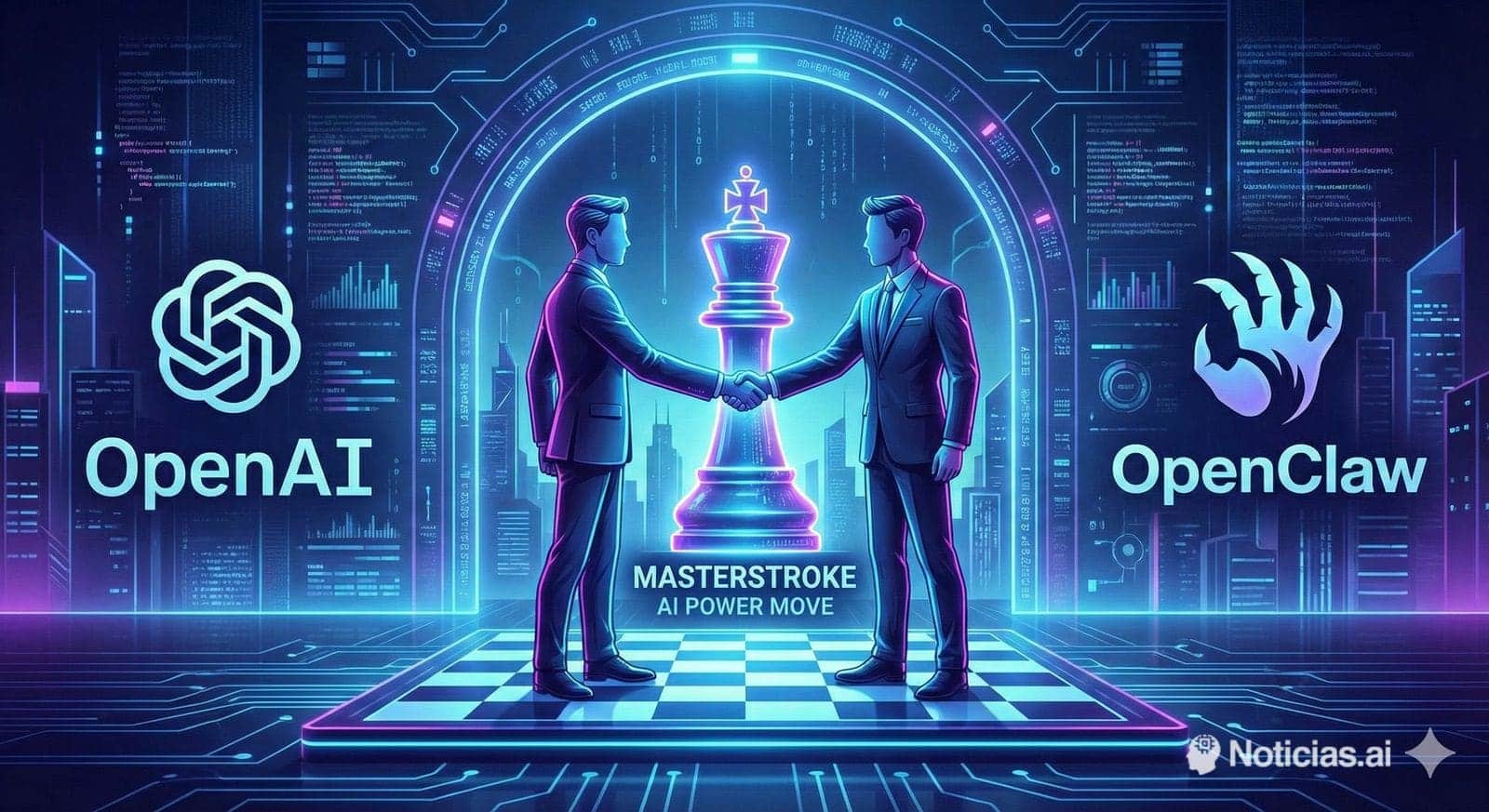
OpenAI has incorporated Peter Steinberger, creator of the open-source assistant OpenClaw, in a move that strengthens the idea that the next big phase of AI won’t just be about “speaking better,” but also doing more things: executing real tasks, coordinating tools, and chaining actions with controlled autonomy. The announcement was made public by Sam Altman on X, where he assured that Steinberger will work on “the next generation of personal agents” and described the future as “extremely multi-agent.” The message included a key commitment to address the community’s usual concerns: OpenClaw will remain open source, will become managed under a foundation, and OpenAI “will continue supporting it.”
The combination of signing and a promise of continuity is intentional. In the industry, “agents” have shifted from being an experimental concept to a product frontier. The simple difference, in theory, is: a chatbot responds; an agent acts. This entails connectors with email, calendar, messaging, tickets, purchases, reservations, or internal tools, with the risks and power that come with allowing software to execute actions on behalf of the user.
From viral experiment to strategic asset
OpenClaw has become one of the most talked-about projects of the tech winter due to its rapid growth. Reuters noted that the repository exceeded 100,000 stars on GitHub and attracted 2,000,000 visitors in a single week, positioning it among phenomena that leap from niche to mainstream conversation within days. This kind of traction often marks a turning point: when a project demonstrates real utility (not just a “demo”), major providers start to move in to attract talent and capitalize on the momentum.
The public narrative around OpenClaw also aligns with the market shift toward “operational” assistants: tools capable of managing emails, automating tasks, or executing repetitive actions from the user’s computer. In an ecosystem where productivity benefits are measured by minutes saved and workflows completed—not eloquence of description—the appeal for a lab like OpenAI is clear.
What does it mean for OpenClaw to become part of a foundation?
That OpenClaw “lives in a foundation” is more than a reassuring phrase; it’s a governance model often used in open-source software when the goal is to separate the project’s future from a single company, enable contributions from multiple stakeholders, and ensure continuity. Practically, a foundation can set rules for branding, licensing, technical direction, and contributions, reducing the risk that a company absorbs, closes, or fragments the initiative.
In a blog post, Steinberger stated that he is joining OpenAI to work on “bringing agents to everyone” and reaffirmed that OpenClaw will remain open and independent, now under a foundation structure. Meanwhile, Altman emphasized the importance of “supporting open source” in a future where multiple agents will interact to execute useful tasks.
The battle for agents: product, not just model
The clear message for a tech outlet is that OpenAI is attempting to turn the concept of an agent into a core part of its offering, competing in the product space with other players also pushing automation and workflow solutions. The hiring of Steinberger suggests that OpenAI aims not just for better reasoning or coding capabilities, but for experience in transforming agents into installable, usable, and integrable components connected to everyday channels and tools.
At the same time, analyses highlight that the “multi-agent future” isn’t about a single super-assistant, but about an architecture with roles: one agent plans, another executes, a third reviews risks, and a fourth verifies outcomes. This approach aligns with reducing errors through cross-checking, especially relevant as AI moves from text generation to interacting with systems: sending emails, transferring payments, modifying reservations, or deploying code.
The tricky angle: security, permissions, and supply chain
If there’s a reason why the agent debate is more heated than that around chatbots, it’s the attack surface. A useful agent needs permissions. And in the real world, permissions mean credentials, tokens, data access, and the ability to perform actions. Reuters even highlighted regulatory concerns related to cybersecurity risks and data exposure if such software is misconfigured—reminding us that automation amplifies both productivity and potential errors.
For sysadmins and development teams, the onboarding of agents into mass-market products carries a familiar checklist, even if the packaging is new:
- Least privilege: tokens with limited scope, permissions per action, short expiry, and separation by environment (dev/test/prod).
- Audit and traceability: action logs, “who did what” (even if the “who” is an agent), and proper retention for investigation.
- Connector and extension control: dependency review, signature policies, trusted repositories, and behavior analysis.
- Secrets management: vaults, rotation, leak monitoring, and prohibiting embedded credentials.
- Safe modes: simulation (“dry-run”), human confirmation for sensitive actions, and impact/spending limits.
The question ultimately isn’t whether agents will arrive, but how they will: with what security mechanisms, what control guarantees, and what accountability models when tools facilitate automated actions.
A sign that sets the tone for 2026
In the short term, the move doesn’t clarify when visible results will appear in OpenAI products or how exactly the company will support the project. But it signals a direction: OpenAI believes that the next competitive advantage isn’t just about larger models, but about useful personal agents, connected to services and coordinated among themselves.
And in that landscape, OpenClaw serves as a practical example: an open-source project that went viral by addressing a concrete problem—automating real tasks—and proved that the market is ready to move from “chat” to “operation.” The big test now is whether the foundation, community, and corporate support can sustain the project’s open spirit while accelerating its evolution toward more reliable, secure, and deployable agents.
Frequently Asked Questions
What is OpenClaw, and why has it become so popular?
It’s an open-source assistant focused on agents that execute real tasks and automate connected workflows with everyday tools. Its adoption skyrocketed due to its practical utility and ease of experimentation.
Will OpenClaw remain open source after its creator joins OpenAI?
Yes. According to the announcement, OpenClaw will become a foundation-managed open-source project, with OpenAI maintaining support.
What does “multi-agent future” mean in AI products?
An architecture where multiple specialized agents collaborate: planning, executing, reviewing risks, and verifying results—to complete complex tasks with greater control and fewer errors.
What security risks does a personal agent connected to email and apps pose?
The main risks involve permission abuse or misconfiguration exposing data or enabling unauthorized actions. These are mitigated through least privilege, auditing, connector control, and robust secret management.