
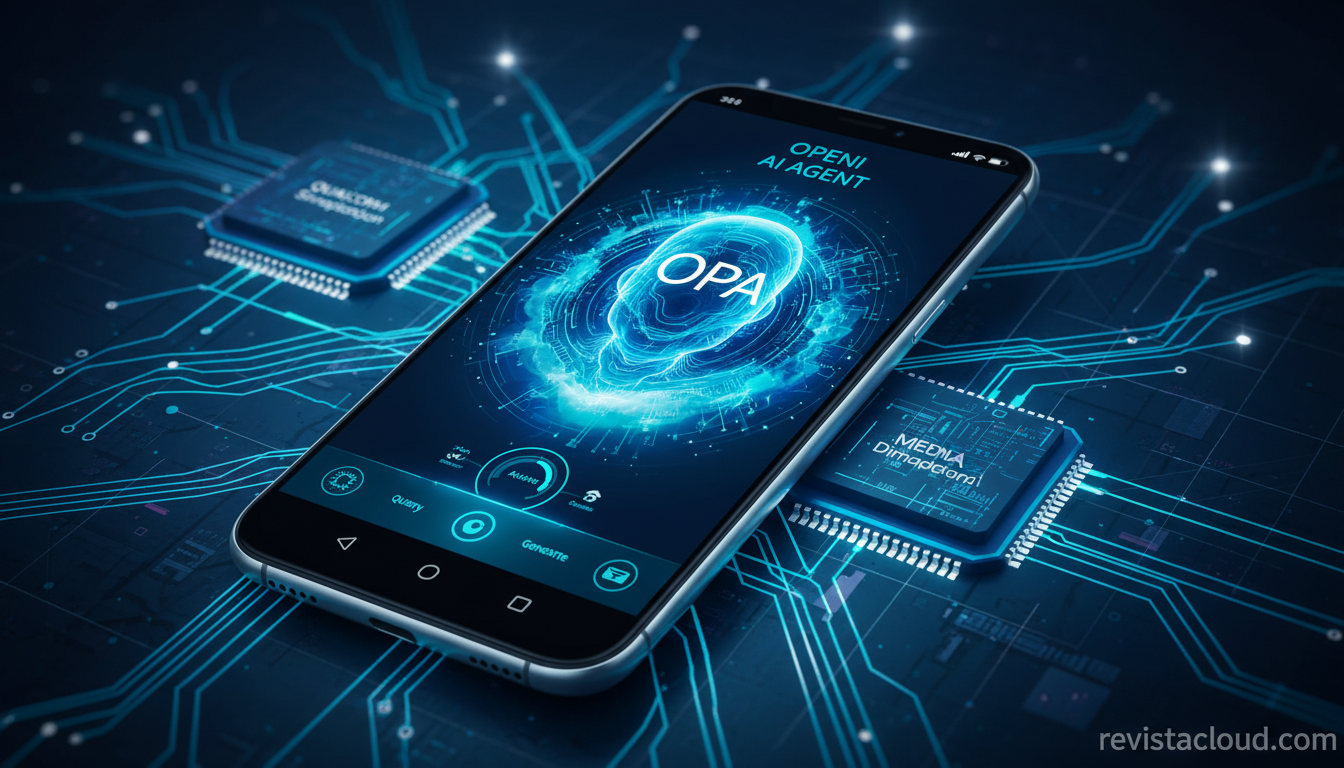
OpenAI has decided to enter the smartphone business big time. According to analyst Ming-Chi Kuo, the company is already working with Qualcomm and MediaTek on a custom processor, with Luxshare as the assembly partner, targeting an annual shipment range of 300 to 400 million units. This figure alone presents a direct challenge to the iPhone.
It’s the first time that OpenAI is placing such emphasis on a mass-market device. Until recently, their hardware bets were smaller products: a pair of earbuds internally code-named Sweetpea (with an expected commercial brand Dime, featuring a Samsung Exynos processor at 2 nm for local processing) and a pen-shaped device, Gumdrop, without a screen, designed to be carried in a pocket or worn around the neck. Kuo’s conclusion is clear: that plan has taken a backseat—for now—compared to the smartphone project.
What exactly does Ming-Chi Kuo say?
Kuo, known for tracking Apple’s supply chain in Asia, published details on X. He states that the smartphone’s specifications should be finalized by late 2026 or early 2027, and it will be a premium device. The centerpiece is the processor, developed in collaboration with Qualcomm and MediaTek. Luxshare, already a critical assembly supplier for Apple, would handle the device’s manufacturing.
Custom processor with Qualcomm and MediaTek
The involvement of two competitors like Qualcomm and MediaTek in the same project hints at the final architecture. Each partner likely contributes different components: Qualcomm dominates mobile connectivity and advanced DSPs, while MediaTek has experience with efficient NPUs and high-volume chips. OpenAI aims to have silicon optimized for local inference models, with blocks tailored for their specific weights and latency needs.
This approach echoes Apple’s strategy with the A-series and M-series chips: vertical integration to ensure that the chip, system, and user experience are perfectly aligned. The key difference is that OpenAI doesn’t control the foundry; it will depend on TSMC or Samsung Foundry to process wafers on 2 nm or smaller nodes when the time comes.
The smartphone as a real-time user state device
OpenAI’s vision redefines the phone’s role. For Sam Altman and his team, the device should not be just an app menu but a permanent node that captures user context and relays it to an AI agent. The idea is to split inference workload between what the chip can handle locally and what is delegated to OpenAI’s cloud. This architecture requires specialized hardware to manage memory hierarchy, power, and data privacy.
If this vision materializes, the app-based business model that supports much of the iOS ecosystem could weaken. The App Store might cease to be the only showcase, with interactions with the AI agent becoming the primary interface. For Apple, which already relies on Google’s Gemini for some AI functions in Siri, this could be an uncomfortable scenario.
Why Luxshare is a key player
The choice of Luxshare as the assembler isn’t incidental. The Chinese company has been scaling its production capacity for Apple for years and understands the quality standards and volumes demanded by the premium segment. For OpenAI, working with Luxshare provides a quick path to hundreds of millions of units without building its own infrastructure. For Luxshare, it’s a significant client that diversifies its exposure to Cupertino.
What risks does OpenAI face?
The challenge is non-trivial. Building a globally oriented smartphone requires establishing a support network, certifications by country, agreements with carriers, and a logistics channel—all of which OpenAI currently lacks. Moreover, even if their AI agent subscription proves capable, it’s uncertain whether it justifies migrating from well-established iOS or Android ecosystems. Additionally, regulatory concerns loom: the EU, US, and China will scrutinize any device capturing full user context in real time.
The precedents of the Humane Ai Pin and Rabbit R1 serve as reminders: introducing new hardware into users’ pockets is very difficult. What distinguishes OpenAI is the strength of its brand and the momentum generated by ChatGPT, with hundreds of millions of monthly users. That user base could translate into genuine demand if the concept succeeds.
Schedule and upcoming milestones
According to Kuo, specifications should be finalized by late 2026 or early 2027. After that, typical high-end smartphone timelines suggest a first release window 12 to 18 months later, with initial production runs being modest before scaling up to the 300-400 million units annually mentioned by the analyst. The pace will be set by production at TSMC or Samsung Foundry and assembly at Luxshare.
Underlying all this is the ongoing “silicon chess” for AI inference. Enabling inference in the pocket has become a key part of the next hardware cycle, aligning with trends in data centers, where major software vendors are repositioning to serve enterprise AI agents. If OpenAI manages to embed its custom processor at the volumes predicted by Kuo, the smartphone landscape could look very different in five years.
Frequently Asked Questions
When will OpenAI’s smartphone arrive?
The specifications are expected to be finalized between late 2026 and early 2027, according to Ming-Chi Kuo. Commercial launch will take longer, probably 12 to 18 months after hardware finalization, making a realistic window between late 2027 and the first half of 2028.
Who is manufacturing the processor?
Qualcomm and MediaTek are collaborating on designing the custom processor with OpenAI. Chip fabrication will almost certainly be handled by TSMC or Samsung Foundry, as they are the only capable suppliers offering advanced 2 nm or smaller nodes on the planned schedule.
What volume is OpenAI aiming for?
The analyst estimates annual shipments between 300 and 400 million units. This range is typical of the high-end global market, and if achieved, would place OpenAI at the top tier of the industry.
Will it be a replacement for the iPhone?
OpenAI sees it as a direct challenge. Their thesis is that the dominant interface will shift from app menus to the AI agent, eroding the traditional App Store model. Apple will need to respond if it wants to maintain its market share.
What about OpenAI’s previous products?
The Sweetpea (Dime earbuds with Exynos 2 nm) and Gumdrop (a pen-shaped device without a screen) projects are now secondary, according to Kuo. The company is focusing hardware resources on the smartphone because it remains the largest category of personal devices and the most direct way to bring their agents to hundreds of millions of users.
