
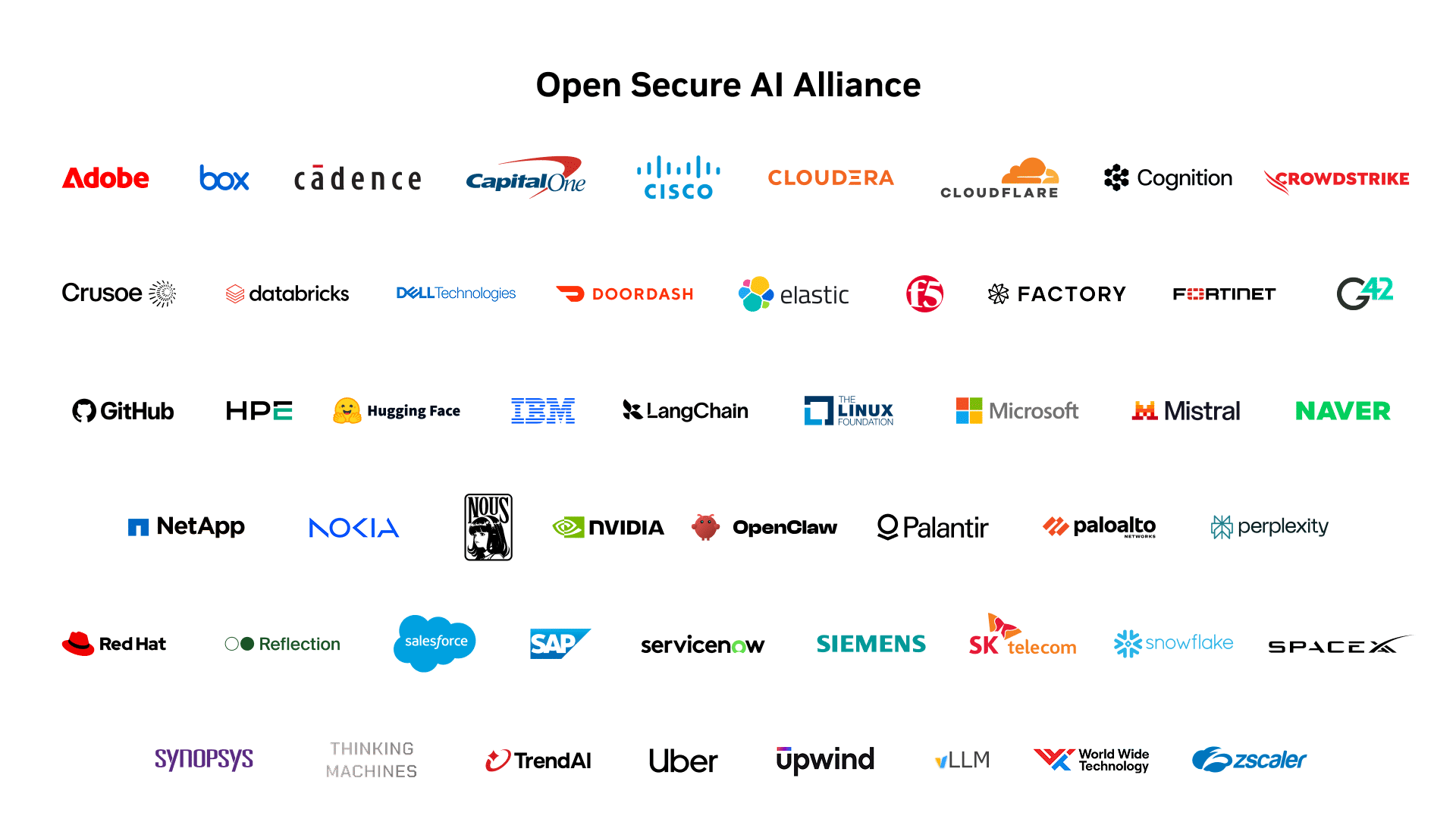
AI security is entering a new phase. Protecting the model or filtering its responses is no longer enough: agents can execute code, query databases, access enterprise tools, and act with real permissions. In response, NVIDIA, Microsoft, Cisco, Cloudflare, CrowdStrike, Hugging Face, IBM, Mistral, Red Hat, and dozens of other companies have created the Open Secure AI Alliance, an initiative aimed at developing open tools to safeguard models, agents, and software supply chains.
The key points of the Open Secure AI Alliance in 30 seconds
- Over 50 companies and organizations are participating in the new alliance.
- The goal is to create an open defensive stack for agents, models, and software.
- NVIDIA contributes NOOA, a framework for testing, tracking, and auditing agents.
- The initiative will also focus on identity, isolation, secure formats, and vulnerability analysis.
- The challenge will be transforming such a broad coalition into interoperable standards and widely adopted projects.
The alliance is based on a concrete technical idea: an AI agent is not just a language model. It is a system composed of the model, the controlling framework, the tools it can call, the permissions it receives, the logs it generates, and the policies that limit its behavior.
This set expands the attack surface. A flaw can occur in the model itself, but also in the agent’s harness, in an API call, in the identity system, in a plugin, in the weights format, or in an open-source dependency.
From model security to entire stack security
In recent years, much of the debate has focused on whether models should be open or closed. The Open Secure AI Alliance aims to shift the conversation toward a more practical question: what controls does an agent need to operate safely in production?
The answer involves multiple layers:
- Verifiable identity for agents and services;
- Least privilege permissions;
- Process isolation;
- Action traceability;
- Complete logging;
- Secure model formats;
- Code and vulnerability analysis;
- Continuous evaluation;
- Controls over tools and connectors;
- Supply chain protection.
This approach resembles cloud security or zero trust frameworks more than traditional model moderation. The issue is no longer just what an AI responds with, but what it can do when it has access to internal systems.
An agent connected to GitHub, SAP, Salesforce, or a corporate database can have a real impact. Therefore, security mechanisms must be integrated throughout the flow—from payload identity to each action’s logging.
Why the alliance advocates for open tools
Proponents believe cybersecurity teams need tools that can inspect, adapt, and run within their own infrastructure.
In forensic investigations, for instance, a company might handle sensitive logs, proprietary code, or customer data. Relying on a closed, external service can limit analysis or introduce confidentiality restrictions.
Additionally, some commercial models block tasks related to malware, exploitation, or reverse engineering because they can’t accurately distinguish between offensive and defensive use. While such restrictions may be reasonable for general services, they can hinder incident response teams.
The alliance argues that open models and self-hosted systems allow for:
- Policy customization;
- Data retention within the organization;
- Behavior auditing;
- Adapting systems to specific environments;
- Reducing dependence on a single provider;
- Mitigating common points of failure.
Of course, this does not eliminate risks. Open models can also be modified to remove protections or used for offensive purposes. The group’s proposal is not to ignore this issue but to combine transparency with evaluations, controls, and correction processes.
NOOA, NVIDIA’s framework for auditable agents
NVIDIA introduced NVIDIA Labs Object-Oriented Agents, or NOOA, as one of its initial contributions.
The project aims to simplify how agents are defined. Instead of splitting state, tools, prompts, and capabilities across multiple files or components, NOOA offers an object-oriented structure where these elements are grouped together.
The goal is to make it easier to:
- Check what tools the agent has available;
- Follow the execution flow;
- Log decisions;
- Test behaviors;
- Limit capabilities;
- Review permissions used.
This approach is useful because many agent frameworks have evolved rapidly and don’t always offer a clear view of everything happening during execution. In enterprise environments, this lack of transparency complicates audits, compliance, and incident response.
Since NOOA is still an early project, its true value will depend on compatibility with models and platforms, the quality of documentation, and developer adoption.
Identity, secure models, and multi-agent scanning
The alliance includes projects across different security layers.
HPE contributes to the SPIFFE and SPIRE ecosystem, which provides cryptographic identities for workloads and services. Applied to AI agents, this would enable verifying which component made a request and whether it is authorized.
Hugging Face offers Safetensors, a weight storage format designed to reduce risks associated with serialization mechanisms capable of executing code.
Microsoft is developing MDASH, a harness coordinating multiple specialized agents to identify and validate vulnerabilities. This multi-agent approach aims to improve analysis by models that review, discuss, and verify each other’s results.
IBM and Red Hat contribute work related to digitally signed patches and supply chain security. The goal is to ensure updates originate from legitimate sources and have not been tampered with.
This combination shows that the alliance is not centered on a single cybersecurity model. It aims to build a defensive infrastructure composed of reusable tools, standards, and formats.
The challenge of interoperability
The member list is extensive: NVIDIA, Adobe, Cisco, Cloudflare, CrowdStrike, Databricks, Dell, Elastic, Fortinet, GitHub, HPE, IBM, Microsoft, Mistral, NetApp, Nokia, Palantir, Palo Alto Networks, Red Hat, Salesforce, SAP, ServiceNow, Siemens, Snowflake, Synopsys, Uber, Zscaler, among others.
This diversity brings experience across nearly all layers of the stack but also complicates coordination.
To succeed, the initiative must address key questions:
- Which specifications will be common;
- Which projects will have priority;
- How repositories will be governed;
- What licenses will be used;
- How vulnerability disclosure will be managed;
- How interoperability will be validated;
- What criteria tools must meet to be considered compatible.
The risk is ending up with a collection of independent projects without a shared architecture. Agents’ security needs components that can work together, not just isolated tools.
Responding to the rise of autonomous agents
The timing of this announcement is deliberate.
Companies are moving from chatbots to agents capable of acting on real systems. This introduces new risks:
- Prompt injection;
- Privilege escalation;
- Tool abuse;
- Secret exposure;
- Code execution;
- Result manipulation;
- Agent impersonation;
- Lateral access to internal services.
In such an environment, traditional defenses are insufficient. A web application firewall doesn’t necessarily understand an agent’s logic. A conventional identity system might recognize the user but not the specific agent acting on their behalf.
The alliance aims to fill this gap with controls tailored for agent-based architectures.
Open and closed models will need to coexist
The Open Secure AI Alliance does not propose that all models should be open.
Its supporters advocate for a blend of both approaches. Closed models can offer better performance, commercial support, and managed controls. Open models enable inspection, local deployment, and customization.
In cybersecurity, the choice depends on the use case.
A company might use a commercial model for general tasks and an open model within its SOC to analyze sensitive data. They could also combine multiple models with varying levels of access.
This multimodel approach reduces reliance on a single provider but adds complexity. Each model may have different capabilities, policies, and risks. That’s why harnesses and control layers are so vital.
The next step: demonstrating results
While the announcement includes many industry leaders, success will depend less on logos and more on tangible outputs.
The alliance will need to publish useful code, establish clear standards, and validate that their tools work in real environments. They must also avoid duplicating efforts already underway within OpenSSF, the Linux Foundation, and other AI security communities.
This coalition’s emergence confirms that agent security is now viewed as an infrastructure issue, not just a model concern.
Enterprise AI is evolving toward action-capable systems. Protecting these systems will require identities, permissions, observability, isolation, and evaluation tools comparable to those used in cloud and traditional software.
The Open Secure AI Alliance aims to build this foundation openly. Now, it must prove it can turn that vision into a practical defensive stack deployable by developers and security teams.
Frequently Asked Questions
What is the Open Secure AI Alliance?
It is an initiative composed of tech companies, cybersecurity firms, and open-source organizations working together to develop open security tools for AI models and agents.
What problem does it aim to solve?
It aims to protect the entire agent stack, including identity, permissions, tools, logs, models, formats, and the supply chain.
What is NVIDIA NOOA?
An open framework designed to structure AI agents in a more traceable, auditable, and testable manner.
Does the alliance only support open models?
No. It advocates coexistence of open and closed models, allowing choices based on security, performance, privacy, and control requirements.
Source: Noticias Inteligencia Artificial
