
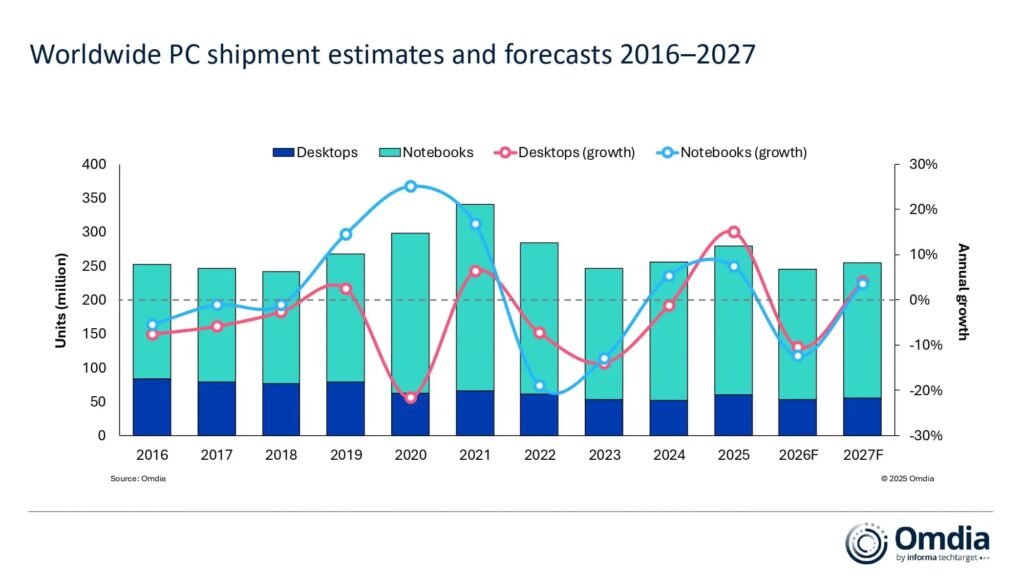
The global PC market is heading toward a much more challenging 2026 than was expected just a few months ago. Omdia estimates that shipments of desktops, laptops, and workstations will decline by 12%, totaling 245 million units, in a scenario marked by sharply rising memory and storage costs. The firm attributes this shift not to a lack of structural interest in PCs but to cost pressures forcing manufacturers to reduce promotions, raise prices, and revisit configurations.
The warning signs are in the components. According to Omdia, memory and storage prices will increase by at least 60% in the first quarter of 2026, with additional tensions throughout the year—though more moderate. The analyst adds that since the first quarter of 2025, the cost of conventional memory and storage configurations has already risen by between $90 and $165, a jump significant enough to completely disrupt the commercial balance of many entry-level systems.
The blow mainly hits the cheapest PCs
The impact will not be uniform. Omdia predicts the most affected segment will be devices under $500, with a projected 28% fall to around 62.1 million units. The reasoning is straightforward: lower-cost products have less margin to absorb additional costs, buyers are more price-sensitive, and many of these models rely on lower-capacity components or older generations that are being deprioritized in supply allocation.
On the other end, the analyst believes high-end machines will fare better. Their price band analysis indicates that $900+ PCs will be relatively better supported and might even see some growth in certain segments, as consumers and IT departments are more willing to accept higher prices when the purchase fulfills a true need. Omdia also warns that this shift toward higher price ranges doesn’t necessarily mean better specs; in many cases, it will simply be a consequence of increased base hardware costs.
Laptops and desktops will decline, but unevenly
By category, Omdia forecasts desktops to reach 53.2 million units in 2026—a 10% decline from this year—while laptops will decrease by 12% to 192.2 million. The core message is that the memory and storage supply crunch will affect the entire PC market, though more intensely in budget and volume-oriented devices.
Platforms will also react differently. Omdia estimates Windows PCs, which account for 83% of global shipments, will drop by 12% in 2026, absorbing most of the impact. Chromebooks will suffer even more, with a projected 28% decline due to their dependence on the education market and narrow margins. Conversely, Macs are expected to limit their decline to around 5%, supported by Apple’s vertical integration and premium positioning. An interesting exception is HarmonyOS on PCs, which will start from a very small base but is projected to grow tenfold year over year as Huawei expands its ecosystem in China.
A market with more downside risk than upside
Omdia does not present its forecast as a definitive snapshot. Instead, it acknowledges significant downside risks and envisions a scenario where shortages of memory and storage worsen, with price increases exceeding current estimates. In such a case, the global PC market contraction could approach 15%, or even more. Added to this is another source of uncertainty: the recent conflict in the Middle East, which could impact international transportation and regional markets if it prolongs.
For manufacturers, distributors, and channels, the key isn’t just the overall decline but what it reveals about changing priorities. If supply is limited, sellers are likely to prioritize profitability over market share, focusing on premium models and reducing exposure in lower-margin segments. This could make the market appear more “high-end” on paper, even though in reality it reflects a combination of component shortages, inflation, and reduced accessibility for price-sensitive buyers. This interpretation stems from price band analysis and Omdia’s own comments on manufacturers’ strategies.
For the end user, the message is less abstract: buying an affordable PC in 2026 will probably be more difficult—not because demand disappears, but because maintaining lower prices will become increasingly unfeasible for the industry. The big question now is whether this cost pressure will ease in 2027 or if it will prolong a more challenging market cycle than expected. For now, Omdia’s message is clear: the challenge is no longer just selling more PCs, but building them at affordable prices.
Frequently Asked Questions
How much will global PC shipments decline in 2026 according to Omdia?
Omdia predicts a 12% decline in 2026, totaling 245 million units of desktops, laptops, and workstations.
Why will the segment under $500 see the largest decline?
Because it has less margin to absorb cost increases, depends heavily on components prone to discontinuations, and its buyers tend to react quickly to price increases. Omdia estimates a 28% drop in this segment.
Which PC platforms will perform better in 2026?
According to Omdia, Macs will limit their decline to around 5% thanks to Apple’s vertical integration and premium focus, while HarmonyOS on PCs will grow strongly from a small base. Windows will fall by 12%, and ChromeOS by 28%.
Is there a risk of the market declining even more than forecast?
Yes. Omdia considers a downside scenario where the decline could approach 15%, or worse, if shortages of memory and storage worsen and prices continue to rise.
via: omdia