
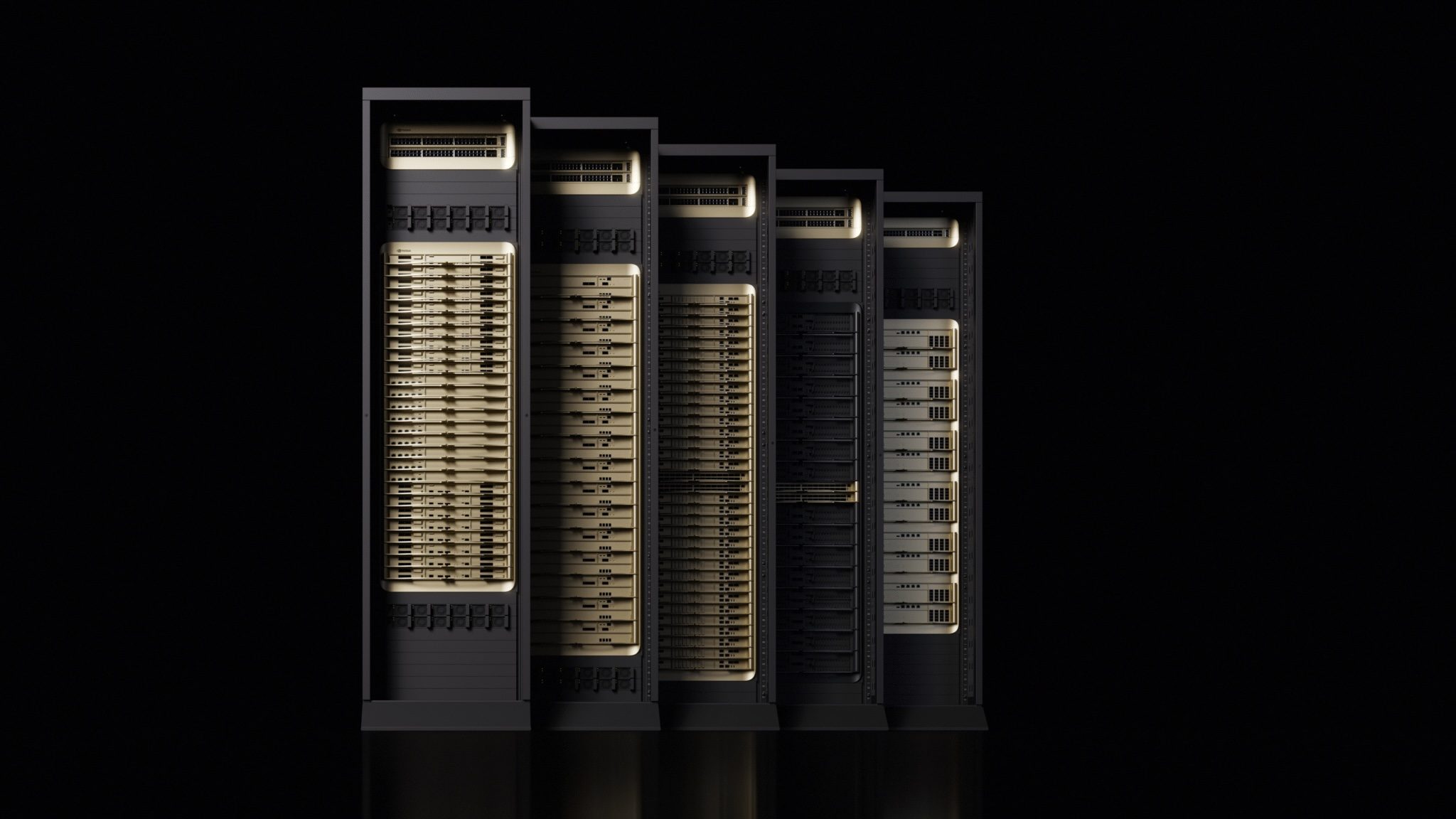
The next generation of artificial intelligence (AI) data centers could run into a problem that buying more GPUs can’t solve: finding enough electricity to power them. NVIDIA’s future Kyber racks, based on the Rubin Ultra NVL576 platform and expected in the second half of 2027, could need up to 600 kW of continuous electrical power per cabinet, a demand roughly equivalent to the consumption of about 500 US households. The figure comes from an estimate on how NVIDIA’s architectures are evolving, and it points to a looming challenge for data centers’ power and cooling infrastructure.
NVIDIA Kyber’s power draw in 30 seconds
- NVIDIA’s future Kyber racks could reach 600 kW per cabinet, according to an estimate circulated by Jessie Dong.
- That figure would be five times the 120 kW attributed to 2024’s Blackwell NVL72 racks, and 75 times the draw of a conventional 8 kW enterprise rack.
- The Rubin Ultra NVL576 platform is expected in the second half of 2027.
- Adapting data centers will require reworking power distribution and cooling systems, not just contracting more capacity from utilities.
- Operators may need facilities purpose-built for these workloads, with investment and timelines that will shape the rollout of new AI infrastructure.
The semiconductor industry has spent years increasing the compute capacity of its accelerators, but every leap in performance brings higher energy demands with it. The growth of generative AI models forces companies to build clusters with more processors, more memory, and more high-speed interconnects. The result is an ever-growing concentration of electrical consumption in smaller spaces.
Until now, much of the attention has focused on DRAM memory shortages and chip manufacturing capacity. But the evolution of NVIDIA’s platforms points to another limit: data centers’ ability to supply power to the equipment and remove the heat it generates.
From 40 kW With Hopper to 600 kW With Kyber
The estimate shared by Jessie Dong shows how NVIDIA racks’ electrical demand has grown across successive generations of hardware. The figures reflect a particularly fast progression in systems designed to pack large numbers of GPUs together.
In 2022, a high-density rack based on the Hopper architecture drew roughly 40 kW. Two years later, Blackwell NVL72 systems pushed that reference up to around 120 kW. The next expected generation, Kyber, would take another sizable leap if the estimates hold true: up to 600 kW per cabinet.
Estimated power draw by rack platform
| Platform | Reference year | Estimated power |
|---|---|---|
| Conventional enterprise rack | 2024 | 8 kW |
| NVIDIA Hopper | 2022 | 40 kW |
| NVIDIA Blackwell NVL72 | 2024 | 120 kW |
| NVIDIA Rubin Ultra NVL576 / Kyber | 2027 | 600 kW |
Figures as given in the source material. Kyber’s 600 kW is an estimate, not an official specification confirmed in the material reviewed.
The comparison helps put the shift in perspective. A Kyber rack would need five times the power of a Blackwell NVL72 rack, and up to 75 times that of a conventional 8 kW enterprise cabinet. Against the 40 kW attributed to Hopper, the increase would be 15-fold.
The 500-US-households comparison also helps convey the scale of the figure. It doesn’t mean a rack would draw exactly as much as 500 homes in any given country, since household consumption depends on many factors. It’s an illustrative equivalence meant to visualize a sustained, continuous 600 kW electrical demand.
The Kyber platform would be tied to Rubin Ultra NVL576, arriving in the second half of 2027. Both the timeline and the projected consumption should be treated as forward-looking references: the available information doesn’t include an official NVIDIA spec sheet confirming 600 kW as the final requirement for every rack.
The Problem Isn’t Just Generating Electricity — It’s Getting It to the GPUs
Getting a utility to supply more power to a data center is only part of the problem. The internal infrastructure also has to distribute that energy safely and reliably all the way to each cabinet.
Conventional data centers were designed for power densities far lower than what these systems demand. Their switchgear, transformers, distribution systems, and internal wiring may not be built to feed a single rack that continuously draws hundreds of kilowatts.
Retrofitting existing facilities can be especially difficult. Even if an operator manages to secure more contracted power, or has access to a grid connection with enough capacity, that doesn’t mean it can deliver 600 kW directly to wherever a cabinet sits inside a server room.
Electrical design has to account for distribution, protection, redundancy, and supply continuity. It also has to factor in energy losses and the capacity of the systems that convert and distribute electricity throughout the facility — a challenge a recent report from ABB and BCG frames as a push toward an entirely new, 800-volt DC power architecture for AI data centers.
Cooling poses another challenge. A very large share of the electricity consumed by accelerators ends up converted into heat, which has to be removed to keep components within their operating limits. Increasing available power without redesigning cooling systems wouldn’t solve the underlying problem.
That’s why future high-density facilities will need to coordinate power distribution and thermal systems from the outset. Building architecture, technical rooms, power delivery systems, and cooling loops will all have to handle loads far above what’s typical today.
Existing Data Centers May Be Too Small for AI’s Next Generation
The difficulty of retrofitting current facilities could reshape operators’ investment decisions. If new platforms require power densities that existing data centers can’t provide, some companies will have to build purpose-built facilities instead of simply expanding the ones they already have.
This scenario particularly affects infrastructure providers that want to offer compute capacity to large AI labs. Organizations training and running the most advanced models typically need the latest acceleration platforms. To compete for those contracts, operators will need facilities capable of hosting the new systems.
The source material also mentions Amazon’s case and an estimated $5 billion in GB300 rack deliveries. According to that same information, the company would be struggling to secure enough electrical infrastructure to power that equipment. However, no documentation is provided to verify the amount, the scope of the deliveries, or the alleged lack of electrical capacity. It therefore cannot be presented as a confirmed fact.
The example does illustrate a question affecting the whole industry: buying accelerators doesn’t guarantee they can go into operation right away. GPU, memory, and server availability has to be matched by facilities with enough electrical power, cooling, and connectivity — the same bottleneck that is pushing some AI data center operators to look at nuclear power as a long-term electricity source.
Building new data centers also requires coordination with utilities and the agencies responsible for the grid. The timelines for expanding substations, installing transformers, or reinforcing transmission lines can move at a different pace than hardware evolves. That mismatch can leave equipment sitting idle while infrastructure catches up.
AI’s growth is thus forcing a rethink of data center design, from the grid connection all the way down to the systems that deliver power to each processor. If the 600 kW estimated for Kyber turns out to be close to Rubin Ultra’s final requirements, power per rack will become one of the main criteria for planning new facilities.
The next generation of accelerators won’t depend solely on how many GPUs NVIDIA can manufacture, or how much memory suppliers can provide. It will also depend on how many data centers can power and cool them in time.
Frequently asked questions
How much electricity will an NVIDIA Kyber rack need?
The estimate circulated by Jessie Dong puts its draw at around 600 kW continuous per cabinet. The figure is tied to the future Rubin Ultra NVL576 platform and isn’t confirmed as an official specification in the available information.
When will NVIDIA Kyber arrive?
The source material points to the second half of 2027, tied to the Rubin Ultra NVL576 platform.
How much does an NVIDIA Blackwell NVL72 rack consume?
The estimate used as a reference puts its consumption at around 120 kW, versus the 600 kW projected for Kyber.
Why do data centers need new electrical infrastructure?
Because AI racks are concentrating more and more power in smaller spaces. Operators need to adapt power distribution, protection systems, and cooling to power and sustain this equipment.
Sources:
- Source material on NVIDIA Kyber’s estimated power draw and the evolution of the Hopper, Blackwell, and Rubin Ultra architectures.
- Rack power evolution chart attributed to Jessie Dong, cited in the original material.
This article is also available in Spanish: «Los racks Kyber de NVIDIA podrían consumir 600 kW: el próximo cuello de botella de la IA será la electricidad», on revistacloud.com.
