
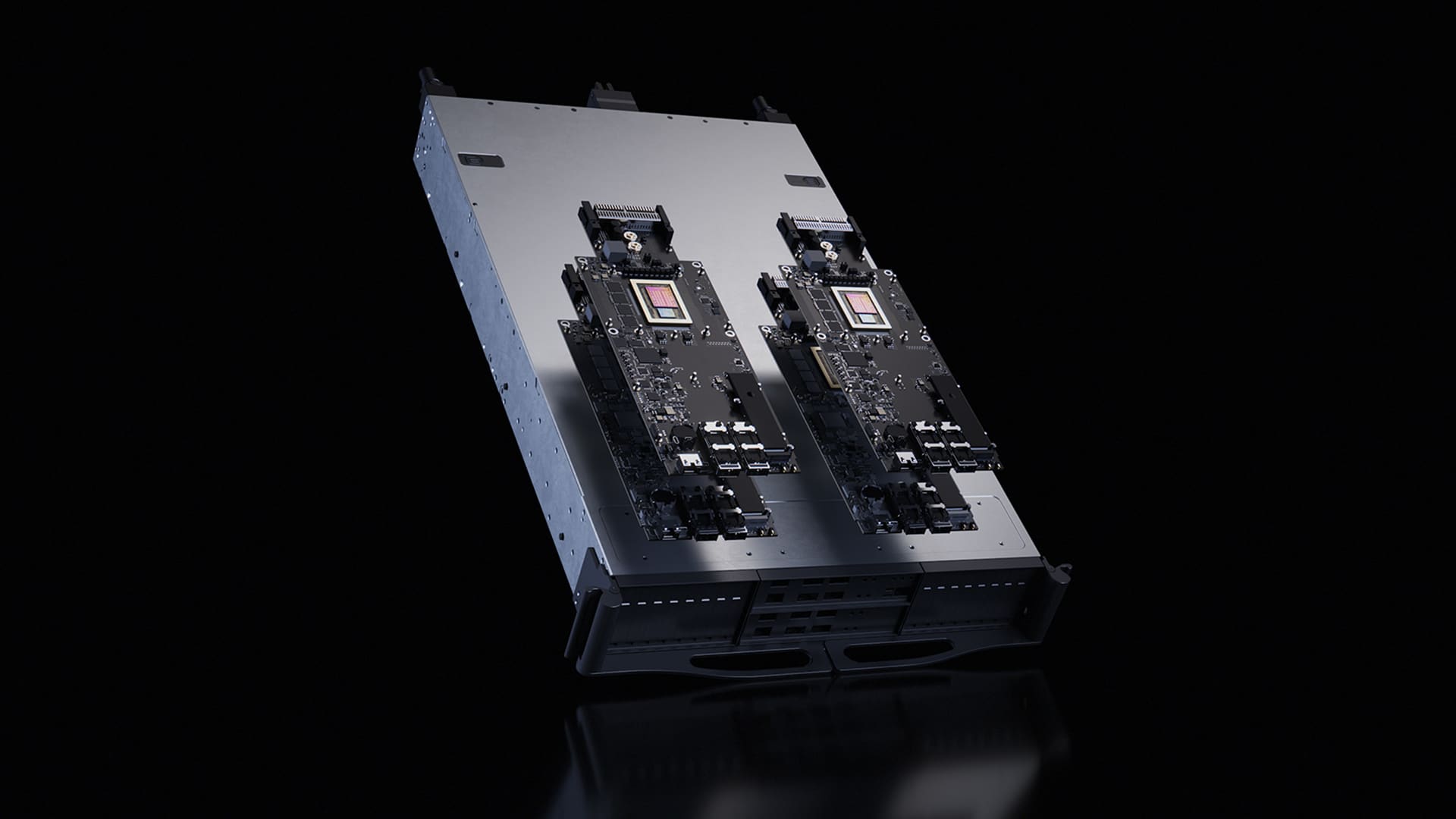
In the race to advance Artificial General Intelligence (models capable of chaining tasks, reasoning over longer periods, and maintaining conversations with context), NVIDIA has focused on a very specific issue: context memory. At CES, the company announced that its BlueField-4 (a data processor/DPU) will be the component driving the NVIDIA Inference Context Memory Storage Platform, a “native AI storage” solution designed for large-scale inference and rapid context sharing between nodes.
The bottleneck: the KV cache, the “memory” that can’t always fit in the GPU
As models grow larger and especially extend their context (more turns, more documents, more reasoning steps), the amount of data the system needs to keep “at hand” to respond coherently also increases. This state is typically represented as a key-value cache (KV cache), essential for continuity, latency, and user experience.
The issue, according to NVIDIA, is that storing that KV cache on a GPU long-term isn’t feasible without turning inference into a bottleneck: GPU memory is too costly and limited to also serve as a persistent store for multiple agents and sessions’ histories.
The proposal: “context memory storage” for AI clusters
The Inference Context Memory Storage Platform offers a new infrastructure layer to:
- Extend the “capacity” of usable memory beyond the GPU (in terms of context).
- Share context at high speed among nodes within “rack-scale” system clusters.
- Improve tokens per second and energy efficiency by “up to 5x” compared to traditional storage approaches, according to the company’s estimates.
In NVIDIA’s vision, this means agents will be able to hold long conversations and perform multi-turn tasks without “forgetting” and without significantly penalizing cluster performance when many users, threads, or concurrent agents are active.
What’s BlueField-4’s role in all this (and why it’s more than “just a network”)
BlueField isn’t a conventional NIC: NVIDIA classifies it as a DPU and links it to the DOCA framework, aiming to offload, accelerate, and isolate infrastructure services (network, security, storage) to deliver data at “cable speed” to workloads.
Specifically, NVIDIA states that BlueField-4 allows for:
- Managing the placement of the KV cache with hardware acceleration to reduce metadata overhead and data movement.
- Isolating access and strengthening security and segmentation controls in multi-tenant environments.
- Integrating with NVIDIA’s software stack to maximize latency reduction and throughput in agent-based inference.
The software pipeline and Spectrum-X’s role
The announcement also ties the platform to NVIDIA’s stack components:
- DOCA as the foundational programming and acceleration platform.
- Integration with NIXL and Dynamo to maximize tokens/second, reduce time-to-first-token, and enhance multi-turn response quality.
- Spectrum-X Ethernet as the networking fabric enabling RDMA access to this “context memory”.
The implication is clear: if future applications shift from “one question, one answer” to agent systems with short- and long-term memory, then storage becomes an active performance component rather than a passive repository.
Ecosystem: manufacturers and storage players are already lining up
NVIDIA reports that multiple players in the storage and infrastructure sectors are building next-generation platforms around BlueField-4. Notable names include Dell Technologies, HPE, IBM, Nutanix, Pure Storage, Supermicro, VAST Data, WEKA, along with specialists such as DDN and Cloudian. The availability of BlueField-4 for this approach is expected in the second half of 2026.
Frequently Asked Questions (FAQ)
What is the KV cache, and why has it become critical in agent-based AI?
The KV cache is the state that a model maintains to respond coherently and with low latency in long and multi-turn contexts. As contexts and agents grow, this state balloons and stresses GPU memory.
What does a DPU like NVIDIA BlueField contribute compared to a traditional CPU + storage architecture?
The goal is to offload and accelerate infrastructure functions (network/security/storage) to reduce overhead, improve isolation, and move data with lower latency toward inference nodes.
Does this replace current enterprise storage systems?
More than replacing them, NVIDIA positions it as a new class focused on a specific use case: context memory for large-scale inference (especially multi-agent and long-context scenarios).
When will the platform based on BlueField-4 be available?
NVIDIA estimates availability in the second half of 2026, with partners already developing products around this approach.
via: nvidianews.nvidia