
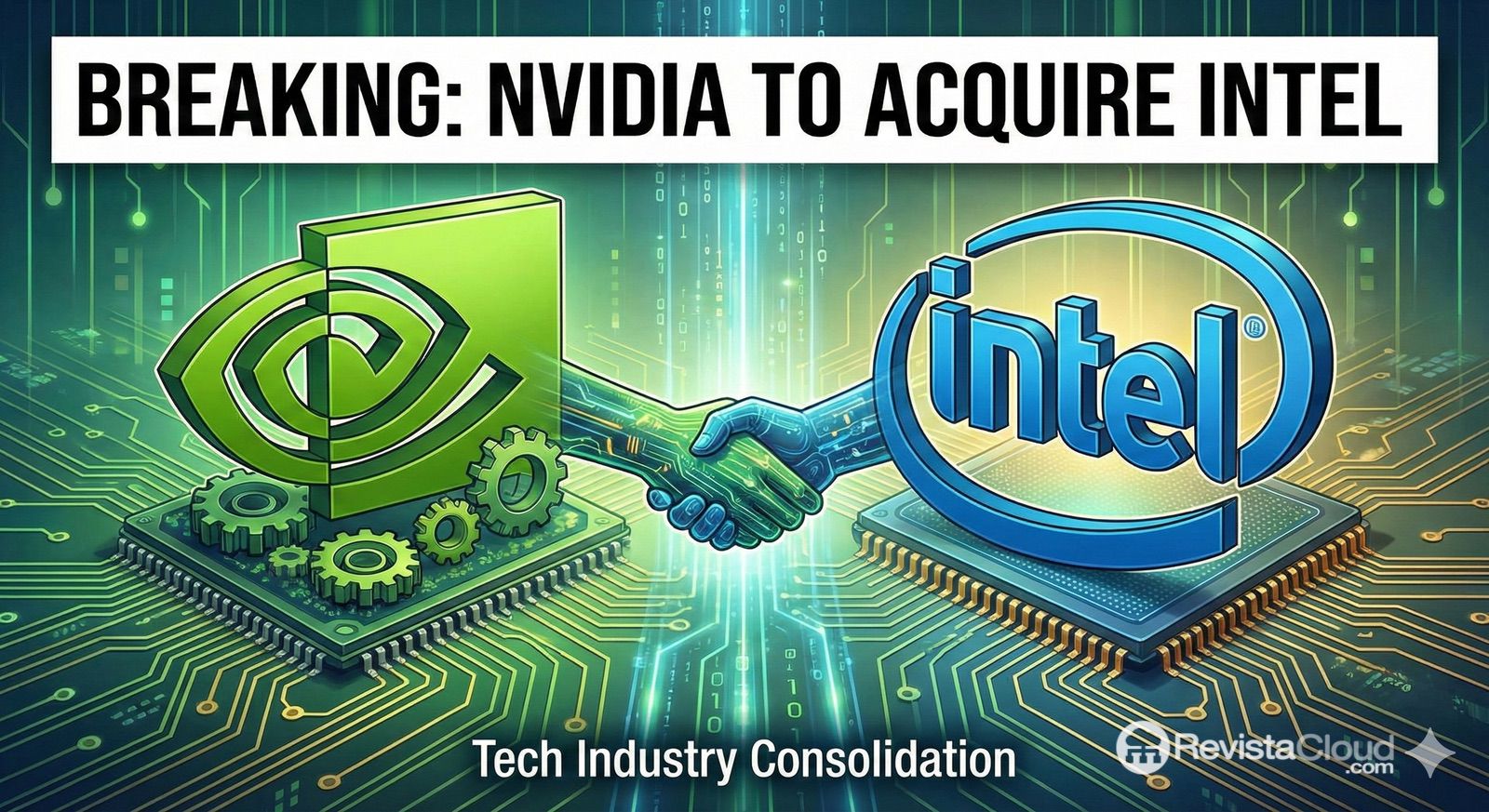
NVIDIA is now officially one of the most significant shareholders of Intel. The company led by Jensen Huang has formalized an investment of $5 billion to acquire almost 5% of the American chip manufacturer, in a transaction that was carried out through a private placement of shares and which, according to the documentation disclosed by Intel, was finalized at the end of December 2025.
The move comes at a time when the industry is living a paradox: there is more capital than ever to build computing capacity for Artificial Intelligence, but the bottleneck is no longer just about manufacturing GPUs or reserving advanced packaging. Increasingly, control over the entire supply chain matters more: CPU, GPU, interconnects, memory, manufacturing capacity, and especially, supply predictability. From this perspective, entering Intel is not just about “buying shares”: it’s about positioning around a strategic piece on the board.
A private placement and a fixed price: why the “how” matters
NVIDIA’s investment was executed through a private placement of more than 214.7 million shares at a fixed price of $23.28 per share, clearly reflecting the industrial intent of the agreement: it’s not a gradual market purchase to take advantage of a dip, but a mechanism designed to seal a deal with volume and defined terms.
The market’s reaction, in any case, has added fuel to the story: Intel’s shares were trading above that placement price by late December, implying that NVIDIA would have a significant unrealized profit if viewed strictly from a financial standpoint. But the subtext is different: Intel has been trying for months to consolidate its recovery strategy and expansion as a manufacturing provider—competing against TSMC’s capacity and execution—and that plan needs capital, credibility, and alliances.
2025: the year Intel became “a matter of national importance” again
The political and strategic context is inseparable from the deal. Throughout 2025, Intel has been at the center of a narrative of reindustrialization in the U.S., largely linked to advanced manufacturing and national security requirements. In this framework, various media outlets have reported U.S. government involvement in Intel’s capital, connected to industrial and security initiatives (including the “Secure Enclave” program), reinforcing the idea that the company is viewed not only as a tech player but as critical infrastructure.
This shift makes NVIDIA’s investment easier to interpret: when a country treats manufacturing capacity and advanced electronics as a strategic asset, major tech companies tend to align with that direction… or risk exposure to decisions beyond their control.
What NVIDIA gains: more control over the AI “stack,” less dependency, and a pathway for challenging alliances
This move addresses a common industry concern: over-reliance on a single supplier or a single technology family can become an operational risk. For years, the AI ecosystem has revolved around NVIDIA and its ecosystem, but NVIDIA also depends on third parties for key components, from server CPUs to manufacturing and packaging capacity.
In this sense, the investment opens the door—and, importantly, strengthens the commitment—to deeper collaborations between the two companies. Specialized media reports indicate that NVIDIA and Intel are exploring approaches to offer more integrated platforms for AI data centers, combining x86 CPUs and accelerators, and exploring ways to optimize the complete “pipeline” (from data processing to inference). In a market where every percentage point of energy efficiency and performance per dollar counts, controlling more parts of the system can make a real difference.
What Intel gains: capital, reputational boost, and a partner with immediate traction
For Intel, having NVIDIA as a shareholder is worth more than the $5 billion invested. Amid its race to regain ground in advanced processes and attract clients for its foundry business, the company needs to demonstrate that its roadmap is not just an ambitious PowerPoint, but a plan backed by top-tier support.
Furthermore, NVIDIA’s role as a significant shareholder sends an implicit message to the market: Intel cares about remaining relevant in the AI era even when media buzz centers on GPUs. If Intel can strengthen its position in data center CPUs, packaging, and manufacturing, it reenters a conversation that has shifted towards other players in recent years.
Risks: competition, cross-dependency, and regulatory factors
Like most transactions of this size in the semiconductor sector, the deal sits on a delicate line. Intel and NVIDIA have competed in numerous areas (directly or indirectly), and shareholding can raise questions about governance, strategic influence, and conflicts of interest.
Regulatory concerns are also relevant: semiconductors have become a geopolitical issue, and any move affecting industrial capacity, exports, or international positioning is scrutinized closely. In a world where export controls and “technological sovereignty” influence corporate strategies, cross-investments among industrial champions are not neutral.
A look ahead to 2026: AI is no longer just about models, but about infrastructure
Beyond the headlines, this operation signals a new era: competitive advantage in AI increasingly depends on both models and the ability to deploy, scale, and sustain infrastructure over the long term. Major buyers—hyperscalers, governments, and multinationals—seek AI platforms in production that are reliable, maintain low costs, and are not dependent on a single source.
The entry of NVIDIA into Intel is thus less a traditional financial investment and more a statement: the AI race will be decided across the entire “stack”.
Frequently Asked Questions
What does NVIDIA owning nearly 5% of Intel mean?
It means NVIDIA becomes a significant shareholder and, most importantly, strengthens a strategic relationship with Intel at a critical moment for the AI and chip manufacturing industry.
What is a private placement of shares, and why is it used in such operations?
It’s a direct transaction between parties (outside the open market), with a fixed price and volume. It’s used to secure capital and finalize strategic deals without relying on gradual stock purchases on the open market.
How might this affect the AI infrastructure market?
It could accelerate trends toward more integrated platforms (CPU + GPU + networks + software) and closer supply arrangements, where capacity predictability is almost as valuable as performance.
Does this impact AMD or other competitors?
Indirectly, yes: any closer collaboration among major players in the AI “stack” can shift negotiation dynamics, platform design, and strategic alliances in AI-focused servers.