
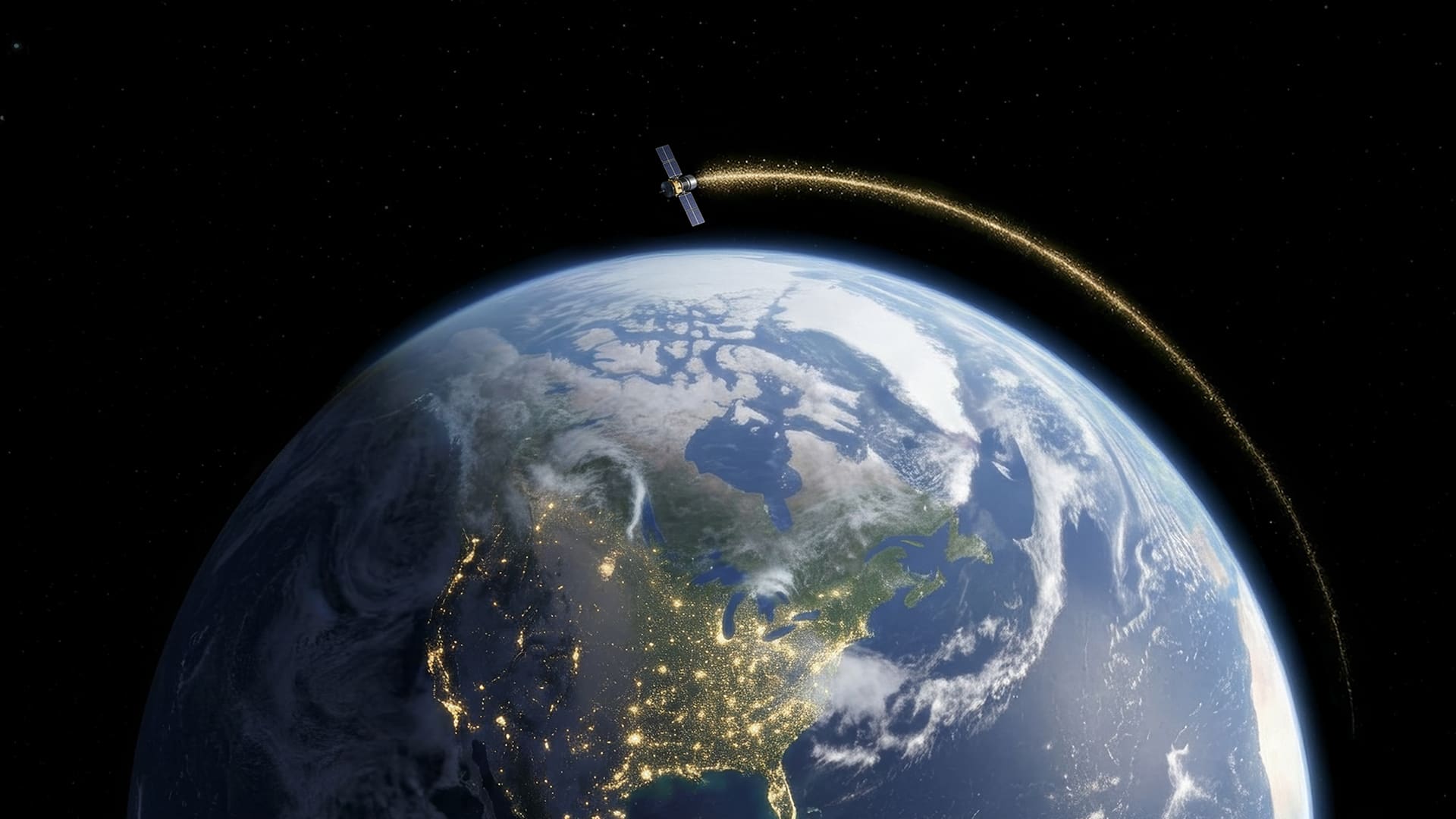
NVIDIA took advantage of its GTC conference to introduce an idea that until recently sounded more like science fiction than an industrial roadmap: bringing some of the artificial intelligence processing directly into space. The company announced a new concept of “space computing” aimed at extending its ecosystem of accelerated computing from terrestrial data centers to satellites, orbital platforms, and future in-orbit infrastructure.
The move isn’t just about placing more power inside a satellite. NVIDIA proposes a hybrid model where part of the data is processed where it’s generated—in space—and the rest is analyzed on Earth with high-performance hardware. The logic is clear: as constellations, ground observation systems, and commercial missions grow, it becomes increasingly difficult to rely solely on transmitting raw data to ground stations for later analysis.
From traditional satellites to orbital computing
The most striking part of the announcement is the upcoming NVIDIA Space-1 Vera Rubin Module, designed for environments with strict size, weight, and power constraints—three critical factors in space industry. According to NVIDIA, this module is engineered to perform AI inference in orbit and could serve orbital data centers, geospatial intelligence systems, and autonomous space operations.
The company asserts that the integrated Rubin GPU in this module will deliver up to 25 times more AI inference computational capacity for space applications than an H100 in the same environment. While this is a significant figure, it should be interpreted cautiously, as it comes from the manufacturer without independent benchmarking or detailed methodology. Nonetheless, the announcement’s clear intent is that NVIDIA aims to become a leading provider in an emerging market where computing extends beyond Earth.
Complementing this future module, NVIDIA’s space ambitions also draw on two existing platforms. On one side, Jetson Orin, a family of compact modules that, in their AGX Orin version, reach up to 275 TOPS with configurable power between 15W and 60W. On the other side, IGX Thor, an industrial platform targeting enterprise needs with support for functional safety and real-time AI capabilities, offering up to 8 times more integrated AI computing than IGX Orin, NVIDIA states.
Although neither Jetson Orin nor IGX Thor was originally designed specifically for space applications, their combined attributes of energy efficiency, local processing, and support for critical environments align well with many needs of edge AI in orbit. Practically, this means analyzing images, navigating, fusing sensor data, or making operational decisions without waiting for all information to be transmitted back to Earth.
Partners are no longer talking about the future: they’re building system components now
One of the most interesting aspects of this announcement is that NVIDIA presents it not as theoretical but with backing from companies already working across different layers of space infrastructure.
Axiom Space, for example, is building the foundations of an “orbital cloud.” Known for its commercial space station project, Axiom launched its first orbital data center prototype, the AxDCU-1, to the International Space Station in 2025. The company also explained that its strategy involves deploying low-earth orbit data nodes to expand computing capacity beyond the station itself.
Kepler Communications is another key player: its network. The Canadian firm is developing a real-time optical communication network between space and Earth and argues that processing in orbit will be crucial for reducing latencies and moving data more efficiently. On January 11, 2026, Kepler announced the launch of its first batch of 10 optical relay satellites, having already deployed a total of 33 satellites. Its integrated approach combines connectivity, onboard storage, and computing to create something resembling a space-based internet layer.
Sophia Space, another mentioned company, is in an earlier phase but equally significant. In February 2026, it announced a seed round of $10 million to accelerate development of its modular TILE platform, designed for AI inference and data processing in orbit. Their focus revolves around a technical challenge more acute in space: how to cool and maintain intensive computing systems under extreme conditions.
Starcloud is also part of this new generation of companies openly discussing space data centers. Their website claims that falling launch costs, continuous access to solar energy, and radiative cooling could make large-scale orbital computing infrastructures viable. It’s an ambitious vision but increasingly plausible.
Aetherflux adds a particularly exciting angle: energy. The company proposes combining space solar power with onboard computing capacity, aiming to leverage space-based energy availability to power AI workloads without being constrained by terrestrial electrical limitations.
Geospatial intelligence: the most immediate application
While “orbiting data centers” make headlines, the most immediate practical use seems to be in geospatial intelligence. This is where NVIDIA’s proposal could see immediate deployment.
Another partner, Planet, has been working for years with large-scale Earth imaging. Such activity produces vast data volumes, often too large to transmit entirely to ground stations without filtering, classifying, or detecting relevant events first. Processing part of this load on the satellite itself or on intermediate orbital nodes can save bandwidth and, importantly, time.
On the ground, NVIDIA offers the RTX PRO 6000 Blackwell Server Edition—a data center GPU with 96 GB of GDDR7 memory. The company claims it can accelerate certain processes by up to 100 times compared to legacy CPU-based systems when analyzing large image datasets. Again, this figure is from the manufacturer, but the core message remains solid: future space analytics will be hybrid, distributed between orbit, ground stations, cloud, and traditional data centers.
This can have a direct impact on critical domains. Early wildfire detection, flood monitoring, spill surveillance, agricultural oversight, energy infrastructure management, and climate analysis are areas where minutes matter. If part of the processing is handled before the data touches Earth, the entire chain benefits from increased speed.
High potential, but a market still in early stages
The significance of this news lies in confirming a trend: space computing is no longer limited to spaceflight electronics or basic onboard processing. Major chip companies are starting to see space as an extension of the global digital infrastructure.
That said, orbital data centers won’t become an immediate alternative to terrestrial cloud regions. The sector remains in early development stages, with prototypes, initial nodes, deploying networks, and many technical and economic questions still to resolve. Radiation, hardware reliability, maintenance, cybersecurity, launch costs, and operational sustainability continue to be major hurdles.
What this announcement changes is the tone of the market. Previously, many ideas were limited to startups, strategic papers, or early demos. NVIDIA’s direct involvement and its partnerships with companies already deploying nodes, satellites, or platforms lend more credibility to an emerging industrial reality.
Frequently Asked Questions
What exactly has NVIDIA announced about space computing?
NVIDIA unveiled a strategy to bring its accelerated computing to space via several products: the upcoming Space-1 Vera Rubin Module for AI inference in orbit, the Jetson Orin and IGX Thor platforms for edge AI, and the RTX PRO 6000 Blackwell Server Edition for geospatial processing on Earth.
What is an orbital data center?
It’s an in-orbit infrastructure designed to process, store, or route data in space before sending it back to Earth. The goal is to reduce latency, save bandwidth, and bring processing closer to where data is generated.
Which companies are already working on this kind of infrastructure?
Among NVIDIA’s mentioned partners are Axiom Space, Kepler Communications, Planet, Sophia Space, Starcloud, and Aetherflux. Some have launched prototypes or satellites, while others are developing networks, computing modules, or energy systems to make orbital infrastructure viable.
How can AI in orbit be practically used?
The clearest applications are in Earth observation and geospatial intelligence: wildfire detection, flood and spill tracking, weather monitoring, critical infrastructure oversight, agricultural analysis, and supporting autonomous operations of satellites and space vehicles.
via: nvidianews.nvidia