
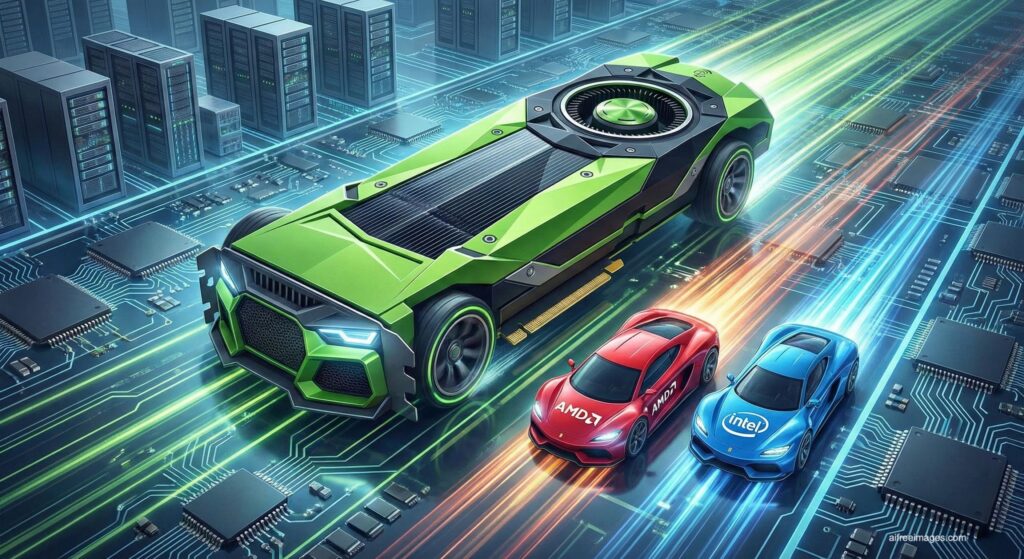
The dedicated graphics card market—those classic “graphics cards” plugged into the motherboard—remains, essentially, NVIDIA territory. However, the latest data from Jon Peddie Research (JPR) shows that AMD and Intel have managed to grab some market share in Q3 2025 amid a context marked by fears of price hikes and new tariffs.
According to the report, the business of dedicated GPUs for “add-in board” (AIB) cards moved about $8.8 billion in Q3 2025, with around 12 million units shipped to the channel. This represents a 2.8% increase compared to the previous quarter. It’s not a surge of growth, but it confirms that the market is far from dead despite the absence of major launches in recent months.
NVIDIA decreases… but remains in a league of its own
In terms of market share, NVIDIA continues to operate in a different division. The company went from controlling 94% of the dedicated GPU market in Q2 2025 to 92% in Q3. This 1.2-point drop, in almost any other sector, would still represent an overwhelming dominance.
Nevertheless, this slight decline is significant because it occurs just as the other manufacturers seem to start gaining ground:
- AMD rises to 7% market share, gaining 0.8 points compared to the previous quarter.
- Intel reaches 1%, adding 0.4 points and steadily consolidating its commitment to dedicated graphics cards.
In summary: NVIDIA still controls 9 out of 10 dedicated graphics cards entering the market, but it’s no longer as close to the “absolute monopoly” it held at 94% previously.
A market growing less than usual
JPR’s figures show that shipments of dedicated GPUs increased by 2.8% quarter-over-quarter, reaching 12.02 million units. The positive note comes with a caveat: the growth is below the average 10-11% typically seen in this quarter over the past decade.
Additionally:
- The “attach rate” (the number of dedicated graphics cards sold per desktop PC) rises to 162%, slightly below the previous quarter but still very high.
- The desktop CPU market declines 7.6% year-over-year, though it increases 3.9% from the previous quarter.
Put simply: fewer complete PCs are being sold than a year ago, but those purchasing new systems or upgrading their current ones continue to strongly favor dedicated graphics cards.
The “panic” effect caused by tariffs and price hikes
One of the most notable points in Jon Peddie Research’s analysis is what happened in Q2 2025. According to the firm, GPU shipments in Q2 were “unusually high” due to a panic buying effect: many distributors and manufacturers pre-purchased inventory ahead of potential price increases tied to new tariffs and supply chain costs.
This preemptive buying would have “stolen” some sales that would normally occur in Q3. Another factor is that several brands have started raising prices for their GPUs looking ahead to 2026, even though many models are still available below their MSRP at major retailers today.
If JPR’s forecasts prove correct, a new cycle of “panic buying” could occur in Q4 2025, as users and system builders try to secure stock before new prices fully hit the channel.
152 million dedicated GPUs by 2029
Looking mid-term, Jon Peddie Research estimates that the installed base of dedicated graphics cards will reach 152 million units by 2029, with a penetration rate of 120%. This figure reflects a trend already visible in gaming, content creation, and AI sectors: more desktops are equipped with one or more dedicated GPUs.
The combination of demanding gaming, AI workloads, and the need for acceleration in professional applications sustains demand—even as hardware refresh cycles lengthen.
What does this mean for the average user?
For most users, the practical takeaway is clear:
- NVIDIA remains the almost unavoidable reference if you’re looking for a dedicated GPU with maximum performance and software support.
- AMD is making progress, especially in segments where performance-to-price ratio is attractive, gradually improving its market presence.
- Although only holding 1%, Intel is beginning to appear more frequently in mid-range setups and pre-built systems, and its progress will be worth watching.
The other major message from the report is that the market is tense due to expectations of price increases and tariffs. Therefore, those planning to upgrade their graphics card in the coming months might face a less favorable environment in 2026, with significant hikes especially in mid- and high-end segments.
Frequently Asked Questions About the Dedicated GPU Market in 2025
Is NVIDIA still the best choice for gaming in 2025?
In terms of market share and ecosystem, NVIDIA continues to dominate with a 92% share of the dedicated GPU market. This translates into strong support for gaming, technologies like DLSS, and a massive presence in gaming laptops and desktops. However, AMD offers competitive alternatives, especially in certain price ranges and resolutions like 1440p, so it’s advisable to compare specific models before making a decision.
Will graphics cards increase in price in 2026?
Analyses from firms like Jon Peddie Research suggest that part of the shipment growth in 2025 was driven by early purchases due to fears of new tariffs and price hikes. Additionally, some manufacturers have already started adjusting their GPU prices. While no exact figures are available, it’s reasonable to expect upward pressure in 2026, especially in mid- and high-end models.
Is it worth waiting for the next generation of dedicated GPUs?
It depends on your usage and urgency. If your current setup suffices and you want to maximize your investment’s longevity, waiting for new architectures might make sense. But if bottlenecks are already evident (poor performance in current games, AI projects not starting, etc.), a current-generation GPU can deliver a significant performance boost without waiting for new releases, which might also come with higher prices.
What role will AMD and Intel play in the future of dedicated graphics?
AMD has increased its share to 7%, establishing itself as a solid second player with a strong focus on gaming and professional workloads. Intel, with 1%, is still developing its catalog and drivers, but its entry adds competition to a market that has been very concentrated for years. If both continue improving at this pace, increased competition could help contain price hikes and offer more options to end-users.