
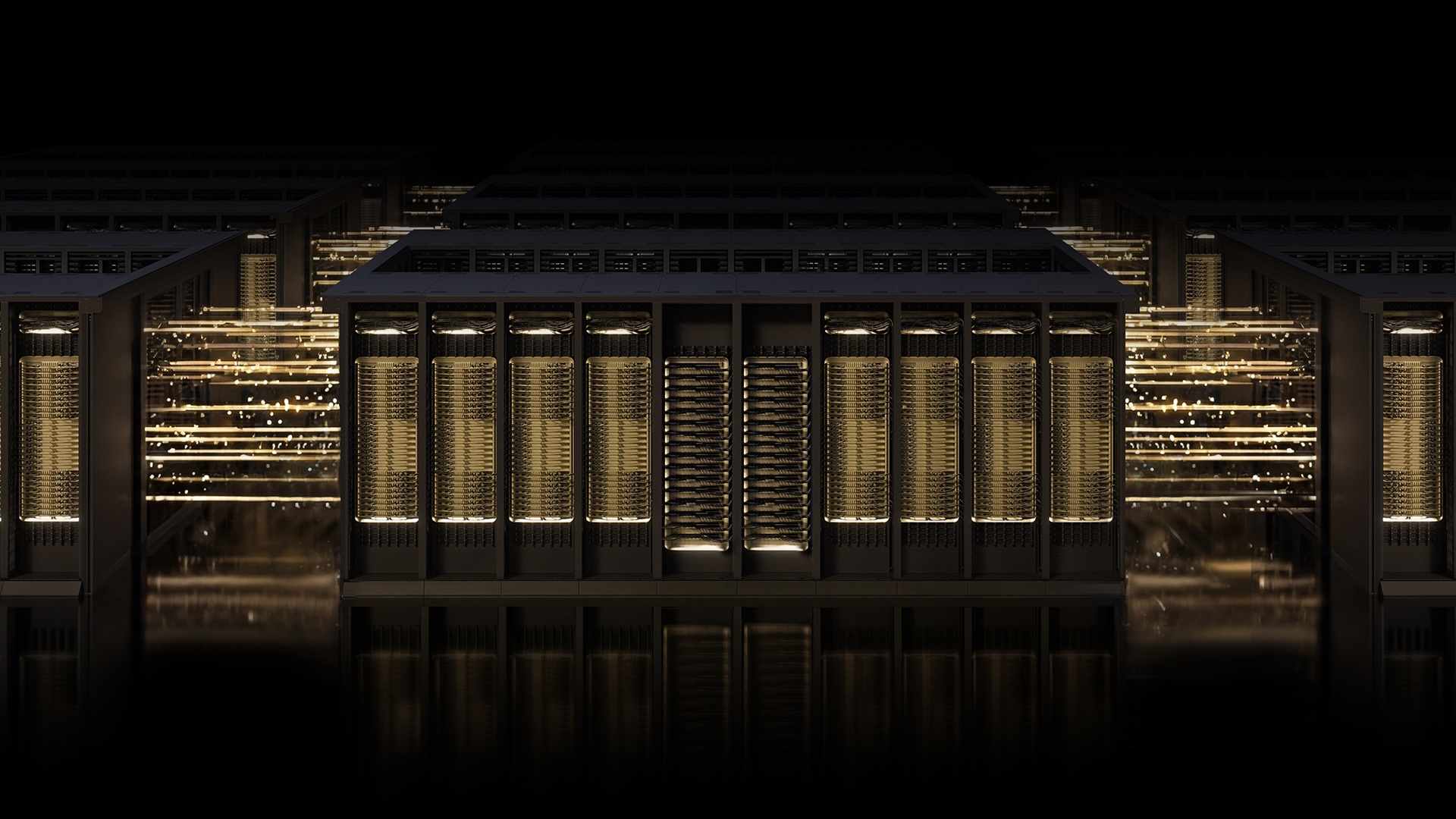
NVIDIA has begun deploying Spectrum-6, their next-generation Ethernet switches for AI data centers. The system achieves an aggregated capacity of 102.4 terabits per second (Tbps), doubling the previous generation, and is part of the Vera Rubin platform, which the company aims to use to connect facilities composed of tens or hundreds of thousands of accelerators.
The key features of NVIDIA Spectrum-6 in 30 seconds
- Spectrum-6 provides 102.4 Tbps of switching capacity, twice that of its predecessor.
- CoreWeave, Microsoft, Nebius, SpaceXAI, and Tesla will be among its first users.
- The system combines switches with ConnectX-9 cards and Spectrum-X software.
- Supports connectable and co-packaged optics, along with liquid cooling.
- NVIDIA states that its platform maintains up to 95% efficiency in networks with over 100,000 GPUs.
This announcement reflects how the network is becoming as critical as the graphics processing units (GPUs) themselves. In a conventional cluster, a server can run most of an application without constant communication with thousands of machines. Training large models and certain distributed inference workloads operate differently.
Accelerators continuously exchange data to synchronize parameters, distribute tasks, and complete collective operations. If a link becomes congested or introduces more latency than expected, it can slow down the entire system. Adding more GPUs no longer automatically translates into higher performance if the infrastructure cannot keep them powered and coordinated effectively.
Spectrum-6 aims to mitigate this problem while also strengthening NVIDIA’s position in a part of the data center where they compete with network chipmakers, switch vendors, and InfiniBand-based solutions.
A capacity of 102.4 Tbps for connecting large-scale clusters
The 102.4 Tbps figure represents the total switching capacity of the chip or system, not the available speed for a single connection. This distinction is important because the figure could be mistaken for the speed of an individual port.
The aggregate capacity allows the construction of switches with many high-speed interfaces, moving more traffic simultaneously between servers. NVIDIA has not detailed all commercial configurations in this announcement, but Spectrum-6 is designed for horizontal expansion networks, known as scale-out, which interconnect different racks and compute domains within an AI facility.
The company asserts that this generation doubles the capacity of its previous systems. This increase accounts for growing clusters and the higher bandwidth required by each accelerator. As GPUs process more data, the network must keep pace to prevent some compute capacity from idling.
CoreWeave, Microsoft, and Nebius are among the initial cloud providers deploying Vera Rubin infrastructure with Spectrum-6. NVIDIA also includes Tesla and SpaceXAI among organizations adopting the new technology.
For now, these are commitments and plans announced by NVIDIA. The company has not specified how many switches each customer will install, the exact timelines for deployment, or the investment involved in these projects.
Spectrum-X adapts Ethernet for AI traffic
Ethernet was developed and has evolved primarily for enterprise networks, servers, storage, and users. Although it has been used for years in supercomputing and high-performance data centers, large-scale AI workloads present particularly demanding patterns.
Much of this traffic flows east-west, between servers within the same data center. Additionally, many accelerators can transmit simultaneously to other nodes during collective operations such as all-reduce or all-to-all. These situations increase the risk of congestion, packet loss, and route imbalances.
Spectrum-X is NVIDIA’s proposal to adapt Ethernet to these scenarios. It is not just a switch; the platform combines the Spectrum-6 chip, ConnectX-9 SuperNIC network cards, and a software layer that manages traffic, selects routes, and handles failure responses.
According to the company, the system distributes flows among available paths, avoids congested links, and accurately recovers data that doesn’t reach its destination. It also supports different transport models via Remote Direct Memory Access (RDMA), a technology enabling data transfer between memories with minimal CPU intervention.
NVIDIA claims that Spectrum-X can deliver up to 1.6 times more network performance for AI than conventional Ethernet infrastructure and maintain up to an 95% efficiency in deployments exceeding 100,000 GPUs. These figures are provided by the manufacturer and may vary depending on topology, traffic patterns, software, and cluster configuration.
The company previously used a similar argument when presenting the network for xAI’s Colossus supercomputer. At that time, they asserted Spectrum-X maintained a 95% effective throughput compared to 60% for standard Ethernet networks under similar conditions.
Co-packaged optics and liquid cooling
Spectrum-6 will be available with connectable optical modules as well as co-packaged optics, known as CPO, for co-packaged optics.
In traditional systems, optical transceivers are inserted at the front of the switch. Co-packaged optics bring photonic components closer to the switching chip, aiming to reduce electrical signal travel distance, minimize losses, and improve energy efficiency.
This architecture is gaining attention as network speeds increase, but it also poses challenges related to maintenance, manufacturing, and component replacement. NVIDIA maintains both options to offer flexibility rather than relying solely on CPO.
The new platform also supports liquid cooling. In AI clusters, energy density isn’t limited to GPUs and CPUs; switches, network cards, and optical modules consume more power and generate heat. Integrating them into a common thermal design facilitates denser racks but requires adaptation of data center infrastructure.
NVIDIA claims their photonic solutions achieve energy efficiencies up to five times higher and ten times longer mean time between failures compared to certain alternatives. Again, these are manufacturer’s claims, and actual performance will depend on conditions and deployment specifics.
Vera Rubin expands NVIDIA’s control over the data center
Spectrum-6 is part of Vera Rubin, the platform succeeding Blackwell in NVIDIA’s lineup. The architecture encompasses the Vera CPU, Rubin GPU, NVLink 6 switch, ConnectX-9 cards, BlueField-4 data processing units, and Spectrum-6 Ethernet switches.
The strategy extends beyond selling accelerators. NVIDIA aims to co-design compute, rack-level interconnects, rack-to-rack networking, software, and infrastructure management.
This approach can simplify the deployment of large-scale systems, as components are optimized to work together. It also increases dependency on NVIDIA as a vendor, even though NVIDIA emphasizes that Spectrum-X uses standard Ethernet, open protocols, and network OS like SONiC.
NVIDIA describes this as vertical integration compatible with a horizontal ecosystem of manufacturers and cloud providers. Practically, customers may use Ethernet and open components but rely heavily on NVIDIA’s chips, cards, and software to achieve performance goals.
The arrival of Spectrum-6 shows that AI infrastructure competition is no longer only about GPU volume. In environments with hundreds of thousands of accelerators, per-token cost and training time depend on how effectively these devices work together. The network is shifting from just connectivity to becoming an integral part of the compute system.
Frequently Asked Questions
What is NVIDIA Spectrum-6?
It is NVIDIA’s new generation of Ethernet switch chips and systems for large AI data centers. It offers a total capacity of 102.4 Tbps and is part of the Vera Rubin platform.
Which companies will use Spectrum-6?
NVIDIA has identified CoreWeave, Microsoft, Nebius, SpaceXAI, and Tesla as initial customers or anticipated users. Specific deployment sizes have not been disclosed.
Does Spectrum-6 replace InfiniBand?
Not necessarily. NVIDIA continues to offer both Spectrum-X Ethernet and Quantum InfiniBand. Each technology caters to different architectures, requirements, and operator preferences.
When will Vera Rubin be available?
NVIDIA announced the Rubin platform in 2026 and has begun to reveal initial deployments. Exact availability will depend on the system, manufacturer, and cloud provider.
