
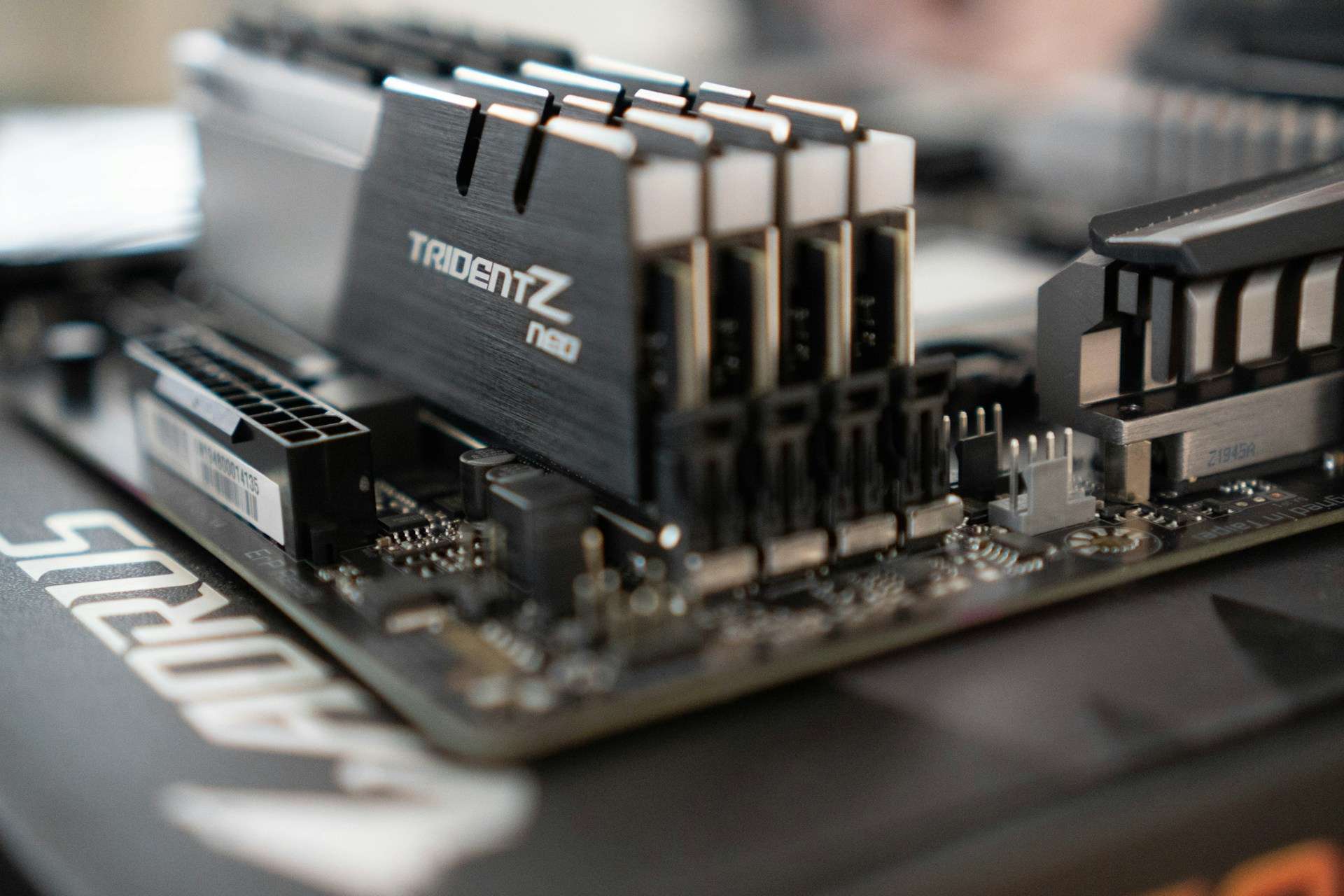
Memory shortage has become one of the major points of tension in the tech industry. It no longer only affects consumer DRAM modules or traditional servers. The demand for artificial intelligence has pushed pressure up to HBM, LPDDR, and other components necessary for building accelerators, complete systems, and large data center clusters.
In this context, statements by Colette Kress, CFO of NVIDIA, have sent a clear message: the company believes many competitors reacted too late. In an interview with analyst Tae Kim, Kress explained that NVIDIA anticipated the price increases and had ordered memory well in advance. Her message was direct: others were surprised by rising memory prices, but NVIDIA had already foreseen it.
This phrase matters because it reveals a less visible advantage than GPU benchmarks. NVIDIA’s dominance isn’t just due to powerful chips or a mature software ecosystem. It also stems from having learned to coordinate the supply chain before many rivals. In the AI era, anticipating memory needs can be as critical as designing the accelerator itself.
Memory has become the new bottleneck
For years, the AI debate focused on GPUs. Models like H100, H200, B200, Blackwell, Rubin, MI300X, or TPU have become common names among companies, investors, and infrastructure leaders. But each generation of accelerators requires vast amounts of high-performance memory to feed models, support longer context windows, and move data at sufficient speed.
HBM has emerged as one of the most contested components on the market. It’s not just any memory: it stacks in multiple levels, offers high bandwidth, and is integrated close to the processor. This makes it ideal for AI workloads but also more complex to manufacture and package. Increasing HBM capacity shifts some industrial efforts away from other memories. The result is pressure that extends to conventional DRAM, LPDDR, and other segments.
Kress explained that NVIDIA doesn’t just buy whatever is available. The company works with memory manufacturers from the design phase, informs them of the configurations it will need, and coordinates capacity with them. According to her, they work with all three major memory suppliers, not just one. This early coordination ensures supply, helps adjust volumes, and avoids dependence on the spot market when prices have already soared.
| Element | Why it matters for AI |
|---|---|
| HBM | Provides high bandwidth for high-performance training and inference |
| DRAM | Remains necessary in servers and systems surrounding GPUs |
| LPDDR | Could gain importance in new integrated AI platforms and systems |
| Manufacturing capacity | Does not expand overnight; requires investment and planning |
| Advanced packaging | Limits the production rate of stacked memories and accelerators |
| Pre-commitments | Give an advantage to those reserving capacity before price hikes |
NVIDIA’s advantage isn’t just chips, but planning
NVIDIA’s results help explain why this foresight is so impactful. In Q3 of fiscal year 2026, the company reported record revenues of $57 billion, a 62% increase year-over-year. Its data center division generated $51.2 billion, up 66% annually. Jensen Huang summarized the situation with a revealing phrase: Blackwell sales were “off the charts,” and cloud GPUs were sold out.
When a company sells almost everything it can produce, the challenge shifts from demand to execution. It’s not enough to have orders; one must secure wafers, memory, substrates, packaging, energy, racks, networks, and assembly capacity. At this stage, NVIDIA operates like a semiconductor company but also like a global infrastructure coordinator.
The difference compared to other players may lie exactly there. Many tech firms built their business on software, cloud, or service integration. NVIDIA, meanwhile, has decades of experience working directly with silicon, memory, board, server manufacturers, and data center operators. That expertise becomes critical when the supply chain comes under pressure.
Kress almost presented it as a critique of the rest of the market: others could have ordered memory earlier, but perhaps didn’t believe strongly enough in the demand’s scale. In an industry where capacity planning spans years, early conviction has very tangible economic consequences.
Rubin could increase the pressure even further
The next major test will come with Rubin, NVIDIA’s next-generation platform. Some market reports estimate that LPDDR demand associated with Rubin in 2027 could surpass the combined demand of Apple and Samsung for smartphones. This figure should be seen as an external forecast, not an official NVIDIA number, but it underscores the scale of the challenge.
Until now, consumers were used to Apple, Samsung, and other mobile manufacturers being large buyers of advanced memory. AI has shifted that hierarchy. A single data center accelerator cycle can compete for capacity with entire consumer electronics sectors.
This shift has cascading effects. If memory manufacturers prioritize high-margin AI contracts, other markets might face price hikes, delays, or reduced availability. PCs, smartphones, traditional servers, storage, and industrial electronics are all exposed to this tension.
| Affected market | Potential AI demand effect |
|---|---|
| Data centers for AI | More investment in HBM, LPDDR, and complete systems |
| Traditional servers | Higher component costs and longer lead times |
| PCs and laptops | Price increases in DRAM and storage if shortages persist |
| Smartphones | Competition for advanced LPDDR memories |
| Memory manufacturers | Higher revenues but increased labor pressure and capacity expansion needs |
| Cloud providers | Need to reserve hardware far in advance |
Memory manufacturers are experiencing their own boom
The shortage is also shifting labor and economic balances in South Korea. SK Hynix and Samsung have seen how AI demand boosts the strategic value of their memory divisions. At Samsung, tensions reached the unionized workforce, with tens of thousands threatening to strike to demand a larger share of profits from the memory boom. The conflict occurred during a particularly delicate moment, with concerns about how a shutdown could impact the global supply of DRAM and NAND.
This situation shows that the AI supply chain doesn’t end in Silicon Valley. It depends on factories in Korea, Taiwan, Japan, the United States, and other countries; chemical, machinery, wafer, and packaging suppliers; and long-term agreements that aren’t improvised when the market is already strained.
For NVIDIA, reserving memory in advance offers a competitive advantage. For rivals, the outcome may be twofold: paying more and receiving later. This affects margins, launch timelines, and the ability to compete in major infrastructure contracts.
The industry’s lesson: AI is won in the supply chain
Artificial intelligence is often presented as a race of models, parameters, and software. But the memory shortage serves as a reminder that it’s also a race of industrial planning. Those who fail to secure critical components on time might have the best design on paper but still fail to produce at scale.
This impacts chip manufacturers, cloud providers, AI startups, governments seeking sovereign infrastructures, and large companies planning their own deployments. Reserving GPUs alone is no longer enough. It’s essential to understand what memory they use, who makes it, which contracts support supply, and what the real timelines are for delivery.
NVIDIA has turned that anticipation into a key part of its advantage. The company doesn’t just sell accelerators; it organizes a complete supply system, joint design efforts, and future capacity planning. In a market where each new AI generation demands more memory, energy, and networking, this capability may be harder to replicate than a technical spec sheet.
Memory shortages are not a transient accident. They are a signal that AI has entered a physical, industrial, and capital-intensive phase. Models can be trained in the cloud, but the cloud depends on factories, chips, wafers, memory, and long-term agreements made years in advance. NVIDIA seems to have recognized this challenge before many others.
Frequently Asked Questions
What has NVIDIA’s CFO said about memory?
Colette Kress stated that NVIDIA anticipated price hikes and had ordered memory in advance, working directly with suppliers to design and reserve capacity.
Why is memory so important for AI?
Because AI accelerators need high bandwidth and large capacity to train models, perform inference, move data, and support workloads with ever-growing contexts.
Does the shortage only affect HBM?
No. The pressure on HBM can displace industrial capacity, ultimately impacting DRAM, LPDDR, and other memory segments used in servers, PCs, and smartphones.
What advantage does NVIDIA have over its competitors?
Besides its GPUs and software ecosystem, NVIDIA appears to have secured memory supply ahead of many rivals, giving it more cost and production stability.
via: wccftech
