
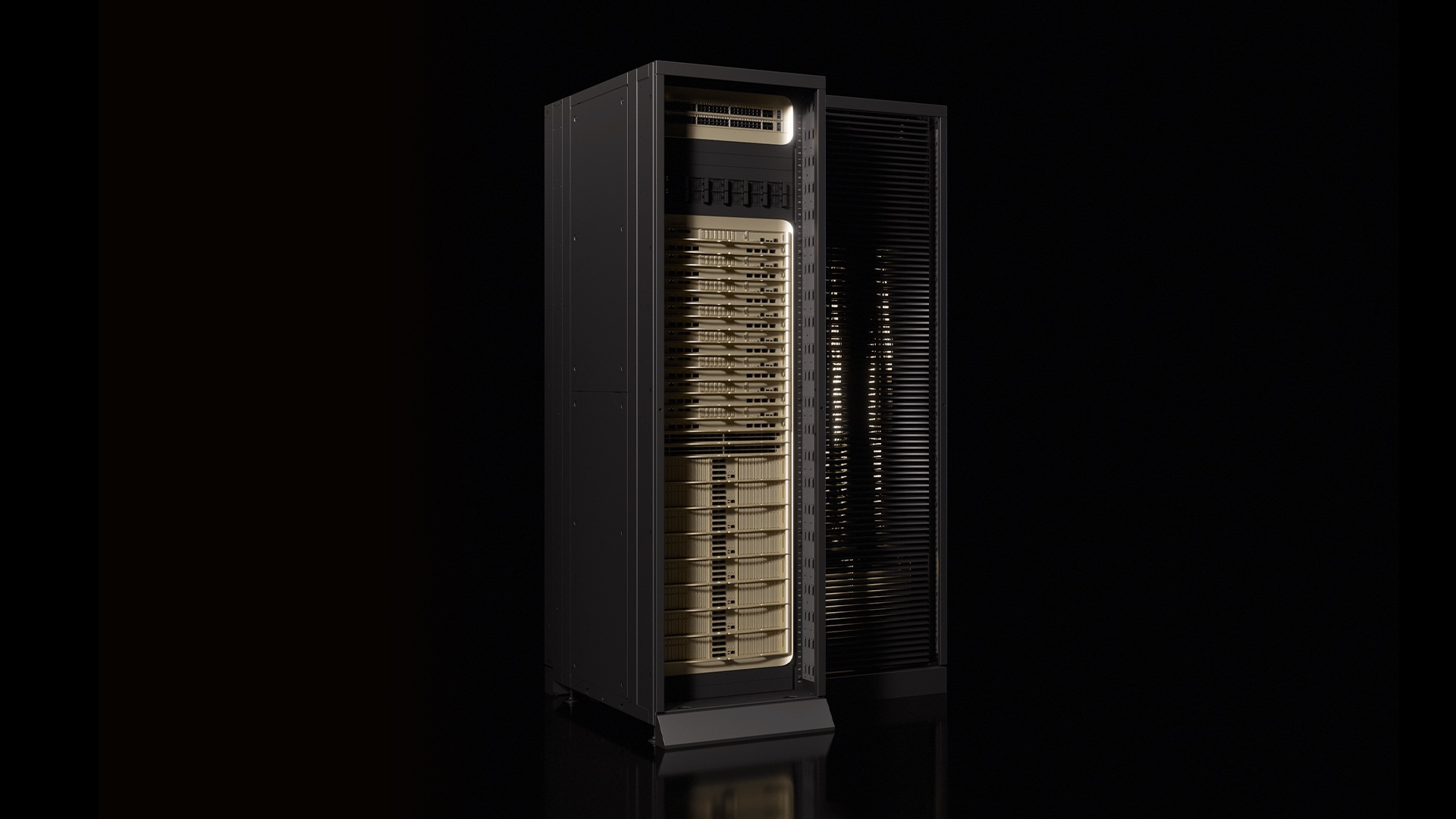
The next major limitation of artificial intelligence is not just the number of available GPUs. It lies in how racks are powered, cooled, and interconnected, reaching energy consumptions once reserved for small industrial facilities. According to TrendForce, NVIDIA is developing its own 800V HVDC power rack to support the arrival of Vera Rubin and, more importantly, to prepare for the leap to Rubin Ultra.
This innovation shouldn’t be seen as merely an electrical change. It’s a signal of where AI infrastructure is moving: from servers to racks, from racks to data halls, from data halls to campuses, and from campuses to the electrical grid. Accelerators are becoming denser, models require more inference and training capacity, and AI architectures are now designed as complete systems where computing, memory, networking, cooling, and power form a single engineering unit.
NVIDIA’s 800V rack is expected to be ready for customer shipments by Q3 2026, but not as a standard configuration. TrendForce anticipates it will be offered as an option for Vera Rubin deployments, with adoption progressively increasing from Rubin Ultra, which is scheduled for the second half of 2027. Widespread deployment would likely occur in 2028, when energy demand per rack makes traditional schemes less sustainable.
From 150 kW to 660 kW per rack
The key factor driving this shift is power. The GB300 generation consumes approximately 150 kW per rack. The VR200 platform increases this to about 225 kW. That’s a significant increase but still manageable with conventional power supplies integrated into the rack itself.
Rubin Ultra changes the scale. TrendForce estimates that power consumption per rack could rise to around 660 kW, with some next-generation systems potentially reaching between 1.2 MW and 1.3 MW. At these levels, the electrical architecture stops being a secondary component and begins to dictate data center design.
| Platform or Generation | Estimated Power Consumption per Rack | Technical Note |
|---|---|---|
| GB300 | 150 kW | High density, still manageable with conventional PSUs |
| VR200 | 225 kW | Increasing consumption, but within current architecture |
| Rubin Ultra | 660 kW | Requires rethink of power supply and distribution |
| Next systems | 1.2 MW–1.3 MW | Energy becomes the main physical bottleneck |
The logic behind moving to 800V HVDC is straightforward: increasing voltage allows for reducing current to deliver the same power. Less current means lower losses, less heat in cables and buses, and more efficient distribution in dense configurations. In environments where each rack can consume hundreds of kilowatts, this difference is no longer marginal.
This change also shifts value towards new suppliers. Power racks, transformers, rectifiers, busbars, connectors, switches, cabling, electrical protection, and monitoring systems become more critical. AI is no longer just buying GPUs; it’s purchasing a complete electrical chain.
Vera Rubin as a transition, Rubin Ultra as a breakthrough
Vera Rubin’s arrival will be the first step, but not necessarily when 800V becomes essential. TrendForce believes Vera Rubin customers will have the option to choose the 800V configuration, but many will continue to use conventional architectures if their density and redundancy requirements permit.
Rubin Ultra represents a different scenario. With racks around 660 kW, a single 800V power rack could support one or two Rubin Ultra racks, though the final ratio will depend on each client’s redundancy needs. A hyperscale provider prioritizing uptime, fault tolerance, and hot-swapping will size their power infrastructure differently than a lab or less critical deployment.
| Element | Role in New Architecture |
| Compute Rack | Houses GPUs, CPUs, memory, networking, and cooling |
| Power Rack 800V | Supplies high-voltage DC power to the system |
| Redundancy | Determines how many power racks are needed per compute rack |
| Liquid cooling | Necessary to dissipate heat at extreme densities |
| Busbars and distribution | Replace part of traditional cabling in dense layouts |
| Electrical monitoring | Critical for operation, safety, and maintenance |
NVIDIA is also developing additional power delivery architectures to offer greater flexibility. This makes sense, as not all clients have the same electrical infrastructure, room design, redundancy goals, or adaptability. Imposing a single electrical model at this stage would limit the market.
Data centers becoming energy factories
The term “AI factory” is no longer just marketing jargon. Large AI data centers increasingly resemble energy-intensive industrial facilities. A gigawatt-scale campus isn’t designed like a typical corporate data center. It is built around substations, transmission lines, energy agreements, transformers, cooling systems, water availability, thermal alternatives, and multi-year civil works planning.
TrendForce indicates that several gigawatt-scale campuses in North America could come online before late 2026. Yet, the actual timetable depends on constraints that aren’t solved by simply buying more GPUs: memory, CPUs, server components, electrical equipment, grid connection, and permits.
| Physical Bottleneck | Importance |
| Memory | Without HBM, DRAM, and modules, full servers cannot be assembled |
| CPUs | AI racks depend on host processors as well |
| Transformers | Delivery times span years |
| Switchgear | Crucial for protecting and controlling electrical distribution |
| Grid interconnection | Can delay projects even with sufficient generation |
| Cooling | High densities require advanced liquid and thermal designs |
| Skilled workforce | Building and operating these campuses requires scarce expertise |
The most critical factor isn’t total energy generation but transmission capacity. According to TrendForce, most electricity markets in the U.S. have sufficient generation for approved projects, but connecting new large loads to the grid remains a challenge. In PJM-managed regions, connection queues for new data centers can exceed five years.
This changes the industry’s pace. A GPU can arrive in months, but a large transformer might take 2.5 years. Transformers from 345 kV to 765 kV can require four to five years — double the time of 2020. In a race where each generation of accelerators is measured in ever shorter cycles, electrical infrastructure moves at a much slower pace.
AI enters the era of megawatts per rack
For years, AI performance was measured in FLOPS, memory, bandwidth, and cost per token. While these metrics remain relevant, they are no longer enough. Going forward, we must also consider kilowatts per rack, distribution efficiency, substation capacity, transformer availability, energy costs, and interconnection permits.
This affects the entire supply chain. hyperscalers can better handle this transition since they design campuses from scratch, establish energy agreements, and work directly with manufacturers. Medium-sized cloud providers and existing data centers will face greater challenges. Many rooms aren’t prepared for 600 kW per rack, let alone going beyond a megawatt. Upgrading them could be more expensive than building new facilities.
An additional gap opens between those with access to energy and those limited to capital for hardware. By 2028, it won’t be enough to just raise funds for GPUs; securing electrical capacity, signing power contracts, obtaining transformers, permits, and designing compatible energy architectures with cutting-edge accelerators will be essential.
Europe must heed this signal carefully
Although the report focuses on North America, the message for Europe is clear. The continent aims for more AI data centers, greater technological sovereignty, and more local processing capacity. But many regions already face issues with grid connections, permitting, energy supply, and community acceptance of new data centers.
If the next-generation racks demand hundreds of kilowatts or more than a megawatt per unit, the European conversation cannot be limited to announcing European AI gigafactories. It must include discussions on electrical grids, substations, permits, renewable energy commitments, storage, cooling, industrial land, and procurement of critical equipment in advance.
AI infrastructure is outpacing energy infrastructure. NVIDIA can design more powerful racks, but if the grid cannot support them, the racks won’t produce. This mismatch could become an advantage for those who plan early, or a setback for those who treat energy administration as just paperwork.
The new power lies in powering AI
NVIDIA’s 800V rack reflects a broader trend: the AI market is shifting from a chip race to a complete system race. Success depends on how well systems integrate compute, memory, network, software, cooling, and energy — and that integration now extends from chip design to substation planning.
For NVIDIA, offering its own power rack also has strategic implications. A more complete platform makes it harder to separate GPUs from the rest of the infrastructure. Customers aren’t just buying accelerators; they’re investing in a reference architecture promising faster scaling with less risk. This reinforces NVIDIA’s control over the design of future AI data centers.
Dependency also increases. If compute, networking, cooling, and power are designed as a closed or semi-closed platform around a single provider, customers gain integration but lose flexibility to mix components. The industry will need to balance efficiency and adaptability.
The move to 800V may not be visible to end users, but it will influence how many AI data centers are built, where they are located, and who operates them. AI no longer only faces GPU availability; it confronts issues with copper, transformers, permits, substations, and transmission lines. This less visible layer will shape a significant part of the market’s next phase.
Frequently Asked Questions
What is an 800V HVDC rack?
It is a power architecture that distributes high-voltage direct current, in this case 800 volts, to deliver large amounts of power with less current and lower losses than lower-voltage designs.
When will NVIDIA’s 800V Power Rack arrive?
According to TrendForce, it should be ready for customer shipments in Q3 2026 as an option for Vera Rubin, but not as a standard configuration.
Why does Rubin Ultra need a different electrical architecture?
Because its power consumption per rack could reach around 660 kW, making traditional integrated power designs in the rack much more challenging.
What is the main obstacle for new AI data centers?
Beyond GPUs, memory, and CPUs, the major bottleneck may be grid connection, transformers, switchgear, and other electrical components with multi-year delivery times.
via: trendforce
