
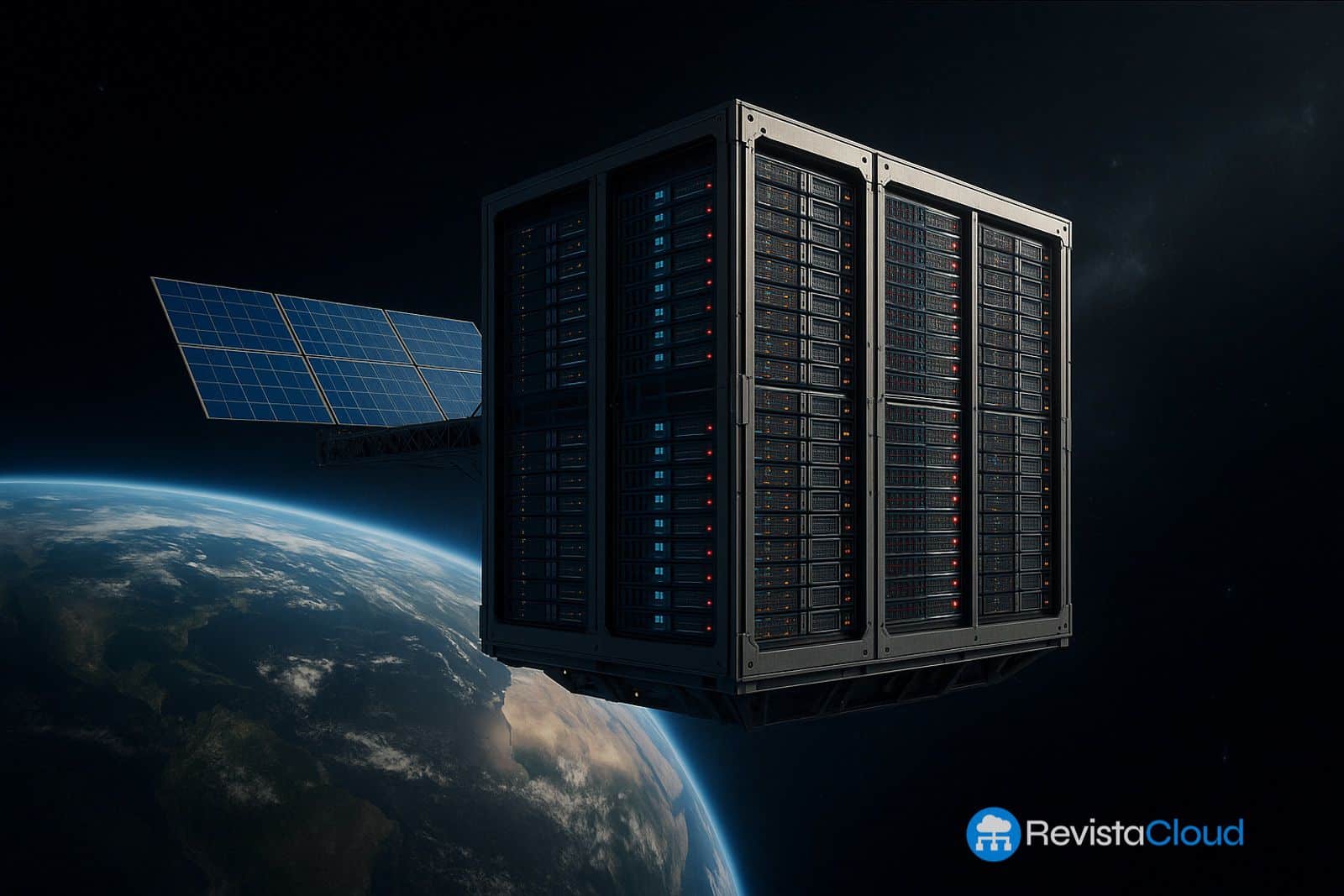
NVIDIA is no longer satisfied with dominating the terrestrial data center. Amidst the rising demand for AI computing—and increasing constraints related to energy, land, and cooling—the company has begun shifting pieces into a territory that until recently sounded like science fiction: taking part of the computing infrastructure into orbit.
The clearest signal has come in the form of a job posting. NVIDIA is hiring an “Orbital Data Center System Architect”, a role responsible for designing “orbital data center” systems “from chip to satellite” and satellite-to-satellite connectivity, with a published base salary range of $224,000 to $356,500 (excluding stock options and benefits). The job description requires knowledge of the space environment—radiation, environmental tolerances, reliability, thermal solutions—and even experience with mechanical challenges related to launches.
This opportunity hasn’t gone unnoticed in the infrastructure sector. Industry media interpret it as an indicator that NVIDIA aims to be involved “at the inception” of a new industry: space computing.
Why would someone want data centers in space?
The idea relies on two promises that appeal to any infrastructure planner: abundant solar energy and theoretical scalability without the same regulatory and territorial constraints as on Earth. However, space isn’t an ideal clean room: radiation damages components, maintenance is complex, and thermal management in a vacuum isn’t as simple as “cold outside.” That’s why even NVIDIA’s public discussions are cautious, reflecting both interest and prudence.
In recent weeks, Jensen Huang—NVIDIA’s CEO—has encapsulated the current state with a remark that sums up the situation: the economics of space-based data centers “are bad for now,” but could improve. The phrase doesn’t halt exploration but grounds it: this remains a technological bet and roadmap, not immediate large-scale deployment.
From theory to initial trials: H100 in orbit and Outposts “in space”
What’s changing in 2026 is that initial demonstrations already exist. The startup Starcloud (frequently mentioned in this field) claims a milestone: operating an NVIDIA H100 in space by late 2025 and running AI workloads as proof of concept.
The next phase, which is already publicly announced, is even more ambitious: Starcloud plans to launch AWS Outposts hardware on a mission scheduled for October 2026, bringing the “hybrid cloud” concept into orbit. Details are found in technical publications and industry sources citing public statements from Starcloud’s CEO.
Google also joins the game: Project Suncatcher with Planet
Google has unveiled Project Suncatcher, an R&D initiative exploring space-scale computing with TPU chips, in collaboration with Planet: two prototype satellites expected by early 2027. The company sees this as a step toward understanding in-orbit reliability, thermal challenges, and future cluster scalability.
SpaceX raises the stakes: up to 1,000,000 satellites… and a wave of criticism
On the more aggressive end is SpaceX. In late January 2026, the company submitted a request to the FCC for a system that could potentially include up to 1,000,000 satellites linked to the idea of orbital data centers—a volume that has sparked broad public and technical debate. The FCC accepted the application and opened a comment period, focusing on feasibility, space safety, and orbital debris risks.
The response has been notably critical and media-focused. Recent weeks have seen high-profile voices labeling the concept as “ridiculous” or “crazy” due to costs, maintenance, launch capacity, and operational risks.
What is NVIDIA’s role here—and why does the job opening matter?
NVIDIA’s job posting is significant because it hints at more than just selling GPUs for space computing; it suggests building architecture for orbital systems (chips, modules, radiation tolerance, interconnects, thermal management, operations). NVIDIA aims to become the “go-to” provider should space compute take off.
It also aligns with an uncomfortable reality: the bottleneck in AI isn’t just silicon anymore; it’s the entire infrastructure (power, cooling, permits, networking, resilience). If part of that pressure shifts to orbit—even in niche applications—NVIDIA wants to be involved from the start.
Summary table: Key movements in “orbital computing” announced in 2025–2026
| Actor | What’s announced or demonstrated | Publicly cited timeline | Risks/limitations |
|---|---|---|---|
| NVIDIA | Hire for “Orbital Data Center System Architect” to design orbital AI systems; base salary $224K–$356.5K | Already announced in 2026 | Economic viability and radiation/thermal challenges |
| Starcloud | Orbit tests with NVIDIA H100; plans for AWS Outposts deployment | H100 operational by 2025; Outposts in October 2026 | Scaling, operations, launch logistics |
| Project Suncatcher with Planet: prototypes with TPUs on satellites | Two prototypes by early 2027 | Reliability and thermal management in orbit | |
| SpaceX | FCC application for a system of up to 1 million satellites | Application filed in 2026 | Cost, space debris, maintenance risks |
Frequently Asked Questions
What is an “orbital data center”?
An infrastructure concept involving deploying hardware (chips/servers) on satellites in orbit to run workloads, utilizing solar power and communication links as key components.
Why is NVIDIA looking for an orbital data center architect?
Because the role aims to design complete “from chip to satellite” systems—preparing products and a roadmap if orbital computing becomes a viable market.
What has already been tested?
Starcloud and partners report demonstrations with an H100 in orbit and plans for an Outposts mission, while Google has announced prototypes for 2027. These are early milestones, still far from a terrestrial-equivalent “data center.”
Is it economically viable in the short term?
Even NVIDIA has publicly noted that “it’s bad for now,” and significant industry criticism exists regarding costs and operational challenges. The debate is ongoing.
Sources: datacenterdynamics, NVIDIA Careers, and Twitter X