
NVIDIA has once again raised the bar for AI infrastructure. The company closed its second fiscal quarter of 2027, ended July 26, with $96.22 billion in revenue, up 106% year over year, while Data Center reached $89 billion, up 117%. But behind the numbers lies a deeper shift: NVIDIA is moving from being the dominant supplier of AI accelerators to offering a full stack that includes GPUs, CPUs, networking, software, rack-scale systems, and even new structures to help finance the construction of data centers.
NVIDIA’s quarter in 20 seconds
- NVIDIA posted $96.22 billion in quarterly revenue, up 106% year over year.
- Data Center contributed $89 billion and now accounts for roughly 92.5% of revenue.
- Vera Rubin is now in production and starting to roll out to major cloud providers.
- AWS and NVIDIA plan to deploy another 2 million GPUs.
- NVIDIA is backing platforms aimed at mobilizing more than $500 billion for AI infrastructure.
The results also help put the pace of change in perspective. Exactly a year ago, NVIDIA posted $46.74 billion in quarterly revenue, with Data Center generating $41.10 billion. In twelve months, the company has nearly doubled in size, while the business directly tied to AI infrastructure has grown even faster.
| Metric | Q2 FY2027 | Q2 FY2026 | Change |
|---|---|---|---|
| Total revenue | $96.22B | $46.74B | +106% |
| Data Center | $89.00B | $41.10B | +117% |
| GAAP operating income | $63.73B | $28.44B | +124% |
| GAAP net income | $59.69B | $26.42B | +126% |
| GAAP diluted EPS | $2.46 | $1.08 | +128% |
| GAAP gross margin | 75.0% | 72.4% | +2.6 points |
From Blackwell to Vera Rubin: NVIDIA sells the full infrastructure stack
The 92.5% figure explains where NVIDIA is heading better than any other number. Data Center is essentially NVIDIA at this point, from a revenue standpoint.
The company still designs chips, but its commercial product increasingly looks less like a standalone GPU.
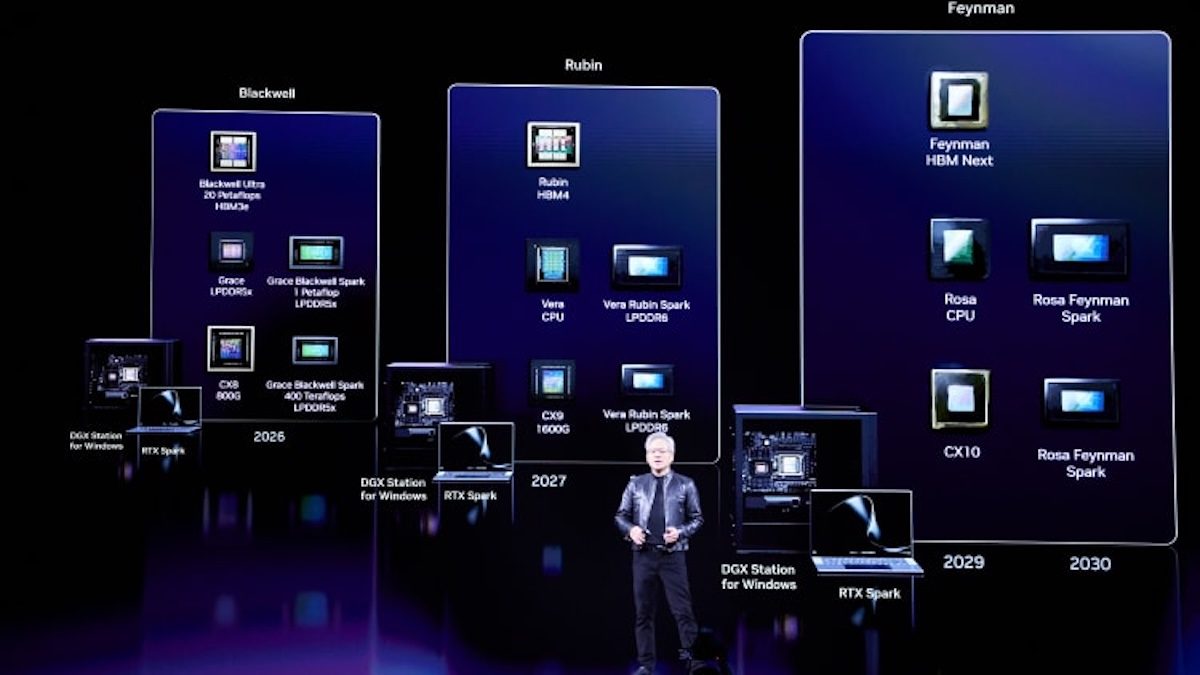
Blackwell, and especially Vera Rubin, push that transformation toward complete systems. NVIDIA combines accelerators, CPUs, NVLink, Ethernet and InfiniBand networking, switches, BlueField, storage tied to AI infrastructure, and a growing software layer.
The company has also introduced DSX, positioned as a platform for designing, building, and operating what it calls “AI factories.” Meanwhile, Vera Rubin is already moving into production, with racks running at providers such as CoreWeave, Google Cloud, Microsoft Azure, Oracle Cloud Infrastructure, and Nebius — early benchmarks already point to up to 30 times more performance per megawatt than Blackwell.
The technology roadmap can be summarized like this:
Hopper → Blackwell → Blackwell Ultra → Vera Rubin
But each generation involves more than just swapping one GPU for another. NVIDIA is shifting its product from the component level to the rack, and from there to the entire data center architecture.
That also reshapes the competitive landscape. AMD can compete with Instinct against certain NVIDIA GPUs, while Google, Amazon, and other hyperscalers develop their own accelerators. But competing against an integrated architecture of compute, interconnect, networking, and software means covering a lot more layers at once.
The phrase Jensen Huang used during the earnings call sums up how NVIDIA frames this shift: “Now, compute is revenue.” The company’s thesis is that tokens generated by AI systems can already translate into economic activity, and that the compute needed to produce them is therefore becoming revenue-generating infrastructure in its own right.
AWS is preparing another 2 million NVIDIA GPUs
The outlook doesn’t point to a slowdown yet, either.
NVIDIA expects $108 billion in revenue for its fiscal third quarter, with a 2% margin of variance. That figure would mean adding roughly $11.8 billion in quarterly revenue compared with the period just closed. The company’s guidance doesn’t include revenue from Data Center compute for China.
At the same time, AWS and NVIDIA have announced an expanded partnership that includes deploying 2 million additional GPUs across Amazon Web Services’ global infrastructure. The agreement also covers Vera CPUs, networking, open Nemotron models, and physical-AI technologies.
The scale helps explain why the conversation around AI is no longer limited to GPU performance alone.
Installing millions of accelerators requires HBM memory, networking gear, optics, cooling, power supply, transformers, land, and data centers capable of handling ever-higher power densities.
The bottleneck may therefore be shifting from compute availability to the physical capacity to install and power it.
NVIDIA also relies on third parties to manufacture, assemble, package, and test its products — something the company itself lists among its business risk factors.
From selling compute to helping finance it
This is where one of the most interesting moves shows up from an infrastructure standpoint.
On August 10, NVIDIA announced agreements with Apollo, BlackRock, Blackstone, Brookfield, Goldman Sachs, and KKR to set up independent platforms for financing compute capacity.
The stated goal is to eventually mobilize more than $500 billion in third-party capital to build AI infrastructure, subject to finalizing the corresponding agreements. It’s part of a broader pattern of NVIDIA betting outside pure hardware sales — the company also put around $7 billion behind AI coding startup Poolside earlier this month.
The figure matters because it points to the market’s next phase.
It’s no longer enough to manufacture enough accelerators. Someone also has to finance the buildings, servers, networks, electrical systems, and cooling where they’ll run.
For NVIDIA, the logic is straightforward: the more funding is available for new AI factories, the larger the potential market for its platforms.
That doesn’t mean the $500-billion-plus figure is direct NVIDIA investment. The company specifically refers to third-party capital and independent platforms, an important distinction from the idea that NVIDIA itself would be spending that amount.
But it does show how far the company’s role in the sector is expanding.
A few years ago, NVIDIA mainly sold GPUs. Now it provides much of the system’s hardware and software, defines reference architectures, and takes part in initiatives designed to make the infrastructure that will eventually host those systems financeable in the first place.
The margin hints at another problem: memory and components
The growth isn’t free of costs, either.
NVIDIA closed the quarter with a 75% gross margin, but expects roughly 74%, plus or minus 0.5 points, for the third quarter.
That’s a particularly interesting figure to watch during the transition to Vera Rubin.
AI platforms increasingly depend on components that are themselves going through cycles of heavy demand, especially high-bandwidth memory, advanced packaging, networking, and cooling systems.
NVIDIA has, for instance, announced a multi-year partnership with SK hynix to advance next-generation memory for this kind of infrastructure.
The upshot is that the race can no longer be measured in FLOPS alone.
The availability of power, HBM, manufacturing capacity, high-speed networking, cooling, and data center space is starting to determine how many GPUs can actually be put into production.
The next test will be utilization of all that capacity
The current results show that demand keeps growing at a rapid clip. NVIDIA doubled its revenue in twelve months and expects to top $100 billion in quarterly revenue for the first time.
The technological and economic unknown shows up a bit further down the road.
The industry is building an extraordinary amount of compute capacity, betting that agents, inference, video generation, coding, robotics, scientific models, and enterprise applications will end up consuming enough tokens to make it pay off. The same dynamic is playing out across the sector — as this look at the broader semiconductor market’s 92% growth forecast for 2026 makes clear.
If that utilization materializes, NVIDIA will have positioned itself across several of the essential layers of a new computing infrastructure.
If installed capacity grows faster than actual workloads, the pressure will eventually shift from data center operators and cloud providers back onto the manufacturers.
For now, the numbers show the opposite. They show NVIDIA saying demand keeps accelerating, even as Vera Rubin enters production and new large-scale deployments are announced.
The difference from previous quarters is that NVIDIA can no longer be assessed just by asking how many GPUs it sells. You also have to look at how many racks are being deployed, what networks connect them, where the electricity comes from, and, increasingly, who is putting up the hundreds of billions needed to finance them.
Frequently Asked Questions
How much did NVIDIA earn in its fiscal second quarter of 2027?
NVIDIA posted $96.22 billion in revenue, up 106% from a year earlier and 18% from the previous quarter.
How much of NVIDIA’s revenue comes from Data Center?
Data Center generated $89 billion, about 92.5% of the company’s total revenue for the quarter.
What is Vera Rubin?
It’s NVIDIA’s next-generation AI infrastructure platform, the successor to Blackwell. It’s already moving into production and combines different compute, interconnect, and networking components for rack-scale deployments.
Is NVIDIA investing $500 billion in data centers?
No. NVIDIA has announced agreements with several major financial firms to create platforms aimed at mobilizing more than $500 billion in third-party capital for AI infrastructure. It is not a direct investment of that amount by NVIDIA itself.
