
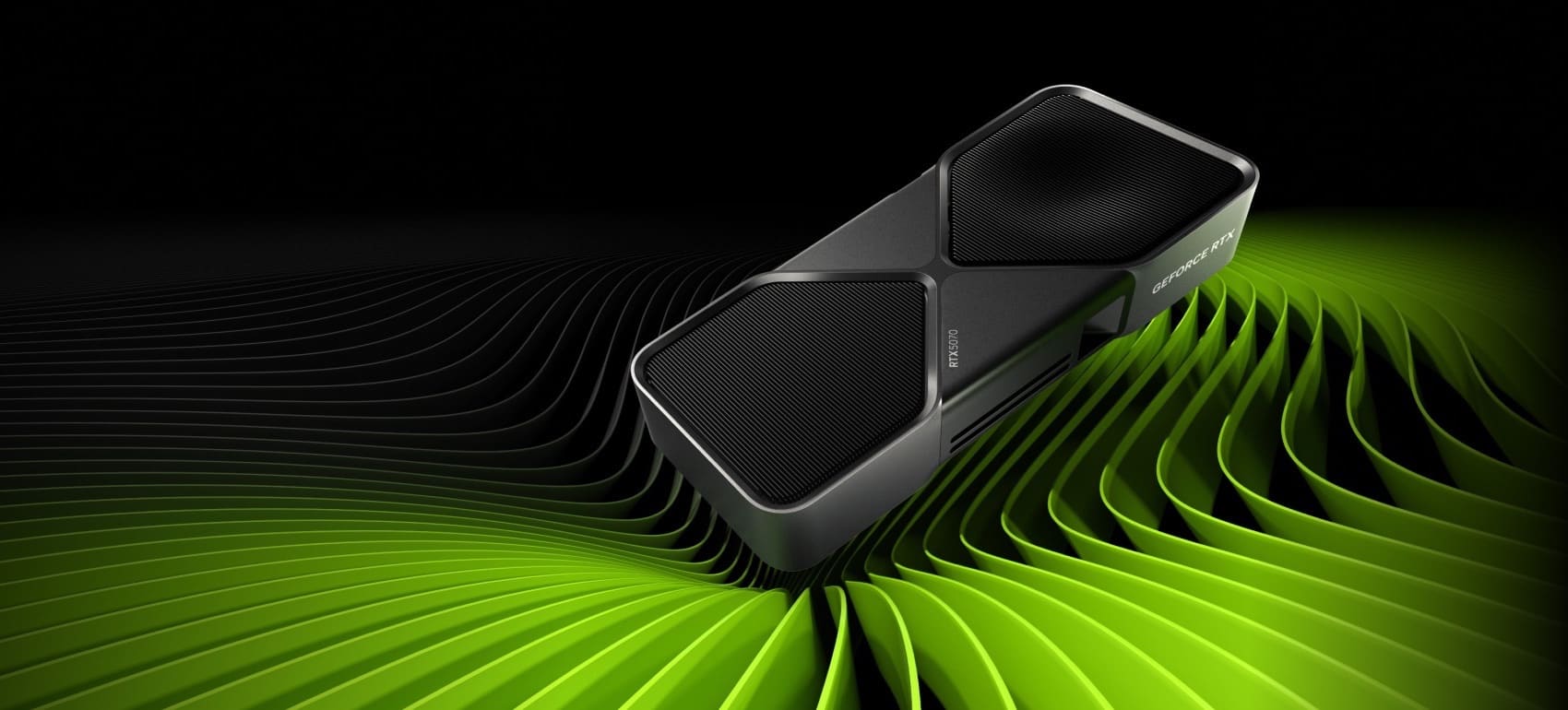
The NVIDIA RTX 50 series continues to expand with the launch of the GeForce RTX 5070 Ti and RTX 5070, two graphics cards that promise outstanding performance for gamers and content creators. With the Blackwell architecture, these GPUs incorporate technologies such as DLSS 4, advanced ray tracing, and fifth-generation Tensor Cores, optimized for artificial intelligence tasks and real-time rendering.
Index
- Technical specifications and comparison with previous generations
- DLSS 4 and its impact on gaming performance
- Performance in synthetic benchmarks
- Tests in modern video games
- NVIDIA Reflex 2 and latency improvements
- Conclusion: Is the RTX 5070 Ti or RTX 5070 worth it?
Technical Specifications and Comparison
NVIDIA has designed the RTX 5070 series as the most accessible option within the Blackwell architecture, offering substantial improvements over the previous generation. Below is a comparison table between the latest models:
Comparison of the RTX 5070 Ti, RTX 5070, and the RTX 4070 Ti SUPER
| Model | RTX 5070 Ti | RTX 5070 | RTX 4070 Ti SUPER |
|---|---|---|---|
| Architecture | Blackwell | Blackwell | Ada Lovelace |
| CUDA Cores | 8960 | 6144 | 8448 |
| Tensor Cores (AI) | 5th Gen – 1406 TOPs | 5th Gen – 988 TOPs | 4th Gen – 1250 TOPs |
| Ray Tracing Cores | 4th Gen – 133 TFLOPS | 4th Gen – 94 TFLOPS | 3rd Gen – 110 TFLOPS |
| Memory | 16 GB GDDR7 | 12 GB GDDR7 | 12 GB GDDR6X |
| Memory Bus | 256-bit | 192-bit | 192-bit |
| BandwidthBandwidth is the maximum transfer capacity of a system. | 896 GB/s | 672 GB/s | 672 GB/s |
| TGP (Power Consumption) | 300W | 250W | 285W |
| Official Price (€) | 889€ | 654€ | 799€ |
The key differences lie in the number of CUDA cores and Tensor Cores, as well as the amount of VRAM. The RTX 5070 Ti is a more trimmed version of the RTX 5080, while the RTX 5070 is positioned as a more balanced option for those seeking performance at a good price in 1440p gaming.
DLSS 4: The Key to Improving FPS Without Losing Quality
DLSS 4 is the evolution of NVIDIA’s scaling technology, allowing for a drastic improvement in performance without compromising visual quality. Now, with Multi Frame Generation, DLSS 4 quadruples the frame rate in supported titles, reducing the impact of ray tracing.
Difference in FPS with DLSS 4 in Cyberpunk 2077 at 4K
| Settings | RTX 5070 Ti (FPS) | RTX 5070 (FPS) |
|---|---|---|
| Native (no DLSS) | 41 FPS | 34 FPS |
| DLSS 3 (Frame Generation) | 138 FPS | 113 FPS |
| DLSS 4 (Multi Frame Generation) | 273 FPS | 224 FPS |
The results show that DLSS 4 turns mid-range graphics cards into very powerful options, allowing for 4K gaming with FPS similar to that of a previous generation RTX 4090.
Synthetic Benchmarks: RTX 5070 Ti vs RTX 5070 vs RTX 4070 Ti SUPER
To evaluate overall performance, we subjected both GPUs to tests in 3DMark and Unigine Superposition with various graphics settings.
3DMark Fire Strike (DX11)
| Settings | RTX 5070 Ti | RTX 5070 | RTX 4070 Ti SUPER |
|---|---|---|---|
| 1080p | 41,276 pts | 38,221 pts | 39,780 pts |
| 1440p | 34,117 pts | 30,863 pts | 32,930 pts |
| 4K | 25,981 pts | 22,345 pts | 24,503 pts |
3DMark Time Spy (DX12)
| Settings | RTX 5070 Ti | RTX 5070 | RTX 4070 Ti SUPER |
|---|---|---|---|
| 1080p | 22,432 pts | 19,012 pts | 20,395 pts |
| 1440p | 17,785 pts | 14,762 pts | 15,930 pts |
| 4K | 13,204 pts | 10,568 pts | 12,102 pts |
In terms of raw performance, the RTX 5070 Ti outperforms the RTX 5070 by 15-20% and performs 10% better than the RTX 4070 Ti SUPER in most scenarios.
Tests in Modern Video Games
We tested both graphics cards on various AAAAAA is a benchmarking framework that integrates tools, processes, etc. titles in Ultra settings. All tests were conducted with DLSS 4 in performance mode.
| Game | Resolution | RTX 5070 Ti (FPS) | RTX 5070 (FPS) |
|---|---|---|---|
| Cyberpunk 2077 | 4K | 273 FPS | 224 FPS |
| Alan Wake 2 | 4K | 197 FPS | 169 FPS |
| Hogwarts Legacy | 1440p | 215 FPS | 182 FPS |
| Marvel Rivals | 1440p | 240 FPS | 210 FPS |
| Starfield | 4K | 142 FPS | 118 FPS |
As seen, the RTX 5070 Ti is an excellent option for gaming at 1440p and 4K with DLSS 4, while the RTX 5070 continues to deliver impressive performance in 1440p with high FPS rates.
NVIDIA Reflex 2 and Latency Improvement
The RTX 5070 Ti and 5070 also include NVIDIA Reflex 2, which introduces Frame Warp, a technique to further reduce latency in competitive gaming. In titles like Counter-Strike 2, Apex Legends, and The Finals, the improvement in response time is notable.
| Game | RTX 5070 Ti (ms) | RTX 5070 (ms) | RTX 4070 Ti SUPER (ms) |
|---|---|---|---|
| CS2 | 12.3 ms | 13.8 ms | 14.7 ms |
| Valorant | 7.1 ms | 8.3 ms | 9.5 ms |
| Fortnite | 15.2 ms | 16.9 ms | 18.4 ms |
With Reflex 2, competitive players can expect up to 20% less latency compared to previous generations.
Conclusion: Is the RTX 5070 Ti or RTX 5070 Worth It?
Both cards offer excellent performance with DLSS 4, advanced Ray Tracing, and latency improvements.
- If you’re looking to play in 4K with high FPS rates, the RTX 5070 Ti is the best option.
- If you play at 1440p and want a powerful GPU at a lower price, the RTX 5070 remains an excellent alternative.
In conclusion, the RTX 5070 Ti and 5070 represent the best value for money within the Blackwell architecture, ensuring high performance, efficiency, and support for future AI and gaming technologies.
