
The hardware industry for data centers has been accustomed to quick product cycles for years, but the wave of AI is shifting something deeper: who captures the value along the supply chain. With the Nvidia GB200 platform (Blackwell family) entering mass production and paving the way for “rack-scale” systems, chassis and rack manufacturers are moving beyond simply providing metal and mechanical parts to becoming full thermal and infrastructure system integrators. That leap, once the domain of large ODMs, is accelerating due to a very specific factor: heat.
The turning point: you no longer buy “a server,” you deploy an entire rack
Before the era of generative AI, the chassis was an important component, yes, but relatively “stable”: a mechanical enclosure for boards, power supplies, and fans. The shift happens when the market moves toward platforms where the deployment unit is no longer a standalone server but a full system rack designed as an integrated solution.
The logic is straightforward: to train and infer large-scale models, operators don’t want to assemble dozens of parts in the data center; they want pre-integrated racks, tested and ready to connect. That’s where the chassis stops being just a “box” and becomes infrastructure: power distribution, cabling (or its absence), instrumentation, and increasingly, liquid cooling circuits.
An indication of where design is headed was provided by Nvidia itself when unveiling new-generation NVL72 architectures: redesigns aimed at accelerating deployments and reducing field complexity, with approaches prioritizing integration and liquid cooling.
Why liquid cooling is becoming “mandatory”
The bottleneck isn’t just computing power but thermal density. As GPU consumption increases and interconnection components multiply within racks, air becomes insufficient or inefficient in many scenarios. Practically, the industry is shifting toward schemes like direct-to-chip (cold plates), liquid distribution via manifolds, quick-connects, sensors, and maintenance procedures designed to minimize leak risks.
This isn’t theoretical: recent reports on NVL72 racks indicate that liquid cooling infrastructure has become a significant line item, with associated system costs that can escalate considerably as thermal demands grow.
Meanwhile, hyperscalers themselves are exploring specialized solutions to handle thermal jumps; for example, approaches such as integrated rack-level heat exchangers have been disclosed for large cloud internal designs.
From “building boxes” to selling integration: the new chassis business
This technical shift translates into a business change. Manufacturers that once competed mainly on price, delivery times, and mechanical tolerances now compete on:
- Thermal design (hydraulics, materials, cold plates, validation)
- Rack integration (assembly, testing, transportation logistics, commissioning)
- Quality and reliability (leak prevention, standards compliance, maintainability)
- Production capacity for large, rapid, and standardized orders
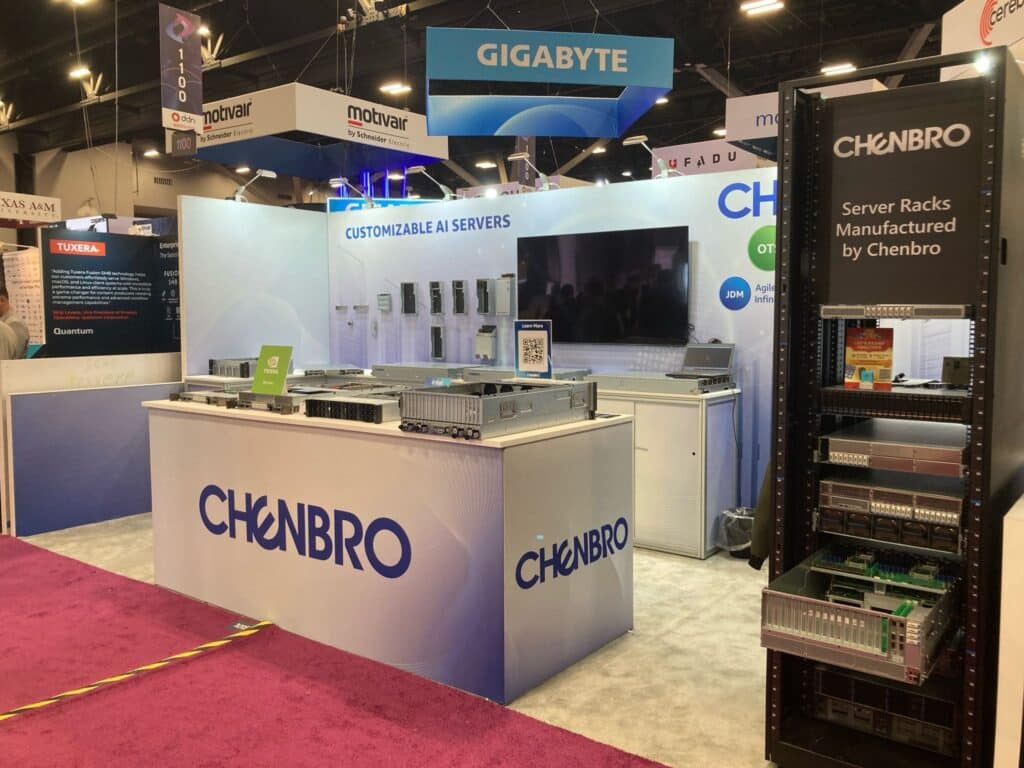
In this context, Asian suppliers traditionally known for mechanical parts are expanding into system assembly and integration. For example, Chenbro has promoted its alignment with modular architectures (MGX) and NVL72 platforms associated with GB200, demonstrating that it’s no longer just about manufacturing chassis but participating in complete infrastructure configurations.
Supply chain specialized media have described this transition as an expansion of chassis manufacturers into solutions that include thermal management and system-level assembly—closer to “systems” than just “components”—at a time when AI is reshaping server hardware priorities.
A trend also visible at the corporate “boardroom” level
When a technology becomes strategic, consolidation activity begins. And in liquid cooling for data centers, this is already happening: major industrial groups have announced initiatives to strengthen thermal and liquid cooling capabilities, signaling that the market expects these solutions to cease being niche and start becoming standard in parts of AI infrastructure.
In other words: it’s not just a engineering trend; it’s an industry-driven move.
What this means for data centers and operators
For data center operators (or those building infrastructure for third parties), this shift has practical consequences:
- Thermal and installation planning: liquid cooling requires redesigning distribution, maintenance, spare parts, and procedures.
- Procurement and contracts: more “rack solutions” and fewer “standalone servers” are purchased.
- Risk and compliance: new testing, traceability, and support requirements emerge.
- Deployment timelines: promise to reduce friction—if integration is well-resolved and standardized.
In the medium term, this transition could raise entry barriers (not everyone can manufacture and validate liquid systems) and simultaneously open new competitive avenues for those previously limited to narrow profit margins on metal components.
Frequently Asked Questions
What is Nvidia GB200 and why is it linked to AI racks?
GB200 is part of the Blackwell family aimed at high-performance AI infrastructure. The industry is shifting toward deployments where the practical unit is the rack, optimized for interconnection, power, and cooling.
Why is liquid cooling replacing air cooling in AI servers?
Because the thermal density of GPUs and interconnection subsystems in advanced racks makes air insufficient or inefficient in many cases; liquid cooling enables more heat removal near the chip and stabilizes temperatures.
What does “rack-level integration” mean for chassis suppliers?
It involves delivering a more complete package: structure, power distribution, cooling components (cold plates, manifolds), cabling/assembly, and testing—approaching system integrator work.
How does this impact the total cost of an AI deployment?
Beyond GPU and CPU costs, expenditures like cooling, installation, and validation increase. Reports on NVL72 racks show significant figures just for the cooling system, illustrating that thermal management is now a “capex” with considerable weight.