
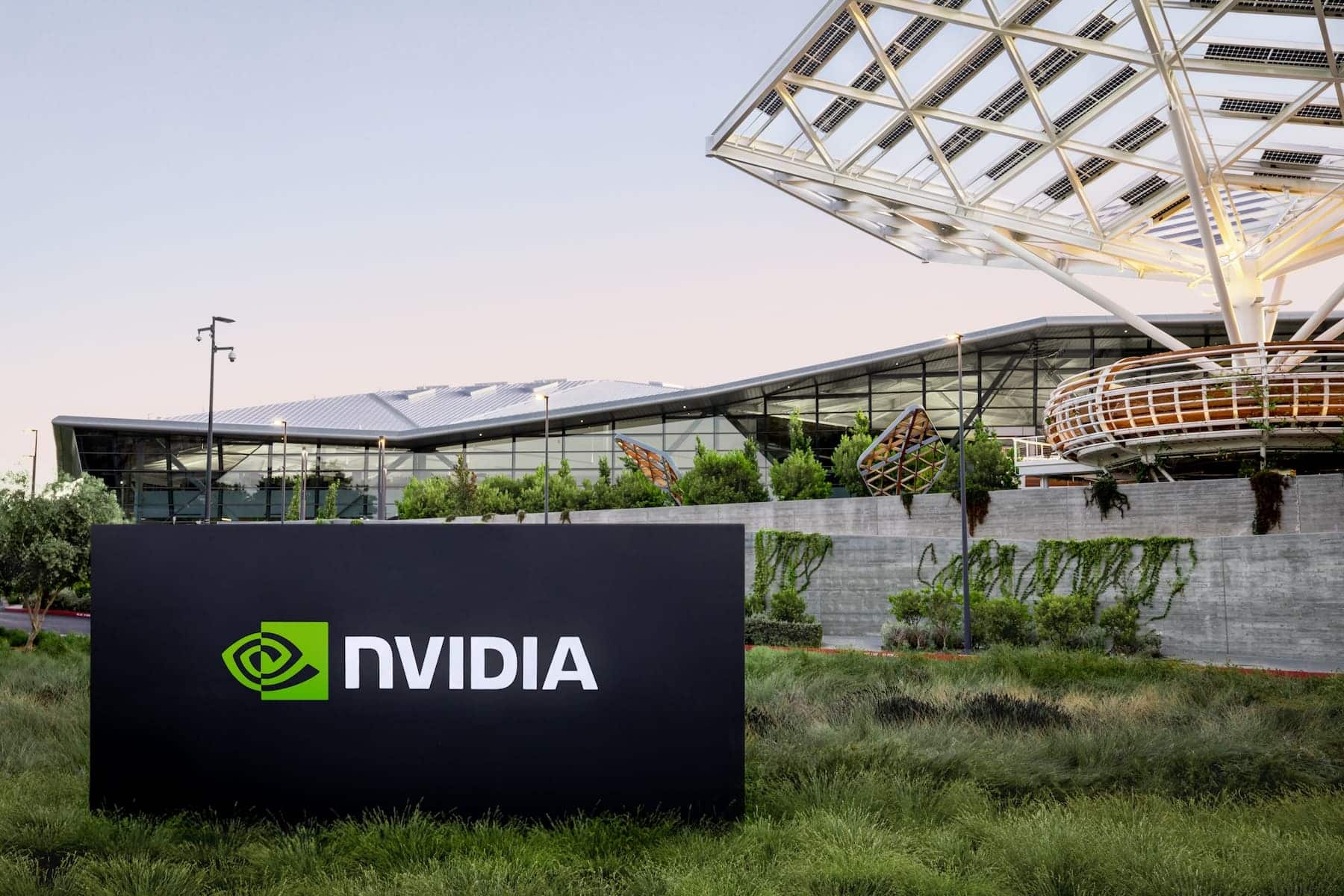
NVIDIA has once again demonstrated that it is the driving force behind the artificial intelligence revolution. The American company announced its third quarter financial results for fiscal year 2026, ended October 26, 2025, with figures that seem from another era: $57.0 billion in revenue, up 22% from the previous quarter and 62% higher than a year ago.
Behind these numbers is primarily a clear reality: demand for AI computing is not only staying strong, but continues to accelerate.
A record-breaking quarter amid the AI fever
The quarterly figures reflect a business in full expansion:
- Total revenue: $57.0 billion.
- GAAP gross margin: 73.4%, with a non-GAAP margin of 73.6%.
- GAAP net income: $31.9 billion, a 65% increase year-over-year.
- Diluted earnings per share: $1.30, both GAAP and non-GAAP.
For a company that just a few years ago was mainly known for its gaming graphics cards, these numbers solidify a radical transformation: NVIDIA has become the central piece of AI infrastructure on a global scale.
Its founder and CEO, Jensen Huang, summarized the moment with a clear idea: the company now feels part of a “virtuous cycle” of AI, where demand for training and inference computing grows exponentially and feeds itself. More foundational models, more AI startups, more industries involved, and more countries seeking to build their own infrastructure.
Data centers, the true heart of the business
If there is one segment that explains NVIDIA’s current trajectory, it is data centers. This business line alone generated $51.2 billion in the quarter, representing roughly nine out of ten dollars the company earns. It’s a 25% increase from the previous quarter and a 66% rise compared to the same period last year.
The key lies in the Blackwell architecture, NVIDIA’s new generation of AI GPUs, which has begun deploying at scale. According to the company’s data, Blackwell achieved the best performance and overall efficiency on the SemiAnalysis InferenceMAX benchmarks, offering a processing capacity per megawatt up to ten times greater than the previous generation. In an era of energy pressure on data centers, this is no small detail.
Huang described it vividly: Blackwell sales are “off the charts” and cloud GPUs are sold out. In other words, major cloud service providers and AI companies are buying everything NVIDIA can produce.
Mega AI infrastructure projects with industry giants
These financial results are accompanied by a raft of strategic announcements that shed light on why demand remains so high:
- Partnership with OpenAI: NVIDIA announced a strategic alliance to deploy at least 10 gigawatts of systems based on its technology for OpenAI’s next-generation infrastructure. This highlights the scale of the new “mega data centers” dedicated to AI.
- Alliances with major cloud providers: companies like Google Cloud, Microsoft, Oracle, and xAI are building AI infrastructure in the U.S. with hundreds of thousands of NVIDIA GPUs.
- Anthropic on NVIDIA infrastructure: for the first time, Anthropic will run and scale its models on NVIDIA infrastructure, starting with 1 gigawatt of compute capacity based on Grace Blackwell and Vera Rubin systems.
- Next-generation supercomputing: together with Oracle, NVIDIA will help build Solstice, the largest AI supercomputer at the U.S. Department of Energy, with 100,000 Blackwell GPUs, along with the Equinox system featuring another 10,000 Blackwell GPUs.
This is complemented by an industrial policy gesture: NVIDIA has celebrated the first Blackwell wafer produced on U.S. soil, at TSMC’s Arizona plant, coinciding with the chip’s production ramp-up. The message is clear: the company aims to be at the center of reindustrializing the advanced semiconductor supply chain in the U.S.
Towards “AI factories”: new chips, networks, and architectures
Alongside its financial results, NVIDIA is deploying a comprehensive conceptual and technological infrastructure built around the idea of the “AI factory”:
- NVIDIA Rubin CPX: a new class of GPU designed specifically for massive-context processing, aimed at models handling very large context windows.
- NVIDIA NVQLink: an open architecture to connect NVIDIA’s extreme computing GPUs with quantum processors. More than a dozen supercomputing centers worldwide plan to adopt it.
- NVLink Fusion with Arm Neoverse: Arm is extending its Neoverse platform by integrating NVIDIA’s NVLink Fusion technology to accelerate AI data center adoption.
- Networks for the AI era: Meta, Microsoft, and Oracle announced plans to strengthen their AI data center networks with NVIDIA Spectrum-X Ethernet switches, optimized for massive AI workloads.
- Omniverse DSX: an open and comprehensive blueprint for designing and operating gigawatt-scale AI factories, integrating simulation, digital twins, and physical infrastructure.
- BlueField-4: NVIDIA’s new processor for its so-called “AI factory operating system,” with partners like CoreWeave, Dell Technologies, Oracle Cloud Infrastructure, Palo Alto Networks, Red Hat, and VAST Data building accelerated data center platforms with BlueField.
The company is also forging sector alliances: from AI-RAN solutions with Nokia for 5G-Advanced and future 6G networks, to an operational AI stack with Palantir, along with reindustrialization projects involving “physical AI” with major robotics and manufacturing players.
Sovereign AI and international expansion: UK, Germany, and South Korea
Beyond the U.S., NVIDIA is focusing on supporting major AI infrastructure projects in other key markets:
- In the United Kingdom, the company works with partners like CoreWeave, Microsoft, and Nscale to build the next-generation AI infrastructure, with an announced investment of £2 billion in the UK market.
- In Germany, alongside Deutsche Telekom, NVIDIA launched the world’s first industrial AI cloud, aimed at transforming the country’s manufacturing sector.
- In South Korea, NVIDIA collaborates with the government and industry giants like Hyundai Motor Group, Samsung Electronics, SK Group, and NAVER Cloud to expand the national AI infrastructure with more than a quarter of a million GPUs.
The implicit message is that the AI race is no longer just technological but also geopolitical. NVIDIA is positioning itself as a key provider for the AI strategies of multiple countries.
Gaming, visualization, and automotive: thriving business segments
While data centers dominate headlines, NVIDIA’s traditional segments continue to grow.
In Gaming, the company posted quarterly revenues of $4.3 billion, nearly flat from the previous quarter (-1%) but up 30% year-over-year. During the quarter, highly anticipated titles like Borderlands 4, Battlefield 6, and ARC Raiders were launched, featuring DLSS 4 with Multi-Frame Generation and NVIDIA Reflex, technologies that boost the appeal of GeForce RTX cards.
The company also celebrated the 25th anniversary of GeForce with a gamer festival in Seoul, South Korea — a symbolic gesture to the community that made GeForce a gaming benchmark, now also used to promote the so-called AI PCs, personal computers optimized to run AI models locally.
In professional visualization, revenues reached $760 million, up 26% from the previous quarter and 56% compared to a year earlier. NVIDIA has begun distributing DGX Spark, a “mini supercomputer” that condenses its complete hardware and software stack into a compact format, designed for companies seeking advanced AI capabilities without deploying large data centers.
The Automotive and Robotics segment also continues to grow, with $592 million in quarterly revenue, a 32% increase year-over-year. Notable announcements include:
- The NVIDIA DRIVE AGX Hyperion 10 platform, a reference architecture for compute and sensors for Level 4 autonomous vehicle fleets.
- An agreement with Uber to scale what aspires to be the world’s largest Level 4-ready mobility network by 2027, aiming for 100,000 vehicles.
- The unveiling of NVIDIA IGX Thor, an industrial platform designed to bring real-time AI to the edge, targeting robotics, manufacturing, and healthcare environments.
Shareholders’ rewards: buybacks, dividends, and cash flow
Business strength is also reflected in cash flow. During the quarter, NVIDIA generated $23.75 billion in cash from operations and a free cash flow of $22.09 billion after investing in new facilities and intangible assets.
In the first nine months of fiscal 2026, the company returned $37.0 billion to shareholders via share repurchases and cash dividends. As of the end of Q3, there were still $62.2 billion available under the current share repurchase authorization.
Furthermore, the company confirmed its upcoming quarterly dividend of $0.01 per share, payable on December 26, 2025, to shareholders recorded on December 4.
Outlook: NVIDIA anticipates further growth in Q4
Far from anticipating a slowdown, NVIDIA issued forward-looking guidance for Q4 that points to another period of strong expansion. The company expects:
- Revenue of around $65.0 billion, with a variation of ±2%.
- GAAP and non-GAAP gross margins of 74.8% and 75.0%, respectively, with expected variations of ±0.5 points.
- Operating expenses around $6.7 billion (GAAP) and $5.0 billion (non-GAAP).
- Other net income of approximately $500 million.
- An effective tax rate close to 17%, with a ±1 point variation.
In other words, the company expects the demand for AI computing to continue to drive growth in the short term. The big question for the market is not just about this quarter, but how long this investment pace by cloud giants and corporations vying for leadership in the new AI economy can be sustained.
For now, the third quarter fiscal 2026 figures confirm that NVIDIA remains several steps ahead of the pack at this stage of the race.
FAQs on NVIDIA’s quarterly results and AI
What are NVIDIA’s key figures for Q3 FY 2026?
NVIDIA posted $57.0 billion in revenue, a 62% increase from a year earlier, with a GAAP gross margin of 73.4% and net income of $31.9 billion. Diluted earnings per share were $1.30. The quarter’s main driver was the data center business, which contributed $51.2 billion in revenue.
Why is the data center business so important for NVIDIA’s results?
The data center segment now accounts for about 90% of NVIDIA’s sales. This includes GPUs for training and inference of AI models, complete supercomputing systems, AI-optimized networks, and solutions like BlueField and Omniverse DSX for “AI factories.” The 66% year-over-year growth in this segment reflects the global race to deploy large-scale AI infrastructure.
What role does NVIDIA’s Blackwell architecture play in the company’s growth?
Blackwell is NVIDIA’s latest generation of AI GPUs and underpins many of its major contracts. It delivers up to ten times more performance per megawatt than the previous generation in inference benchmarks, enabling clients to train larger models and run more inferences with the same energy consumption. Major players like OpenAI, Anthropic, leading cloud providers, and supercomputing projects like Solstice are building on this architecture.
What does NVIDIA forecast for Q4 FY 2026, and what factors could influence future results?
For Q4, NVIDIA expects around $65.0 billion in revenue and gross margins near 75%. The company believes demand for AI computing will continue to grow, driven by new models, more users, and more countries building their own infrastructure. Going forward, factors such as the pace of investment from large tech companies, AI chip competition, and semiconductor manufacturing capacity will be critical in determining the sustainability of this growth.
Sources:
NVIDIA – “NVIDIA Announces Financial Results for Third Quarter Fiscal 2026” (official earnings press release).