
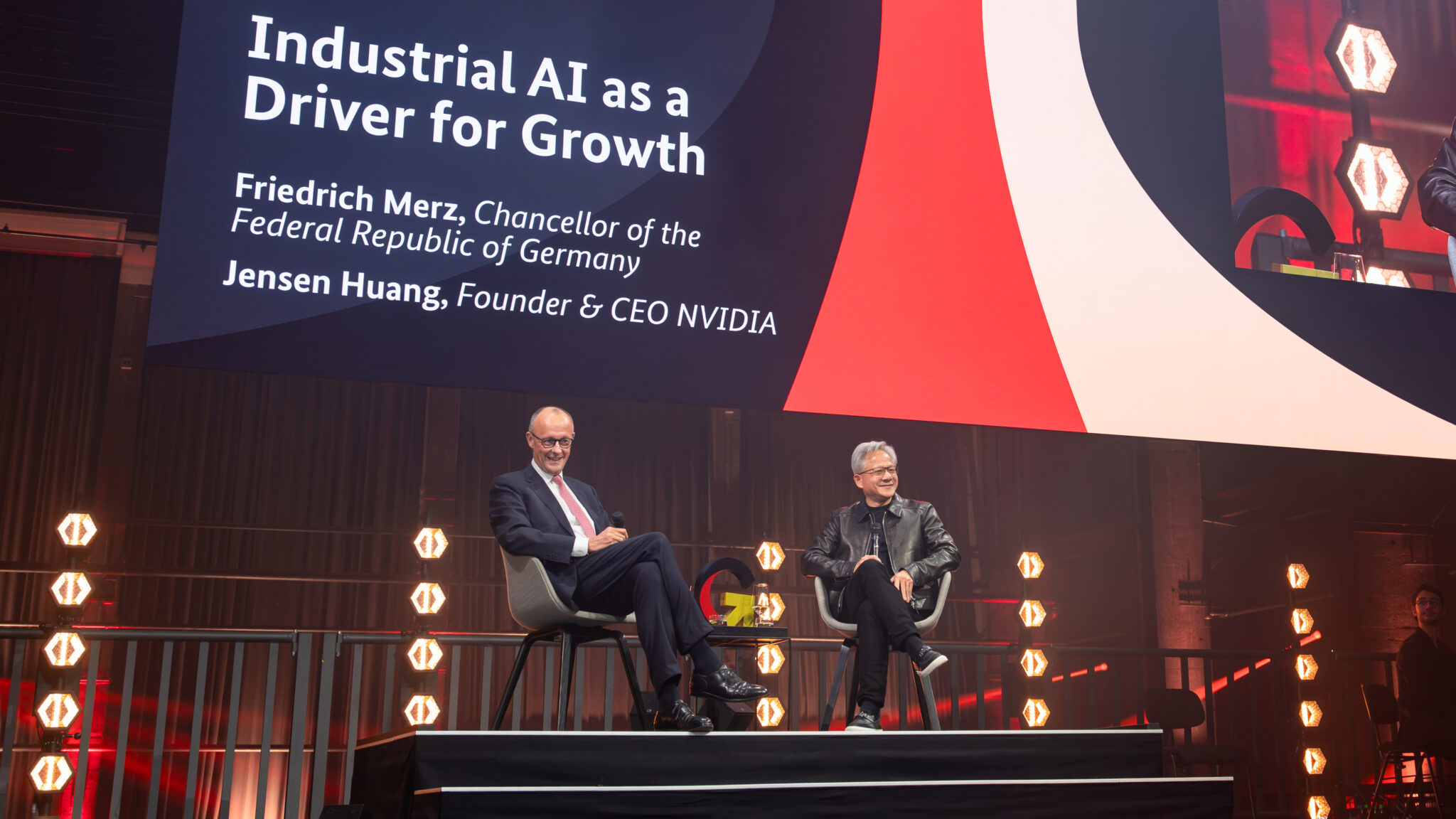
German Chancellor Friedrich Merz and NVIDIA founder and CEO Jensen Huang shared the stage on October 19, 2026, at the Invest in Germany Summit in Berlin, where the federal government and the company signed a joint declaration of intent to develop advanced physical artificial intelligence (AI) models. The event, held at Kraftwerk, a former power plant in the German capital, also saw NVIDIA announce investments in four German startups and Siemens unveil a partnership with the company on autonomous factories.
NVIDIA and Germany’s physical AI alliance in 20 seconds
- Merz, two federal ministries, and NVIDIA sign a declaration of intent on physical AI, with no disclosed timeline or budget.
- NVIDIA plans to invest in Agile Robots, Avelios Medical, Mirelo, and Reflex Aerospace.
- Siemens announces a partnership with NVIDIA for autonomous factories.
- NVIDIA simulated a 104-qubit quantum computer on the JUPITER supercomputer.
Physical AI is the term NVIDIA uses for AI systems that perceive and act in the real world: robots, autonomous vehicles, automated factories. It’s the field where Germany, with its heavyweight manufacturing industry, stands to gain or lose the most, and that was the thrust of both leaders’ message. The event also served as a prelude to GTC Berlin, where Huang is scheduled to deliver a keynote on Wednesday, October 21, 2026, from 11:00 a.m. to 1:00 p.m. Central European Time.
What the German government is signing with NVIDIA
The declaration was signed by the Chancellor, the Federal Ministry for Economic Affairs and Energy, the Federal Ministry of Research, Technology and Space, and NVIDIA. According to the company, it commits the parties to a joint initiative to advance leading physical AI models, and it formalizes and expands the collaboration NVIDIA already had with the government and with the Industrie 4.0 platform, Germany’s industrial digitalization initiative. The stated goal is to bring industrial AI into widespread use.
It’s worth reading the agreement for what it is: a declaration of intent, not a contract. NVIDIA hasn’t published a timeline, a budget, or which specific models will be developed or who will fund them. Merz did make one request: he said he’d like to see Huang “regularly, let’s say at least once a year,” to review progress.
The announcement adds to other NVIDIA moves in the country, such as the Industrial AI Cloud that Deutsche Telekom opened in Munich with the company and Polarise, and its presence at events like Hannover Messe, although NVIDIA’s note on Berlin doesn’t mention them.
Four startups, Siemens, and JUPITER
NVIDIA announced planned investments in four young German companies. Munich-based Agile Robots builds AI-powered robots, including robotic arms and the Agile ONE humanoid, for manufacturing, logistics, and healthcare. Avelios Medical, also based in Munich, develops a hospital information system with AI built into clinical and administrative workflows. Mirelo creates models that generate sound effects, voice, and music for video. And Berlin-based Reflex Aerospace designs and builds satellites that can be ready for launch in about 12 months.
The company doesn’t break down how much it will invest in each one. It only says they’re part of a nearly $10 billion commitment in Europe, and that it already backs other German companies such as n8n, Neura Robotics, and Black Forest Labs.
Siemens, for its part, announced a partnership with NVIDIA to advance AI-powered autonomous factories and showcased new solutions at its Erlangen plant. According to Siemens, fully virtual commissioning of a production line cuts engineering effort by up to 85%, and AI-agent-based production planning saves up to 20% in costs. These are the company’s own figures, qualified with the word “up to,” and aren’t accompanied by details on how they were measured.
The third announcement came from the world of supercomputing. NVIDIA researchers used JUPITER, Europe’s largest supercomputer, located at the Jülich Supercomputing Centre, to simulate a fault-tolerant, 104-qubit quantum computer, which the company describes as the largest and most detailed simulation of its kind to date. cloudnews.tech previously covered how Germany inaugurated JUPITER, its exascale system.
Merz appeals to the Mittelstand, Huang to German know-how
Merz insisted that Germany wants to be “one of the most advanced places in the world, not just in the European Union,” and pointed to the Mittelstand, the country’s fabric of mid-sized industrial companies, as its biggest asset. His ask to them: “Please open your doors to AI to make the most of your data.” The Chancellor said he was “very optimistic” that Germany could become one of the world’s most successful economies.
Huang, who traced NVIDIA’s relationship with German industry from the early 2000s (systems for video games, workstations, and car design) to its current work on autonomous vehicles and digital twins of factories, addressed German engineers and companies directly: “That knowledge belongs to you.” He added that it “can’t be replaced” and that AI “can only increase your capacity, not replace it.” His advice was to use the technology as “a new instrument,” closing with another line: “in the Chancellor’s words, you are redesigning Germany. This is your chance to do it right.”
The speech fits with the weight NVIDIA has given physical AI in its recent announcements, from CES to Hannover Messe. For Germany, the question is whether the declaration turns into programs with real money and concrete deadlines, something that hasn’t been communicated so far.
FAQ
What did NVIDIA and the German government sign?
A joint declaration of intent to develop a common initiative on advanced physical AI models, expanding its collaboration with the Industrie 4.0 platform. No timeline or budget has been disclosed.
Which German startups will NVIDIA invest in?
Agile Robots, Avelios Medical, Mirelo, and Reflex Aerospace. NVIDIA hasn’t detailed the amounts, which are part of a nearly $10 billion commitment in Europe.
What savings does Siemens attribute to AI at its Erlangen plant?
According to Siemens, up to 85% less engineering effort with virtual commissioning and up to 20% cost savings with agent-based planning.
When is Jensen Huang’s keynote at GTC Berlin?
Wednesday, October 21, 2026, from 11:00 a.m. to 1:00 p.m. Central European Time.
Source:
