
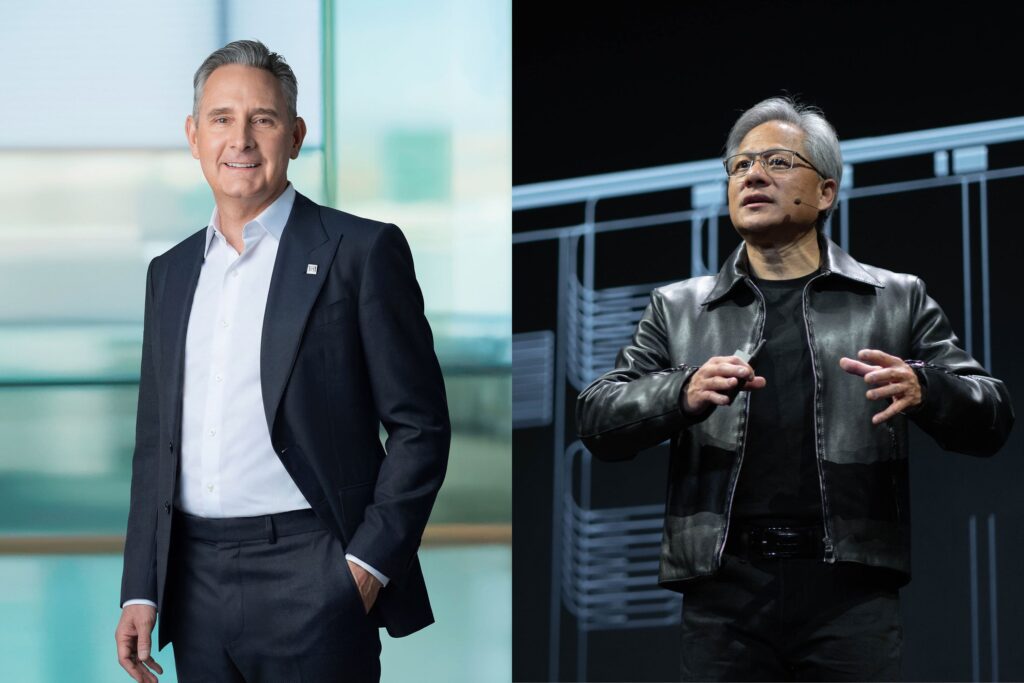
The joint presence of Jensen Huang, founder and CEO of NVIDIA, and Matt Murphy, president and CEO of Marvell Technology, at Computex 2026 will not be just a courtesy photo. It will be the public showcase of one of the most interesting moves in the new AI chip war: NVIDIA has decided to bring Marvell into its ecosystem with a $2 billion investment and a technical alliance around NVLink Fusion.
This move reflects how the industry is changing. Until recently, Marvell was seen as an indirect threat to NVIDIA in the custom silicon market for AI. Its XPUs, connectivity solutions, and optical technologies positioned it as an attractive option for hyperscalers aiming to design their own accelerators and reduce dependence on standard GPUs. NVIDIA has chosen a pragmatic approach: rather than allowing that market to grow outside its control, it is integrating it into its architecture.
From Potential Rival to Strategic Partner
The alliance announced in March between NVIDIA and Marvell revolves around NVLink Fusion, a rack-scale platform that allows clients to develop semi-custom AI infrastructure using the NVLink ecosystem. Marvell will provide customized XPUs and scale-up networks compatible with NVLink Fusion, while NVIDIA will supply technologies like Vera CPU, ConnectX, BlueField, NVLink, Spectrum-X, and rack-scale computing infrastructure.
The $2 billion investment doesn’t seem like a conventional financial bet. It’s a way to align incentives. Marvell remains Marvell—with its business in custom silicon, networking, and optical connectivity—but now it’s closer to NVIDIA’s core focus. For clients wanting custom chips, the message is clear: they can have more flexibility without leaving the NVIDIA ecosystem entirely.
| Component | What NVIDIA Contributes | What Marvell Contributes |
|---|---|---|
| AI Computing | GPU, Vera CPU, and rack-scale infrastructure | Custom XPUs |
| Interconnect | NVLink and NVLink Fusion | Scale-up compatible networks |
| Data Network | ConnectX, BlueField, Spectrum-X | Connectivity technologies and ASICs |
| Optics | AI network ecosystem | Collaboration in silicon photonics |
| Target Customers | Hyperscalers, AI cloud providers, enterprises, and sovereignty projects | Clients seeking custom silicon |
This approach enables NVIDIA to defend its leadership position without ignoring a reality: major AI buyers want more options. Amazon, Google, Microsoft, Meta, and others have been exploring custom or semi-custom chips for years. Not all want to depend solely on general-purpose GPUs. Some seek better cost efficiency, more control, load-specific efficiency, or tighter integration with their infrastructure.
Why Connectivity Has Become So Critical
The title of Marvell’s keynote at Computex 2026, “The Future of AI Depends on Connectivity,” is no coincidence. Modern AI no longer relies solely on having the most powerful accelerators. It depends on connecting thousands of chips, moving data between memory, compute, and network, reducing latency, controlling power consumption, and scaling entire systems without interconnection bottlenecks.
Marvell plays a particularly important role here. The company doesn’t compete with NVIDIA as a pure GPU maker. Its strengths are in custom silicon, connectivity, data infrastructure, and optical technologies. In the era of AI racks, this can be as crucial as the accelerator itself. If data doesn’t arrive on time, the GPU stalls. If bandwidth doesn’t scale, the cluster loses efficiency. If the network consumes too much power, the cost per token rises.
NVIDIA recognizes this. That’s why its strategy isn’t just about selling chips but controlling the entire system: GPU, CPU, DPU, NIC, switches, software, interconnects—and now also enabling third parties to integrate custom XPUs into its AI fabric. NVLink Fusion is a response to a market demanding flexibility without sacrificing the performance of an integrated architecture.
NVIDIA’s Tactical Shift
The partnership with Marvell signals a shift in tone. For years, the simplest interpretation was “NVIDIA against everyone”: NVIDIA versus AMD, against custom ASICs from hyperscalers, startups, Chinese alternatives, and specialized architectures. While that still holds some truth, it’s not the full story.
NVIDIA is leveraging its dominant position to build an ecosystem where even competitors end up orbiting around its technologies. If a customer wants a custom Marvell XPU, NVIDIA prefers that chip to support NVLink Fusion, integrate with Vera, use its network, and be deployed within an AI factory compatible with its platform.
This strategy reduces the risk of being shut out from custom silicon projects. It also makes Marvell a useful partner to reach clients who don’t want a fully standard solution. Instead of fighting every design as a GPU substitute, NVIDIA can participate in hybrid infrastructures where its components remain essential.
| Scenario | Risk for NVIDIA | Response with Marvell |
|---|---|---|
| Hyperscalers develop custom chips | Decreased demand for standard GPUs | Integrate custom XPUs via NVLink Fusion |
| Optical connectivity expands | New players capture network value | Collaborate with Marvell on silicon photonics |
| Clients seek lower dependence | Margin pressure and lock-in risks | Offer flexibility within NVIDIA’s ecosystem |
| AI moves to rack-scale | Isolated chips lose prominence | Sell complete AI factory architecture |
Computex as a Political Arena for AI
Huang and Murphy sharing the stage in Taipei also carries symbolic significance. Computex has become one of the world’s premier venues for AI infrastructure, not just for chip announcements but also for Taiwan’s role in servers, boards, systems, memory, packaging, and supply chains. Every gesture from NVIDIA at Computex has industrial impact.
Their joint appearance is scheduled during Matt Murphy’s keynote on June 2, 2026, at the Taipei Nangang Exhibition Center. According to organizers, both executives will explain how NVIDIA and Marvell work together to offer more options in developing next-generation AI infrastructure. The message arrives as the industry seeks alternatives beyond simple GPU increases: more efficiency, more connectivity, optical tech, customization, and system architecture.
For Marvell, the photo with Huang reinforces its position as a strategic AI supplier. For NVIDIA, it shows that its ecosystem isn’t an enclosed cage but a platform capable of absorbing custom pieces without losing control over the architecture. It’s an elegant way to address those who believe the future will be solely of proprietary ASICs: perhaps in part, but NVIDIA wants those ASICs to remain connected to its world.
Implications for Clients and Competitors
For major clients, the alliance offers an intermediate path. They don’t have to choose between buying a fully closed NVIDIA platform or designing their own entirely. They can explore custom chips while maintaining compatibility with part of the NVIDIA ecosystem.
For AMD, Broadcom, Intel, and other AI infrastructure providers, this complicates the landscape. NVIDIA isn’t just defending its current business; it’s positioning around the layers that could erode it. Meanwhile, Marvell gains access to a dominant platform and increases its chances of featuring in next-gen designs.
The big question: will this strategy reduce actual competition, or accelerate the development of more open architectures under NVIDIA’s leadership? The outcome matters greatly. If NVLink Fusion becomes the preferred connection point for custom XPUs, NVIDIA could maintain influence even in environments where all components don’t carry its brand.
The AI chip race thus enters a more mature phase. It’s no longer enough to have the best accelerator. Controlling the network, packaging, memory, optics, power, software, and relationships with custom silicon designers is essential. NVIDIA has realized Marvell could be an uncomfortable rival at this layer. With $2 billion, it’s chosen to turn it into a partner.
FAQs
What have NVIDIA and Marvell announced?
NVIDIA and Marvell announced a strategic alliance around NVLink Fusion, along with NVIDIA’s $2 billion investment in Marvell.
What is NVLink Fusion?
It’s a NVIDIA rack-scale platform designed for clients and partners to develop semi-custom AI infrastructure within the NVLink ecosystem.
Why is Marvell important for AI?
Marvell designs custom silicon, networks, and optical connectivity technologies that are increasingly critical for scaling AI data centers.
What does it mean that Huang and Murphy share the stage at Computex?
It’s a public signal that their alliance goes beyond a financial investment. NVIDIA and Marvell aim to demonstrate a joint strategy for next-generation AI infrastructure.
via: Computex
